

German Startup Sparxity Secures €80Mn to Advance AI Computing Technology
Nov 11, 2026 | By Oliver Bennett

German computing startup Sparxity has raised funding in a Series A round, bringing its total funding to €80 million ($90 million). The company also announced that it has changed its name from SpiNNcloud to Sparxity.
SUMMARY
- German AI computing startup Sparxity has raised Series A funding, taking its total funding to €80 million ($90 million).
- he round was led by ICM HPQC Fund, with participation from Lockheed Martin Ventures, GlobalFoundries, GS Futures, Cloudberry Ventures, TGFS and the EIC Fund.
- Founded in 2021, Sparxity develops sparse computing technology for AI, data centres and supercomputers.
 Follow us
 Follow us
The funding round was led by ICM HPQC Fund. Other investors included Lockheed Martin Ventures, GlobalFoundries, GS Futures, Cloudberry Ventures, TGFS and the EIC Fund.
The round also received investments from angel investors Richard Socher of Recursive Superintelligence and Nancy Xu of Moonhub, which was acquired by Salesforce. Existing investors Atlantic and Silicon Catalyst also continued to support the company.
“The next era of AI will be defined not just by how much computing power we can deliver, but by how intelligently and efficiently we use it,” says Sparxity co-founder and CEO Hector Gonzalez. “This financing is a powerful validation of our vision for sparse-native computing and the complementary positioning of our systems. With the backing of leading, strategic investors, we’re accelerating the transition from dense, energy-intensive architectures to heterogeneous datacenters with dedicated silicon for ultra-sparse workloads to unlock greater AI performance and lower costs.”
RECOMMENDED FOR YOU

Beroe Secures $34Million Investment To Complete Procurement Intelligence Stack
Kailee Rainse
Sep 25, 2025

Oska Health Raises €11M To Grow Its AI-powered Chronic Care Platform
Kailee Rainse
Feb 26, 2026
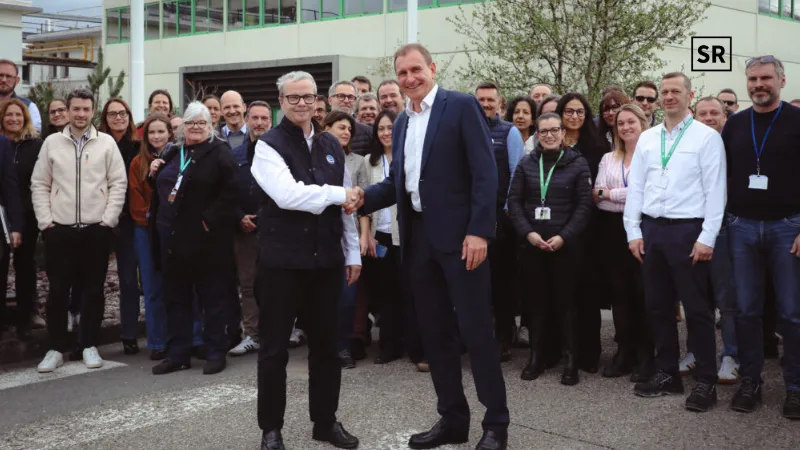
“Our work with PEER demonstrated the potential of dynamic sparsity, activating only a fraction of the compute across millions of fine-grained experts,” adds Xu Owen He, former Google DeepMind researcher and Sparxity strategic advisor. “Yet today’s hardware limits how far we can take these approaches. Co-designing AI models, distillation pipelines, and hardware around sparsity unlock a new level of computing efficiency.”
“Sparxity has a unique complementary positioning at the infrastructure stack. Its architecture is grounded in first principles, addressing the inevitable shift toward sparse activation and the structural limitations of conventional hardware,” says Matthew Gould of ICM HPQC Fund.
Founded in 2021, Sparxity develops computing technology for artificial intelligence (AI). Its systems are designed for large-scale data centres and supercomputers. The company has already deployed its technology across Europe and the United States.
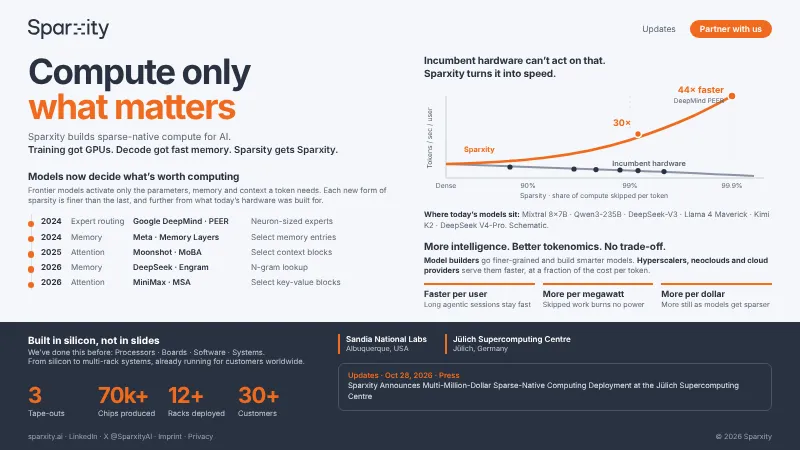
Sparxity uses a method called sparse computing, which reduces unnecessary calculations and data movement. This helps computers process information more efficiently while using fewer resources.
The company says its technology has delivered strong results in selected workloads. These include solving certain computing problems up to 10 times faster, reducing energy use by 18 times in event-based machine learning and cutting the time needed for some optimisation tasks by 20 times.
Read Also- Sumary Raises $25Mn in Seed Funding to Expand Its AI-Powered Accounting Platform in Europe
Recommended Stories for You
Kailee Rainse Nov 19, 2024

Oliver Bennett Jan 29, 2024

Oliver Bennett Jul 23, 2026

Oliver Bennett Aug 5, 2026

Kailee Rainse Nov 19, 2025
Oliver Bennett Sep 3, 2026
Trending Stories
Omilia Raises €58.1 Mn Series B to Expand AI-Powered Customer Experience Platform
NeoFleet Capital Raises €3.5 Mn in Pre-Seed Funding to Expand Taxi Fleet Financing
Piney Raises €1.6 Mn to Expand Its AI-Powered Property Operations Platform

Cyprus-Based Gaming Startup Nice Plans Studio Secures $3M Funding For Game Development

Studio 42 Funding News – Studio 42 Raises $3.6M To Build Next-Gen Puzzle Games

AINA Secures $1M Seed Round For AI Hiring Platform
Mika Games Raises $10 Mn to Support Mobile Game Studios and Expand Marketing
Anymaster funding news – Nicosia-based Anymaster has Raised €350k in Funding