

Qluster Secures €4.7Mn Pre-Seed Funding to Build Quantum Computers
Nov 18, 2026 | By Oliver Bennett
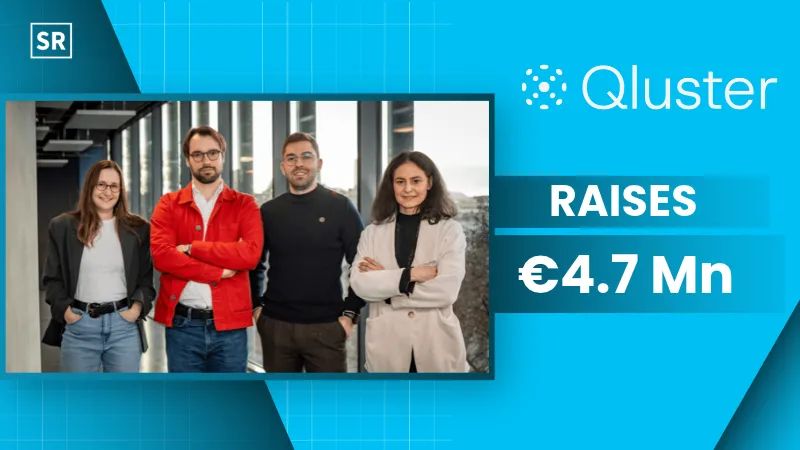
Paris-based quantum computing startup Qluster has raised €4.7 million in a pre-seed funding round. The round was led by Quantonation, an investment fund focused on quantum technology and physics-based innovations.
SUMMARY
- Paris-based quantum computing startup Qluster has raised €4.7 million in pre-seed funding.
- The funding round was led by Quantonation, with participation from Quantum Launchpad and Bpifrance.
- The company was founded by David Fainsin, Ambroise Boyer, Clarisse Thibault and Valentina Parigi.
 Follow us
 Follow us
The funding round also received support from Quantum Launchpad and Bpifrance.
"For several years, the race to build quantum computers has largely focused on developing increasingly powerful qubits. But the challenge today is to ensure that the computing architecture can meet the needs of industry. This is the approach Qluster has adopted from day one, with the goal of developing an intermediate-scale quantum computer by 2032, "explains David Fainsin, co-founder and CEO of Qluster.
Qluster was founded as a spin-off from Laboratoire Kastler Brossel, a research laboratory linked to three Nobel Prizes in Physics. The company was started by David Fainsin (CEO), Ambroise Boyer (CTO), Clarisse Thibault (COO) and Valentina Parigi (CSO), a physicist and professor at Sorbonne University.
RECOMMENDED FOR YOU

Nscale funding news – Nscale to Invest £2 Billion in the UK data centre industry
Kailee Rainse
Jan 15, 2025
Arqh Raises $3.8M To Revolutionize Logistics With AI-Powered Decision Intelligence
Kailee Rainse
Sep 30, 2025

Venture Capital Firm Verb Ventures Launches €25M Fund For Supply Chain Platforms
Kailee Rainse
Apr 30, 2025
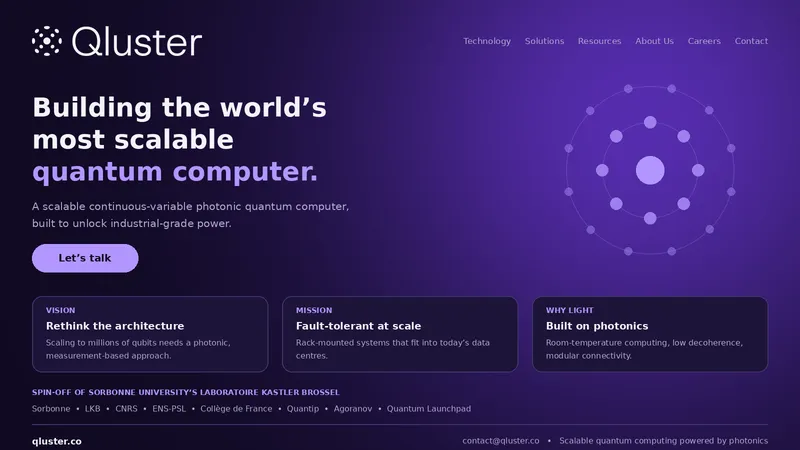
The startup uses years of research in quantum optics to develop a new generation of quantum computers.
Qluster aims to build a universal quantum computer that can handle errors and solve complex problems for industries. Its approach combines photonic quantum computing, which uses light to process information, with an "Architecture First" strategy. This means the company focuses on the computing needs of industrial applications rather than building around the limits of one particular qubit technology.
The company's technology uses light to process quantum information. This approach is designed to make quantum computers more stable and easier to scale. It is based on a patented miniature photonic source developed by Parigi and Fainsin at Laboratoire Kastler Brossel. The core idea behind this technology has already been tested successfully and published in a scientific journal.
Recommended Stories for You

Kailee Rainse Jul 31, 2025

Harbor Lab funding news – Greece-based Harbor Lab Secures €14.7 Million in Series A Round Funding
Oliver Bennett May 15, 2024


Oliver Bennett Oct 26, 2023

Kailee Rainse Sep 18, 2025

Oliver Bennett Oct 29, 2026
Trending Stories

Getir has Acquired New York City-based Online Grocery Company FreshDirect

Exergy3 Raises €11.4M Seed Funding To Scale Thermal Energy Storage For Industrial Decarbonisation

UK Quantum Motion Startup Raises $160M Funding In Series C Round

Worldly Acquires UK-Based Bendi Software to Strengthen Supply Chain Intelligence

[Funding alert] London-based Insurance Claims Automation Company Sprout.ai Secures £5.4 Million in Funding

QMatter Raises $1.2M In Pre-Seed Led By 55 North

London FinTech Startup PANTA Raises €3.4 Million To Modernise Financial Indices

Fresha Becomes New UK Unicorn After €68.9M Investment From KKR