

 Follow us
 Follow us
Building a startup has never been easy. Founders are expected to grow revenue, acquire customers, optimize operations, manage teams, and attract investors, often while working with limited resources and tight budgets. Unlike large enterprises that can solve growth challenges by expanding teams or increasing spending, startups must find ways to do more with less.
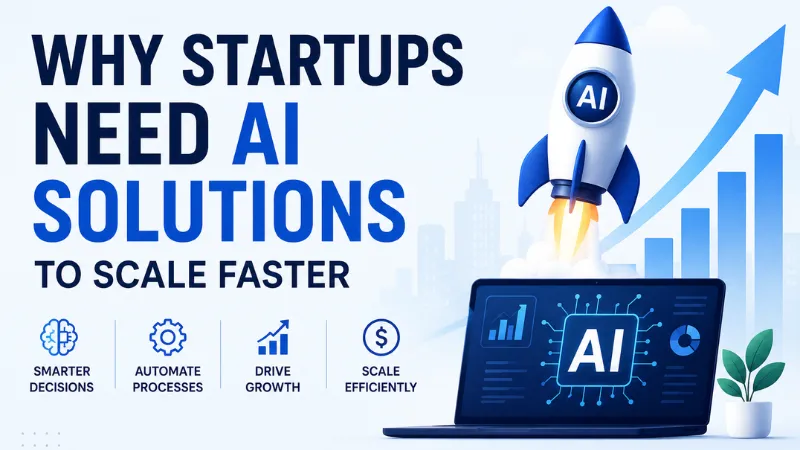
This is one of the reasons artificial intelligence is rapidly becoming a strategic advantage for startups worldwide. While AI is often associated with large corporations investing millions into advanced technologies, the reality is that AI is increasingly accessible to businesses of all sizes. For startups, AI is not simply a tool for automation. It is a force multiplier that allows small teams to operate with the efficiency, speed, and capabilities of much larger organizations.
According to McKinsey's State of AI report, AI adoption continues to grow across industries as organizations seek productivity improvements and operational efficiencies. At the same time, advancements in generative AI, cloud infrastructure, and AI-powered software have significantly lowered the barriers to entry for startups.
The question is no longer whether startups should explore AI. The more important question is how quickly they can integrate AI into their growth strategy.
The Startup Scaling Challenge
Most startups face a similar problem once they begin gaining traction. Early growth often depends on a small team wearing multiple hats and managing a wide range of responsibilities. Founders may handle sales calls in the morning, product decisions in the afternoon, and customer support issues in the evening.
This approach can work during the initial stages of a business. However, as customer demand increases, operational complexity grows much faster than headcount.
Common scaling challenges include:
- Limited hiring budgets
- Growing customer expectations
- Rising operational workloads
- Increasing acquisition costs
- More complex internal processes
- Pressure to achieve profitability
Many startups discover that growth itself becomes a bottleneck. The more successful the business becomes, the harder it becomes to maintain efficiency using manual processes.
This is where AI begins to create meaningful business value.
Rather than expanding teams every time a new challenge emerges, startups can use AI to automate repetitive tasks, streamline workflows, and improve decision-making. This allows teams to focus on activities that directly contribute to growth and innovation.
AI Allows Small Teams to Operate Like Larger Organizations
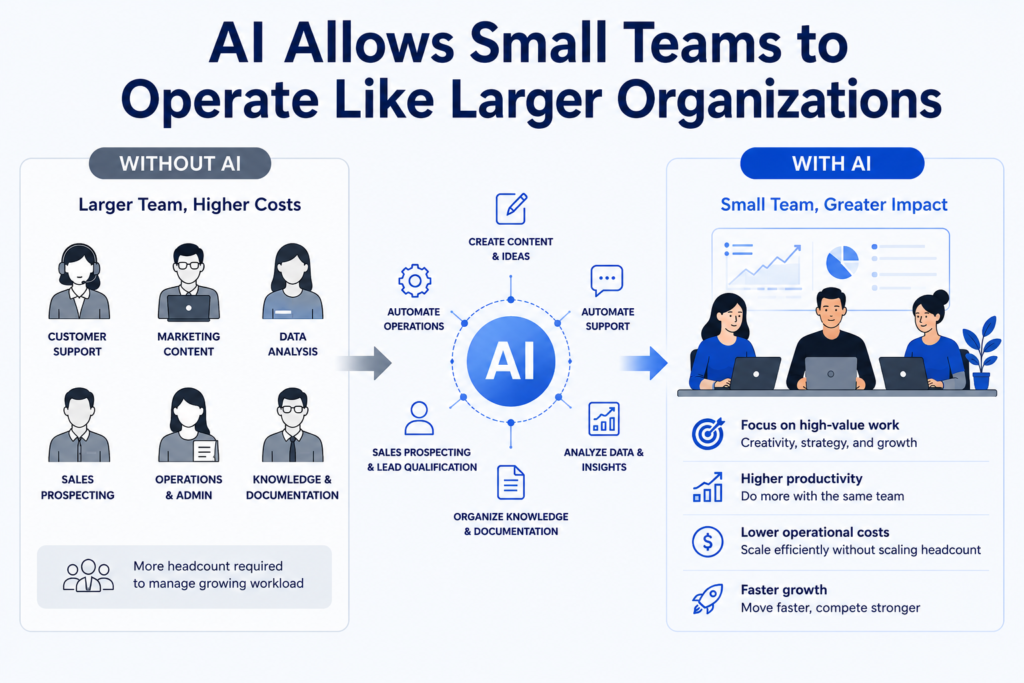
One of the most significant advantages of AI is its ability to increase organizational capacity without increasing headcount at the same rate.
Historically, scaling a business often required hiring additional employees to manage growing workloads. Customer support teams expanded to handle more inquiries. Marketing teams grew to produce more content. Operations teams increased in size to manage larger volumes of data and transactions.
Today, many of these functions can be augmented by AI-powered systems.
For example, startups are using AI to:
- Generate marketing content and campaign ideas
- Automate customer support interactions
- Analyze customer behavior and engagement patterns
- Organize internal knowledge and documentation
- Assist with sales prospecting and lead qualification
- Automate administrative and operational tasks
This does not mean AI replaces employees. Instead, it enables employees to focus on higher-value work that requires creativity, critical thinking, and strategic decision-making.
A startup with twenty employees today can often achieve operational output that previously required teams two or three times larger. In highly competitive markets, that advantage can significantly accelerate growth.
Faster Decisions Create Faster Growth
One of the most underestimated benefits of AI is its impact on decision-making.
Startup environments are characterized by uncertainty. Founders must make decisions quickly, often with incomplete information and limited resources. The ability to identify opportunities and risks before competitors can have a significant impact on business outcomes.
AI-powered analytics platforms help startups transform raw data into actionable insights.
These systems can assist with:
- Customer churn prediction
- Revenue forecasting
- Demand forecasting
- Pricing optimization
- Customer segmentation
- Product performance analysis
Rather than relying solely on intuition, startup leaders can use AI to support data-driven decision-making.
For example, a subscription-based SaaS company may use AI to identify early signs of customer churn. By analyzing behavioral patterns, usage trends, and engagement metrics, the system can highlight at-risk customers before they cancel. This allows the company to intervene proactively and improve retention rates.
When multiplied across hundreds or thousands of customers, these improvements can have a substantial impact on revenue growth.
Delivering Enterprise-Level Customer Experiences
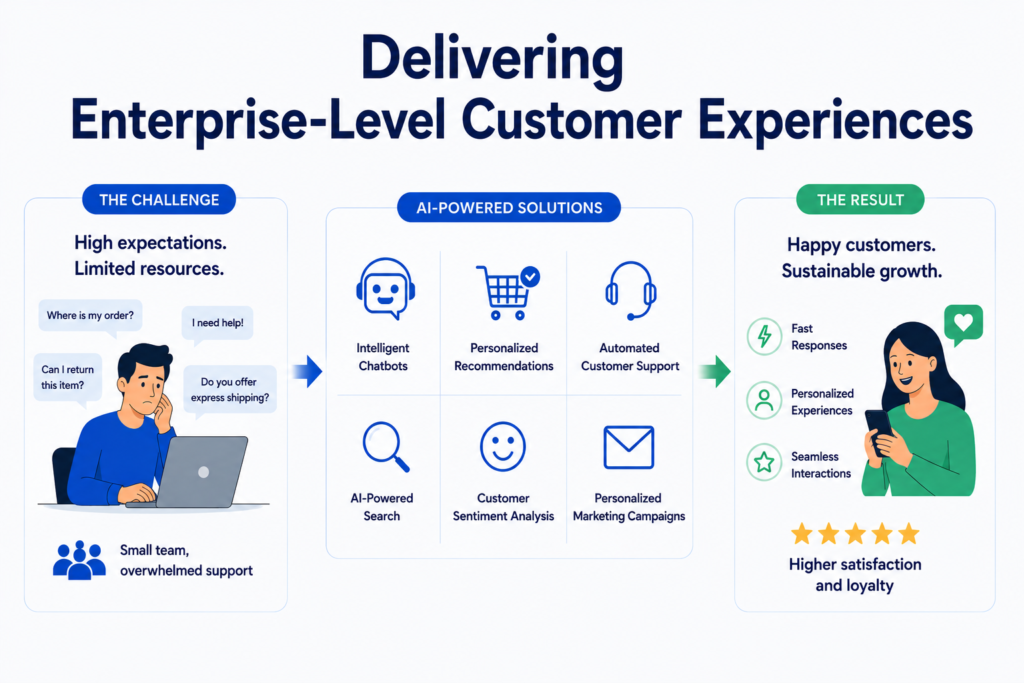
Customer expectations continue to increase regardless of company size.
Today's users expect fast responses, personalized experiences, and seamless interactions. They compare startup experiences not only with direct competitors but also with leading digital platforms such as Amazon, Netflix, and Spotify.
Meeting these expectations can be difficult for startups with limited resources.
AI helps level the playing field. Modern AI solutions can support customer experience initiatives through:
- Intelligent chatbots
- Personalized product recommendations
- Automated customer support
- AI-powered search experiences
- Customer sentiment analysis
- Personalized marketing campaigns
Consider an early-stage eCommerce business with a rapidly growing customer base. Without automation, customer inquiries may quickly overwhelm support teams. AI-powered support systems can resolve common questions instantly, allowing human agents to focus on more complex issues.
As a result, startups can improve customer satisfaction while maintaining operational efficiency.
Mini Case Study: Scaling Customer Support Without Scaling Headcount
Imagine a SaaS startup that experiences rapid user growth following a successful product launch.
Within a few months, the number of support requests doubles. Shortly afterward, it doubles again. Hiring additional support agents becomes increasingly expensive and may reduce profitability.
Instead of immediately expanding the support team, the company implements an AI-powered customer support platform.
The system is designed to:
- Resolve routine inquiries automatically
- Route requests based on urgency
- Recommend solutions using knowledge base content
- Provide support outside business hours
- Assist human agents with response generation
Within a short period, the startup significantly reduces average response times while maintaining customer satisfaction levels.
Most importantly, the company continues scaling its user base without increasing support costs at the same pace.
This example demonstrates one of AI's most valuable benefits for startups: enabling growth without proportional increases in overhead.
Why Startups Should Adopt AI Earlier Rather Than Later
RECOMMENDED FOR YOU



A common misconception among founders is that AI should be explored only after a business reaches a certain size.
In reality, early adoption often creates long-term advantages.
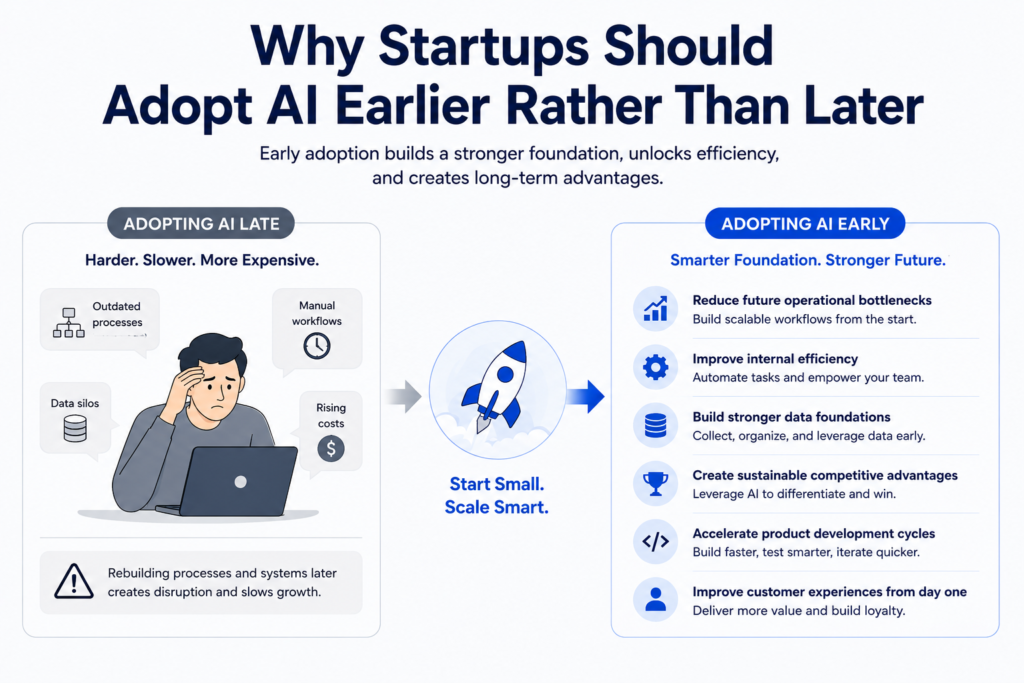
Organizations that integrate AI into their operations early can build scalable workflows from the beginning rather than attempting to redesign processes later.
Early adoption can help startups:
- Reduce future operational bottlenecks
- Improve internal efficiency
- Build stronger data foundations
- Create sustainable competitive advantages
- Accelerate product development cycles
- Improve customer experiences from day one
As AI technologies continue to become more accessible, the cost of delaying adoption may become greater than the cost of experimentation.
This does not mean startups should implement AI everywhere. Instead, they should identify areas where AI can generate measurable business impact and expand gradually from there.
Choosing the Right AI Strategy
Despite growing enthusiasm around AI, successful implementation requires a clear strategy.
Many startups make the mistake of adopting AI because it appears innovative rather than because it solves a meaningful business problem.
The most successful AI initiatives typically begin with questions such as:
- Which processes consume the most time?
- Where do operational bottlenecks occur?
- Which activities generate the highest costs?
- What decisions would benefit from better insights?
- Which customer interactions could be improved?
Answering these questions helps startups identify opportunities where AI can generate measurable value.
Rather than pursuing complex transformation programs immediately, many organizations start with targeted initiatives that produce quick wins. These early successes create momentum and establish a foundation for broader AI adoption.
As the technology ecosystem continues to mature, startups are increasingly exploring AI solutions for startups that align with their specific business models, growth stages, and operational requirements.
The Growing Importance of Technology Partners
While AI adoption has become more accessible, implementation remains challenging.
Many startups lack dedicated AI engineers, data scientists, solution architects, or MLOps specialists. Building these capabilities internally can be costly and time-consuming.
As a result, many growing companies choose to work with technology partners that can accelerate implementation and reduce risk.
Experienced partners can help startups:
- Define AI roadmaps
- Design scalable architectures
- Integrate AI into existing systems
- Establish governance frameworks
- Accelerate deployment timelines
- Reduce technical complexity
This approach allows startup teams to focus on their core business while leveraging external expertise to navigate rapidly evolving technologies.
Companies such as SotaTek support startups in this process by helping organizations align AI adoption with business objectives, scalability requirements, and long-term growth strategies. Rather than viewing AI as a standalone technology initiative, the focus is placed on creating measurable business outcomes that support sustainable growth.
Looking Ahead
The startup landscape is becoming increasingly competitive. Founders are under constant pressure to grow faster, operate more efficiently, and deliver better customer experiences while managing limited resources.
Artificial intelligence is changing the economics of growth.
By automating repetitive work, enhancing decision-making, improving customer engagement, and increasing operational scalability, AI enables startups to achieve levels of performance that were previously difficult to attain without substantial investment.
The startups that thrive over the next decade will not necessarily be those with the largest teams or the biggest budgets. They will be the ones that learn how to leverage technology strategically, scale efficiently, and transform data into competitive advantage.
For founders seeking sustainable growth, AI is no longer a future consideration. It is becoming an essential component of modern startup success.
References
McKinsey State of AI Report
https://www.mckinsey.com/capabilities/quantumblack/our-insights/the-state-of-ai
PwC Global Artificial Intelligence Study
https://www.pwc.com/gx/en/issues/artificial-intelligence/publications/artificial-intelligence-study.html
Recommended Stories for You

Team SR Aug 17, 2026

Team SR Aug 10, 2026

Team SR May 5, 2026

Team SR Jan 29, 2026


Team SR Dec 11, 2025
Trending Stories
Credit Math For An AI Map Generator On Seed Budget
5 technical choices that make the difference between growth and stagnation

Is Gamification as a Service the Next Major Battleground for Startups?

Top 10 Backlink Agencies Businesses Trust for Real Authority
Are Working Students the Quietest Demographic Relying on the Essay Writing Service EssayService.com?

Why UK Startups Need Better Access to Legal Documents as They Scale

How Local Taxi Services Help Keep Highland Tourism Moving

What to Know Before Adding Battery Storage to Your Home