


 Follow us
 Follow us
Last year my analyst Priya lost the final week of every month to one job: pulling rankings, stitching traffic exports, and rebuilding twelve client decks by hand. Roughly 24 hours a month on assembly no client thanked us for. Our first fix made it worse: a brittle no-code chain that broke and shipped a half-empty report. We had automated before agreeing what the report needed to say. Once we fixed the brief and moved the work onto proper seo automation tools, the run took under 4 hours, and the 20 we clawed back went into billable analysis.
That is the case for automated seo in one story: it removes repeatable hours instead of adding another screen to check. 88% of organizations now report using AI in at least one business function, much of it buying novelty, not returned time. So I ranked these eight by what they gave back.
The bar each tool had to clear:
- Removes recurring manual hours, not another dashboard to check.
- API or MCP included, not gated behind a top tier.
- Native scheduling and alerting, so jobs run without a human starting them.
- Plugs into your stack (Looker, Sheets, Zapier, Make, n8n) without a developer.
- Honest setup and maintenance cost, counted in hours.
Methodology: we ran each on real client accounts, logging the hours.
| Rank | Tool | Best for | What it automates | API access | Starting price |
| 1 | SE Ranking | Full-stack agency reporting | Rank tracking, audits, report assembly | API + MCP, every plan | $129/mo |
| 2 | DataForSEO | Bulk data pipelines | Raw SERP and keyword pulls | API is the product | From $50 deposit |
| 3 | Screaming Frog | Deep desktop crawls | Scheduled site crawls | No REST data API; Google integrations only | £199/yr |
| 4 | AccuRanker | High-volume rank monitoring | Daily rank checks, alerts | Read API, all tiers | $224/mo |
| 5 | Sitebulb | Audit depth and guidance | Scheduled audits, reporting | n/a; integrations + Sheets export | $18/mo |
| 6 | Semrush | Broad all-in-one suite | Rank tracking, audits, research | API only on Advanced $549 | $139/mo |
| 7 | Alli AI | On-page change automation | Bulk on-page edits | API on Agency $499+ | $249/mo |
| 8 | Nightwatch | Rank tracking at scale | Rank checks, reporting | API on Professional €159+ | €79/mo |
What SEO Automation Actually Removes (And What It Doesn’t)
Automation is good at the repeatable and poor at judgment. The jobs worth handing over are the ones you do the same way every time: rank checks, site audits, report assembly, bulk data pulls. Those are hours, not decisions. A seo automation platform runs all of them overnight and drops the output where your team already works, so the morning starts with data, not exports.
What it cannot do is decide what any of it means. Which ranking drop matters, which audit issue is worth a sprint, which story the numbers tell a client: that stays manual. Clear the busywork now: the ground is moving fast. Google's AI Overviews reached 2 billion monthly users, which means more surfaces to monitor, less time stitching spreadsheets. Good seo automation tools buy back the hours you need for the calls the machines still get wrong.
1. SE Ranking
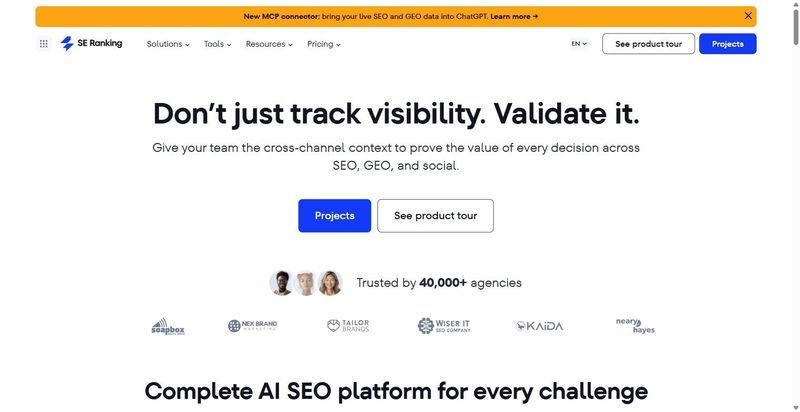
An SEO and AI-search-visibility platform whose automation hooks, API and MCP, scheduling and connectors, are built into every plan rather than sold as an upgrade.
Best for: Agencies and mid-market in-house teams automating reporting, rank and AI-visibility monitoring, scheduled audits, and recurring data pulls.
Standout feature: Both the API and MCP connector ship in every tier, Core and Growth, where many tools gate an API behind a top plan near $299 to $549. The API is dual: a Data API for bulk retrieval and a Project API for in-platform workflows. The MCP exposes 160-plus tools, plain-English SEO data inside Claude, ChatGPT, and Cursor.
Pros:
- API and MCP in every tier, with no paid add-on to automate.
- Pre-built no-code connectors for n8n, Make, Zapier, and Looker Studio, plus GA4 and GSC.
- Scheduled, white-label reporting via the Agency Pack (from $69/mo, annual), with unlimited scheduled reports and AI summaries.
- Automated Website Audit (115+ checks, JS rendering) and daily rank plus AI-results tracking, all schedulable through the API.
Cons:
- Default requests-per-second runs lower than some data-first providers; you raise it by contacting support.
- No first-party SDKs; you integrate through the Postman collection and REST reference.
- Some databases are smaller than the largest single-purpose vendors.
Pricing: Core $129/mo ($103.20/mo billed annually), Growth $279/mo ($223.20/mo billed annually). API and MCP included in every plan; standalone Data API from $179/mo (annual). 14-day free trial, no card.
What it returned: Reporting, rank and AI-visibility monitoring, and scheduled data pulls all automated from one subscription, with no separate invoice to unlock the API. For my team that folded manual hours back into campaign work each week. Less suited to teams wanting turnkey SDKs over REST and Postman.
2. DataForSEO
RECOMMENDED FOR YOU

Are You Getting the Most Out of Your Child’s Junior ISA? 5 Considerations To Take
Kailee Rainse
Feb 5, 2026


The plumbing under many SEO tools: raw data over an API, no dashboard, priced by usage.
Best for: Teams with a developer building their own dashboards and pipelines on raw SEO data.
Standout feature: Live mode when you need numbers now, queued mode when you can wait and pay less. No-code connectors into n8n, Make, Zapier and Sheets wire up pipelines fast.
Pros:
- Covers SERP, Keyword, Backlinks, On-Page, Domain Analytics and AI Optimization endpoints
- Bills usage-based, so you pay only for what you pull
- Runs queued tasks cheaper when speed is not urgent
Cons:
- Ships as raw API with no interface, so someone must build on it
- Per-endpoint rates vary, so budgeting takes a test run
Pricing: Usage-based from a $50 minimum deposit, no subscription tiers.
What it returned: Wired up, it wiped out the manual data pulls that ate an analyst's mornings. Those hours shifted to the developer who built the pipeline; it pays back over months, not day one.
3. Screaming Frog SEO Spider
The desktop crawler technical SEOs keep open: deep crawls you schedule against your Google data.
Best for: Technical SEOs and agencies wanting a schedulable deep crawler they can run on repeat.
Standout feature: Set a deep crawl to run overnight: render JavaScript, validate structured data, pull in Analytics, Search Console and PageSpeed, then a finished report and sitemap.
Pros:
- Crawls deep and renders JavaScript
- Schedules recurring crawls that run unattended
- Connects Analytics, Search Console and PageSpeed
Cons:
- Desktop software, so scheduled crawls need a machine left on or a VM
- No REST data feed, and memory-bound on very large sites
Pricing: Free up to 500 URLs; paid at £199 per license per year, annual only, no monthly option.
What it returned: Scheduling deleted the manual re-crawls that swallowed an afternoon a week. The catch is the machine: tie automation to a desktop and you leak hours keeping it awake, or a VM.
4. AccuRanker
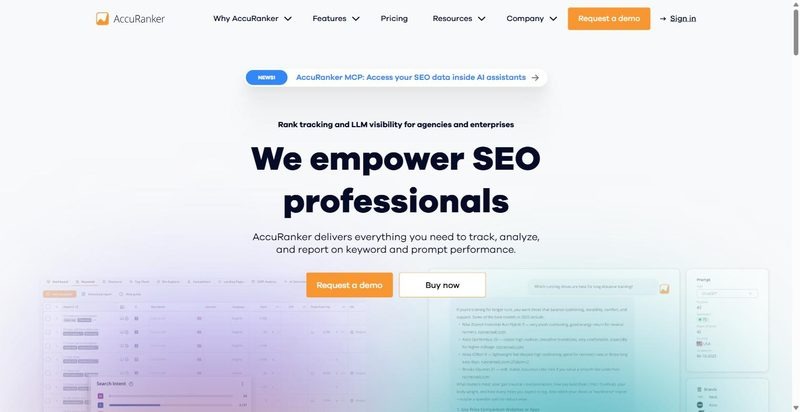
The fastest rank tracker my team has run at scale, doing what an analyst used to do every Monday: pull the numbers.
Best for: Agencies and mid-to-large in-house teams that need fast, automated rank reporting across big keyword sets.
Standout feature: Daily keyword updates land in the dashboard on their own, and the read API is included on every tier, so position data flows into your reporting stack without an upsell. Teams can automate seo reporting on a set cadence.
Pros:
- Daily updates with no manual refresh
- Read API on all tiers; GSC, Analytics, and Looker or Data Studio on Expert and up, BigQuery on Enterprise
- Automated reporting and scheduled exports
Cons:
- Rank-tracking focused; pair it with an audit tool
- Write API is Enterprise-only
- Keyword-count pricing climbs quickly
Pricing: Professional $224/mo with 10% off annual, Expert $764/mo, Enterprise custom.
What it returned: The Monday rank-report pull my team assembled by hand, handed back automatically every week.
5. Sitebulb
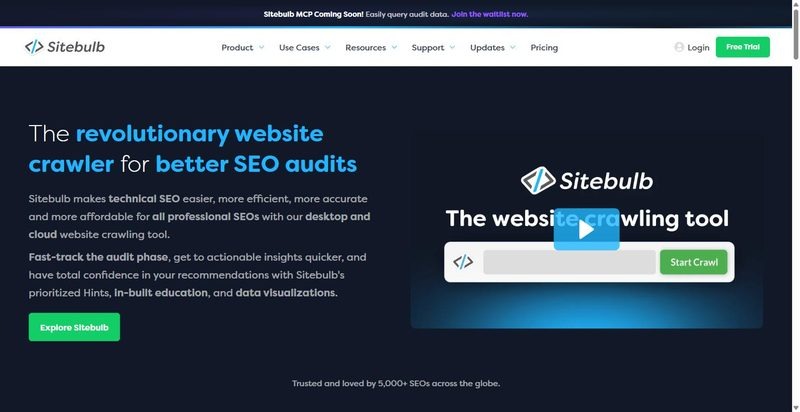
A technical-audit tool that crawls a site, ranks fixes by priority, then repeats on a schedule so audits stop being something to remember.
Best for: SEO consultants and agencies who want scheduled technical audits with a prioritized fix list.
Standout feature: Scheduled audits with auto-export to Google Sheets. With only 48% of mobile sites passing Core Web Vitals, the sites you manage drift between manual checks, and a recurring crawl catches the slip first.
Pros:
- Scheduled audits plus auto-export to Sheets on Pro
- JavaScript crawling for rendered pages
- Prioritized, actionable fixes; GA, Search Console, and Looker connections
Cons:
- Scheduling is Pro-tier only
- Cloud pricing is partly custom
- Lower tiers are desktop, not cloud
Pricing: Lite $18/mo, Pro $42/mo per user, Sitebulb Cloud from $125/mo for recurring crawls.
What it returned: The "run the crawl, paste it into a report" hour, handed back every audit cycle.
6. Semrush
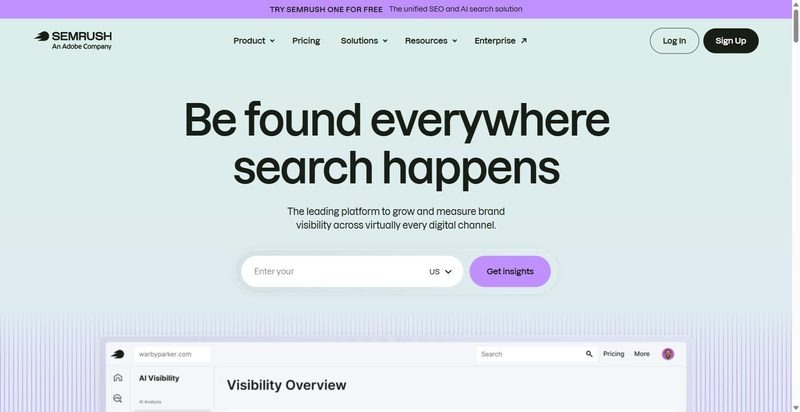
A broad SEO and marketing platform that covers most of the discipline, with automation late in the price list.
Best for: Mid-market to enterprise teams that already live in Semrush.
Standout feature: AI visibility tracking sits alongside the keyword, audit, and competitor tools, and MCP access opens from the Starter tier.
Pros:
- Broad, mature coverage across SEO, content, and paid.
- AI visibility tracking built in.
- MCP access from the Starter tier upward.
Cons:
- API data integration is gated to the Advanced tier at $549/mo.
- Scheduled reporting sits behind paid report add-ons at $10-$20.
- Extra users add $45/mo each, and the costs stack fast.
Pricing: SEO plan $139/mo ($117.33/mo billed annually), Starter $199/mo, Pro+ $299/mo, Advanced $549/mo.
What it returned: Broad coverage you can lean on, but the automation you came for, API pipelines and scheduled reports, sits behind the $549 tier. Inside an existing Semrush team the hours-back are real; buy it purely to automate and you pay top-tier.
7. Alli AI
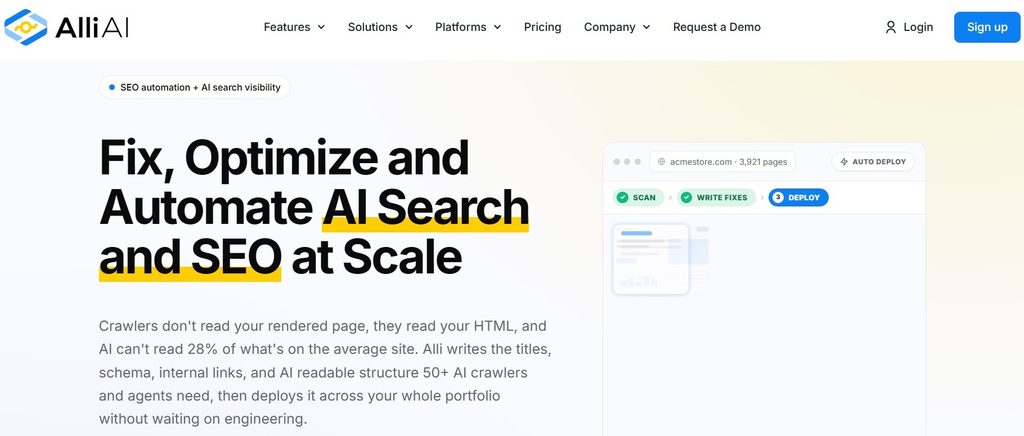
An SEO automation tool that auto-implements on-page and code changes on live sites.
Best for: Agencies and in-house teams ready to let a tool push on-page changes to live sites.
Standout feature: It auto-implements on-page and code fixes through a WordPress plugin, JS snippet, or tag manager, and serves pre-rendered pages to 50-plus AI crawlers, with CMS hooks for Shopify and Webflow.
Pros:
- Changes ship without a developer in the loop.
- Bulk edits across many sites at once.
- Pre-rendered pages served to 50+ AI crawlers.
Cons:
- The entry price is high at $249/mo.
- API access only opens on the Agency plan at $499/mo.
- Editing a live site needs a real QA gate.
Pricing: Business $249/mo ($2,990/yr), Agency $499/mo (adds API access and white-label snippet hosting), Enterprise custom.
What it returned: Potentially the biggest hours-back here, because changes ship without a developer. That speed only pays if you trust the auto-implementation and keep a rollback plan.
8. Nightwatch
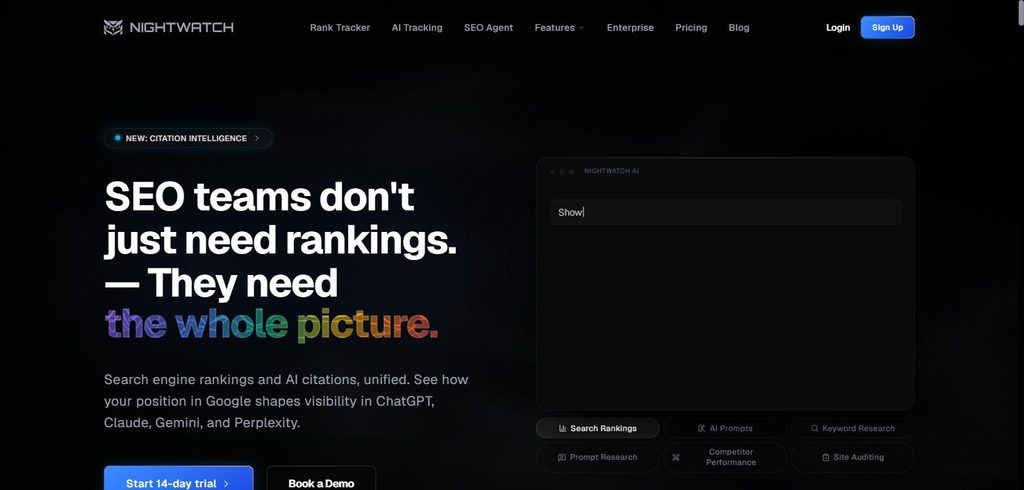
A dedicated rank tracker built for automated daily monitoring, with unlimited seats on every tier.
Best for: Growing teams and agencies wanting automated rank tracking without per-seat fees.
Standout feature: Automated daily rank tracking runs on every plan, and unlimited seats put the whole team on one dataset. From Professional up, white-label and automated reports cover the client side.
Pros:
- Automated daily rank tracking across all tiers.
- Unlimited user seats on every plan.
- White-label and automated reports from Professional up.
Cons:
- API access is not in Starter; you need Professional at €159/mo or higher.
- Priced in EUR.
- Rank-tracking focused, not a full suite.
Pricing: Starter €79/mo, Professional €159/mo (adds API access, GA and Looker Studio, white-label), Agency €399/mo, Enterprise custom.
What it returned: On Professional, daily rank tracking and white-label reports run themselves, and unlimited seats keep the team in one place. It does one job: if rank monitoring is your recurring drain, this hands those hours back. One instrument, not the orchestra.
The Ledger: Which SEO Automation Tools Actually Give Hours Back
Among these seo automation tools, for most agency and mid-market in-house teams the one that returns the most hours from a single subscription is SE Ranking, because the automation layer travels with the plan rather than sitting behind a paywall. The API, MCP connector, scheduling, connectors and white-label reporting are included, not gated, so the hours you save are not rebought as add-ons. One subscription, one seo automation platform where the automation lives.
Skip it if the setup does not match your staffing. Do not start with Alli AI unless you can staff the QA that live-site edits demand. Do not start with DataForSEO unless you have a developer; raw data returns hours only after someone builds on it.
The action: shortlist two or three, then log the hours before and after on your accounts.
Frequently Asked Questions
How do you automate SEO without breaking things?
What is the best tool for automated SEO reports?
How do you choose an automated SEO reporting tool?
How is SEO part of marketing automation?
Recommended Stories for You

Team SR Aug 8, 2026


Team SR Aug 18, 2026

Team SR Nov 26, 2025

Team SR Mar 9, 2026

Team SR May 21, 2026
Trending Stories

Why UK Startups Need Better Access to Legal Documents as They Scale

Is Gamification as a Service the Next Major Battleground for Startups?

Top 10 Backlink Agencies Businesses Trust for Real Authority

How Local Taxi Services Help Keep Highland Tourism Moving

Are Working Students the Quietest Demographic Relying on the Essay Writing Service EssayService.com?

Building a Startup While Still in University: A Practical Guide

What to Know Before Adding Battery Storage to Your Home

How to choose between growing your team and improving your process