

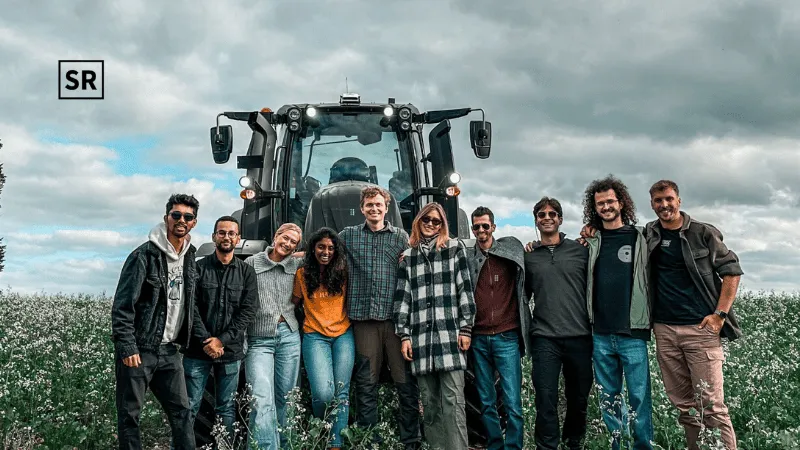
Danish AgTech startup Perplant has raised €1 million to scale its AI-powered farming technology that promotes more sustainable and efficient agriculture.
SUMMARY
- Danish AgTech startup Perplant has raised €1 million to scale its AI-powered farming technology that promotes more sustainable and efficient agriculture.
 Follow us
 Follow us
Founded in 2022 by Rasmus Emil Hansen and Sumod Nandanwar, the company is developing plug-and-play AI camera systems for tractors that enable real-time crop monitoring and precision spraying.
The funding round included support from private angel investors, industry experts, the Export and Investment Fund of Denmark, the European Space Agency, and Innovation Fund Denmark.
Perplant’s edge-AI system acts as a “digital eye” on tractors, scanning fields in real time to apply herbicides and fertilisers only where needed. The company claims this can reduce herbicide use by up to 90% and fertiliser use by 30%, improving yields and lowering costs for farmers.
RECOMMENDED FOR YOU

Origin Funding News- UK-Based Origin Raises $21M In Series A Round
Kailee Rainse
May 16, 2025

Income Funding News- Estonian Fintech Startup Income Secures €540k
Kailee Rainse
May 23, 2025

Read Also - Lithuania’s Backoffice Raises €150k To Expand Hospitality Platform Across Europe
Its high-resolution sensor system captures plant-level data with centimetre-level accuracy, far exceeding traditional satellite imaging, and is designed to support verification for regulators, insurers and financial institutions.
The company has already mapped over 200,000 hectares across Europe and operates in multiple countries, with further expansion planned, including entry into the US market.
”When our AI drives across the field, it documents the field’s variation, every single plant, and groundwater-sensitive areas. It removes the bureaucracy for the farmer and ensures that we can shut off the sprayer precisely over groundwater-sensitive areas with centimetre precision,” said Rasmus Emil Hansen, CEO and co-founder of Perplant.
About Perplant
Perplant is an AgTech company on a mission to democratise AI in farming through affordable, plug-and-play camera sensors. Its system uses real-time field monitoring to optimise pesticide and fertiliser use, reduce waste and improve crop yields, supporting more sustainable and efficient agricultural practices.
Recommended Stories for You
Kailee Rainse Jul 11, 2025

Oliver Bennett Sep 16, 2026

Signadori Bio Secures €11 Million Seed Round To Advance Next-Generation Solid Tumour Platform
Oliver Bennett May 6, 2026

Oliver Bennett Jun 2, 2026

Kailee Rainse Mar 17, 2025

Oliver Bennett Feb 2, 2024
Trending Stories

WholeSum Secures £730K To Develop Qualitative Data Analysis Platform

Algori Secures €3.6M To Expand Its AI-Powered Shopper Insights Platform Worldwide

Panakès Partners Raises €8.5 Mn from Lombardia Venture STEP to Support MedTech and BioTech Startups
Agurotech funding news – Amsterdam-based Agurotech Secures €2.25 Million in Funding

Le Fourgon funding news – Le Fourgon Secures €8.2 Million Extension to its Series A Round Funding

Phlux Technology funding news – Sheffield-based Phlux Technology Secures €10.7 Million in Series A funding

Sweden-Based Vesiro Raises €1.6M Funding

Ghent-Based Ringtime Raises €1.8M Seed Round Led By Volta Ventures To Boost Blue-Collar Hiring