

Best Business Electricity Rates UK: A Complete Guide
Nov 26, 2026 | By Oliver Bennett
 Follow us
 Follow us
Electricity is an important expense for businesses across the UK. Whether you run a small shop, restaurant, office, warehouse or factory, choosing the right electricity deal can help you save money and manage your business costs.
However, finding the best business electricity rates is not just about choosing the supplier with the lowest price. You also need to look at daily standing charges, contract length, electricity usage and other fees.
Business electricity prices can differ depending on your location, how much electricity you use and the type of contract you choose. Unlike household customers, businesses are not covered by Ofgem's domestic energy price cap.
In this guide, we explain the average business electricity rates in November 2026, the suppliers you can compare and how to find a suitable deal for your business.
What Are the Best Business Electricity Rates in the UK?
There is no single electricity supplier that offers the cheapest rates to every business. The best deal depends on how much electricity you use and how much the supplier charges for its daily standing fee.
The following table shows average business electricity rates in November 2026 for smaller businesses.
| Business size | Annual electricity use | Average unit rate | Average standing charge |
|---|---|---|---|
| Micro business | 5,000–15,000 kWh | 29.1p/kWh | 125.4p/day |
| Small business | 15,001–25,000 kWh | 29.1p/kWh | 157.4p/day |
RECOMMENDED FOR YOU


These figures are based on average rates collected from a supplier panel between 1 and 9 November 2026. They include the maximum broker commission, so the actual price offered to your business may be different. VAT and other charges may also affect your final bill.
A business that uses more electricity may be able to negotiate a different rate. Some suppliers offer personalised quotes based on a company's energy needs and usage.
Which Business Electricity Suppliers Should You Compare?
Several energy companies offer electricity deals to businesses across the UK. The right supplier for your company will depend on your location, electricity usage, meter type and contract requirements.
Here are some popular suppliers worth comparing:
- EDF Energy: Offers electricity contracts for businesses, including shops, offices and smaller commercial premises.
- British Gas: Provides business electricity deals for companies of different sizes, including larger businesses.
- E.ON Next: Offers electricity plans for small and medium-sized businesses.
- ScottishPower: Provides business energy contracts for companies with different electricity requirements.
- SSE: Supplies electricity to commercial customers, including businesses with higher energy needs.
- Yu Energy: Focuses on business energy and offers different options for commercial customers.
- SmartestEnergy: Provides electricity solutions for businesses, including larger energy users.
- Yorkshire Gas and Power: Offers business energy services and is another supplier worth including when comparing quotes.
A November 2026 comparison found that EDF Energy had the lowest estimated annual cost among the suppliers listed for a business using around 9,234 kWh of electricity per year.
For a larger business using 80,000 kWh annually, SSE had the lowest estimated cost in the same comparison.
This shows that the cheapest supplier can change depending on how much electricity your business uses. These prices are estimates and do not guarantee the same rates for every customer.
Understanding Business Electricity Rates
Before choosing an electricity contract, you should understand the main charges included in your business energy bill.
1. Unit Rate
The unit rate is the amount you pay for each unit of electricity your business uses. It is measured in kilowatt-hours (kWh) and usually shown in pence.
For example, if your supplier charges 29p per kWh and your business uses 1,000 kWh, your electricity usage will cost £290. This amount does not include standing charges, taxes or other fees.
2. Standing Charge
A standing charge is a fixed daily fee for keeping your electricity supply connected. You have to pay this amount even if your business does not use any electricity.
For example, if your standing charge is £1.25 per day, you will pay around £456.25 over a year.
This is why you should compare both the unit rate and standing charge. A supplier may offer a lower unit rate but charge a higher daily fee.
3. Additional Charges and Taxes
Business electricity bills may also include network charges, government policy costs and the Climate Change Levy (CCL), where applicable. VAT may also be added to your bill.
Before accepting an offer, check whether the quoted price includes VAT, CCL, broker commission and other charges. This will help you understand the actual cost of the contract.
Types of Business Electricity Contracts
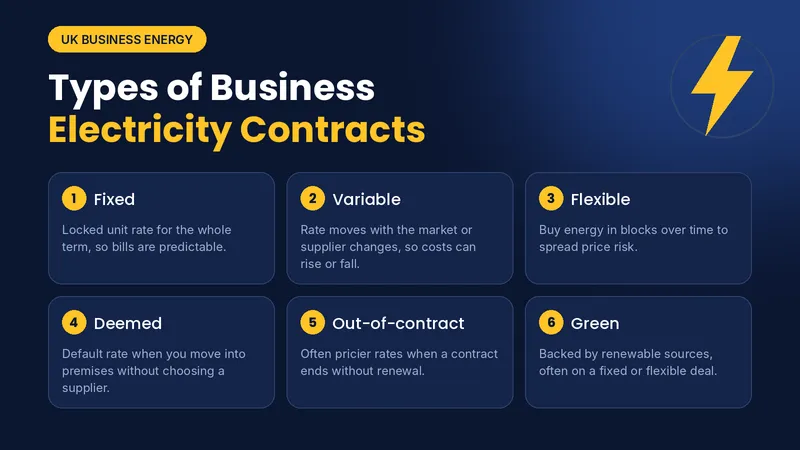
UK businesses can choose from different types of electricity contracts. Each option has its own pricing structure and benefits.
Fixed-Rate Contracts
A fixed-rate contract keeps your agreed unit rate and standing charge the same throughout the contract period.
This makes it easier to plan your monthly energy budget because your agreed rates will not change with movements in wholesale energy prices.
However, if electricity prices fall during your contract, you may not benefit from the lower market rates.
Variable-Rate Contracts
With a variable-rate contract, the price of electricity can go up or down during the agreement.
This type of contract may suit businesses that are comfortable with changing energy costs. However, it can make it harder to plan your monthly expenses.
Deemed Contracts
A deemed contract usually applies when a business moves into new premises and starts using electricity without signing a new agreement with a supplier.
These contracts can be more expensive than negotiated business electricity deals. Businesses should compare other available options rather than staying on deemed rates for too long.
Out-of-Contract Rates
If your existing electricity agreement ends and you do not arrange a new contract, your supplier may move you onto out-of-contract rates.
These rates can be higher than the prices available through a new business electricity agreement. It is better to start comparing deals before your current contract expires.
Flexible Contracts
Flexible electricity contracts are generally designed for businesses that use large amounts of electricity.
Instead of agreeing on one fixed price for all their energy needs, businesses can purchase electricity in stages. This gives them more control over when and how they buy energy.
However, flexible contracts require careful planning and a good understanding of the energy market.
Ofgem explains the different types of business energy contracts and encourages companies to understand the terms before signing an agreement.
How to Find the Cheapest Business Electricity Rates
Finding a good electricity deal takes some research. Comparing different suppliers and checking all the charges can help you avoid paying more than necessary.
Here are some steps to follow:
1. Check Your Annual Electricity Usage
Start by checking your recent electricity bills. Look at how many kilowatt-hours your business uses in a year.
This information helps suppliers understand your energy requirements and provide more accurate quotes.
2. Compare Unit Rates and Standing Charges
Do not focus only on the unit rate. Check the daily standing charge as well.
A supplier with a lower unit rate may still be more expensive if it charges a higher standing fee.
3. Get Quotes From Different Suppliers
Ask several business electricity suppliers for quotes instead of accepting the first offer you receive.
You can contact suppliers directly or use a business energy comparison service to compare available deals.
4. Check the Contract Length
Business electricity contracts are available for different periods.
Think about how long you want to stay with a supplier and whether the contract offers the right balance between price and flexibility.
5. Check Exit Fees and Renewal Terms
Before signing an agreement, read the contract carefully.
Check whether you will have to pay an exit fee if you leave early. Also look at the renewal rules and how much notice you need to give before switching suppliers.
6. Compare the Total Annual Cost
Calculate how much each electricity deal will cost over a full year.
Include your estimated electricity usage, unit rates, standing charges and any additional fees.
Comparing the total annual cost gives you a better idea of which supplier offers the best value.
What Affects Business Electricity Prices in the UK?
Business electricity rates can change for several reasons. Even two companies using similar amounts of electricity may receive different quotes.
Some of the main factors include:
- Business Location: Electricity prices and network charges can differ depending on where your business premises are located.
- Annual Electricity Usage: Companies that use more electricity may receive different rates from suppliers.
- Meter Type: The type of electricity meter installed at your premises can affect the tariffs available.
- Contract Length: Longer contracts can provide more price certainty, while shorter agreements may offer greater flexibility.
- Wholesale Energy Prices: Changes in the wholesale electricity market can affect the prices suppliers offer to businesses.
- Time of Use: Businesses that use more electricity at certain times of the day may benefit from tariffs that reflect their usage patterns.
Because of these factors, electricity prices are not the same for every business.
When Should You Switch Business Electricity Suppliers?
It is a good idea to compare electricity deals before your current contract ends. Starting early gives you enough time to check different offers and avoid moving onto expensive out-of-contract rates.
You should also consider comparing suppliers when:
- Your current electricity contract is close to ending.
- Your monthly electricity bills have increased.
- You have moved your business to new premises.
- Your company's electricity usage has changed.
- You want to reduce your regular business expenses.
Before switching, check your existing agreement for its notice period, renewal date and any early exit charges.
Business electricity contracts can have different switching rules from household energy agreements, so always read the terms carefully.
FAQs
1. Who offers the cheapest business electricity rates in the UK?
There is no single supplier that is cheapest for every business. EDF Energy, British Gas, E.ON Next, ScottishPower, SSE and other suppliers are worth comparing. The best deal will depend on your electricity usage, location, standing charge and contract terms.
2. What is a good business electricity rate per kWh in 2026?
According to November 2026 supplier-panel averages, micro and small businesses pay around 29.1p per kWh. However, the actual rate offered to your business may be higher or lower depending on your requirements and location.
3. Is business electricity cheaper than domestic electricity?
Not always. Business electricity prices depend on commercial contracts, energy usage and supplier rates. Businesses also do not receive the same protection from Ofgem's household energy price cap.
4. Can a small business switch electricity suppliers?
Yes. Small businesses can compare electricity suppliers and switch when their contract allows. Before switching, check your renewal date, notice period and any early termination charges.
5. What is a standing charge on a business electricity bill?
A standing charge is a fixed daily fee for keeping your electricity supply connected. You pay this amount even when your business is not using electricity. It is separate from the unit rate.
6. How can I reduce my business electricity bill?
You can lower your electricity costs by comparing supplier rates, switching when your contract allows and using energy-efficient equipment. Turning off unused appliances and keeping track of your electricity usage can also help reduce bills.
Final Thoughts
Finding the best business electricity rates in the UK is about comparing the full cost of different deals, not just the price per kWh.
Standing charges, contract length, annual electricity usage and additional fees can all affect how much your business pays.
Suppliers such as EDF Energy, British Gas, E.ON Next, ScottishPower, SSE and Yu Energy are worth comparing. However, the cheapest option for a small office may not be the best deal for a restaurant, warehouse or factory.
Before choosing a supplier, check your recent electricity bills, understand how much energy your business uses and request quotes from different providers.
Taking time to compare the total annual cost can help you find a suitable electricity deal, control your business expenses and avoid paying high out-of-contract rates.
Recommended Stories for You

Team SR Nov 10, 2025

Oliver Bennett Nov 10, 2025

Team SR Jan 18, 2025

Kailee Rainse Feb 10, 2025
Oliver Bennett Oct 20, 2026

Kailee Rainse Nov 7, 2024
Trending Stories
Average Bed and Breakfast Income UK: How Much Can a B&B Earn in 2026?

Leading AI Startup in Europe

Unique Business Ideas in Luxembourg

Unique Business Ideas In Amsterdam For 2024

Best Startup Industries In 2024 – 2025

Series A Funding NEWS Europe – July 2024
Business Bank Accounts for Startups in UK

Best Business Ideas in Spain 2024