

 Follow us
 Follow us
Tesla and BYD have become two of the biggest names in the electric vehicle industry. Both companies are helping shape the future of electric mobility, but they have taken very different routes to get there.
Tesla is known for its software-focused vehicles, strong efficiency, advanced driver-assistance technology, and premium electric cars. BYD, meanwhile, has built a much broader vehicle lineup and is known for its battery technology, competitive pricing, and large manufacturing scale.
That makes the Tesla vs. BYD comparison interesting for anyone considering an electric vehicle.
Tesla generally focuses on fully electric vehicles, while BYD sells both battery-electric vehicles and plug-in hybrids. Tesla also puts a strong emphasis on software and connected features, whereas BYD places considerable attention on battery technology, hardware integration, and offering vehicles across a wide range of price points.
So, which one should you choose?
The answer depends on your budget, driving habits, preferred features, and the type of EV experience you are looking for.
Tesla vs BYD at a Glance
| Parameter | Tesla EVs | BYD EVs |
| Core Strategy | Pure-electric vehicles only | Battery EVs and plug-in hybrid EVs |
| Best-Selling EV | Model Y | Seagull (Dolphin Mini in some markets) |
| Typical Real-World Range | 450–600 km on mainstream models | 300–570 km on mainstream models |
| Battery Chemistry | Primarily LFP and NMC batteries from multiple suppliers | Primarily in-house Blade LFP batteries |
| Energy Efficiency | Typically 12–15 kWh/100 km | Typically 13–17 kWh/100 km |
| Fast-Charging Speed | Up to 250 kW on Tesla Superchargers | Generally 80–230 kW depending on model |
| Software Updates | Frequent over-the-air updates | OTA updates available |
| Driver Assistance | FSD and Autopilot ecosystem | God’s Eye ADAS and DiPilot systems |
| Vehicle Architecture | Highly software-defined | Strong focus on hardware integration and cost efficiency |
| Manufacturing Approach | Gigacasting and simplified production | Vertical integration from battery cells to semiconductors |
| Vehicle Portfolio | Sedan, SUV, pickup truck | Hatchback, sedan, SUV, MPV, luxury EV, off-roader |
| Expected Entry-Level EV Price in India | ₹25–30 lakh, estimated | ₹10–15 lakh based on global entry-level models; not currently sold in India |
| Main Competitive Edge | Efficiency, software, charging ecosystem | Affordability, battery technology, manufacturing scale |
These figures come from the comparison source and are intended to provide a broad picture rather than represent every model sold by either company.
Tesla vs BYD Vehicle Lineup Comparison
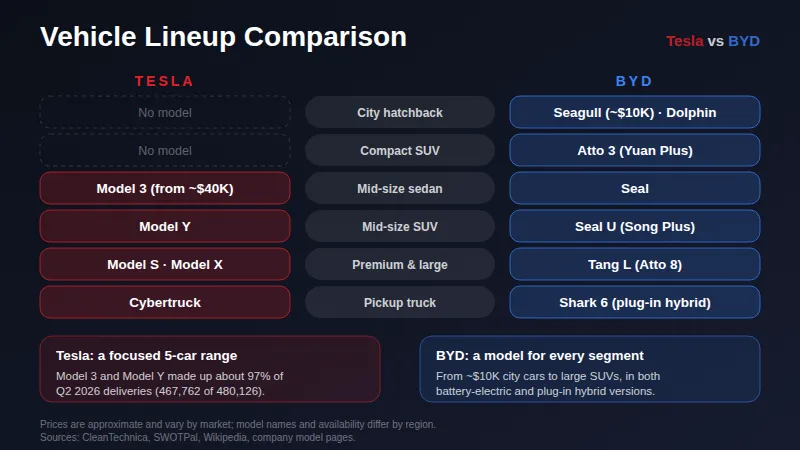
The two companies take very different approaches to their product ranges.
Tesla has a relatively focused lineup built around premium and mid-premium electric vehicles. BYD offers a much wider selection, covering everything from smaller hatchbacks to luxury SUVs and plug-in hybrids.
| Category | Tesla | BYD |
| Number of Mainstream Models | 5 major models | 20+ EV models globally |
| Entry-Level EV | Model 3 | Seagull, Dolphin |
| Compact Hatchback | Not offered | Seagull, Dolphin |
| Sedan | Model 3, Model S | Qin, Seal, Han |
| SUV | Model Y, Model X | Atto 3, Song, Sealion, Tang, Yuan |
| MPV | Not offered | D9, M9 |
| Pickup | Cybertruck | Shark Plug-in Hybrid Pickup |
| Luxury Sedan | Model S | Han, Yangwang U7 |
| Luxury SUV | Model X | Yangwang U8 |
| Performance EVs | Model 3 Performance, Model S Plaid, Model X Plaid | Seal Performance, Yangwang U9 |
| Off-Road Vehicles | Cybertruck | Yangwang U8 |
| Plug-in Hybrids | Not offered | Extensive PHEV lineup |
| Commercial Vehicles | Limited | Electric buses, trucks, vans and fleet vehicles |
| India Portfolio | Expected Model 3 and Model Y initially | Atto 3, Seal, Sealion 7 |
| Main Target Audience | Premium EV buyers and technology enthusiasts | Mass-market buyers, families, premium buyers and luxury customers |
RECOMMENDED FOR YOU



Design and Interior Experience
Both Tesla and BYD have modern interiors, but they approach cabin design in noticeably different ways.
Tesla
Tesla follows a minimalist design philosophy. Many controls are built into a large central touchscreen, and the cabin has relatively few physical buttons.
The result is a clean and futuristic interior that suits buyers who enjoy a technology-first experience. Features such as panoramic glass roofs, over-the-air software updates, and digital infotainment add to that feel.
BYD
BYD takes a more conventional approach while still giving its vehicles a premium look.
Its cabins often combine large touchscreens with physical controls for commonly used functions. Depending on the model, buyers can also find softer materials, ambient lighting, and a wider range of comfort-focused features.
BYD’s rotating touchscreen and feature-rich interiors are designed to combine modern technology with everyday practicality.
Performance and Driving Experience
Electric cars are known for instant torque, and both Tesla and BYD can deliver strong performance. The difference is more about how each company tunes its vehicles.
Tesla
Tesla places a strong emphasis on acceleration, handling, and efficiency.
Models such as the Model 3 Performance and Model S Plaid are built for drivers who want particularly strong performance. The battery’s low position also helps lower the centre of gravity, which can improve stability and cornering.
BYD
BYD generally takes a more balanced approach.
Many of its vehicles are designed around comfort, efficiency, and everyday usability rather than outright performance. There are performance-oriented models such as the Seal Performance, but much of the range focuses on smooth driving and practical urban use.
For daily commuters and families, this comfort-oriented approach can be appealing. Drivers looking for sharper performance may be more interested in Tesla’s performance-focused models.
Tesla vs BYD: Which EV Battery Technology Is Better?
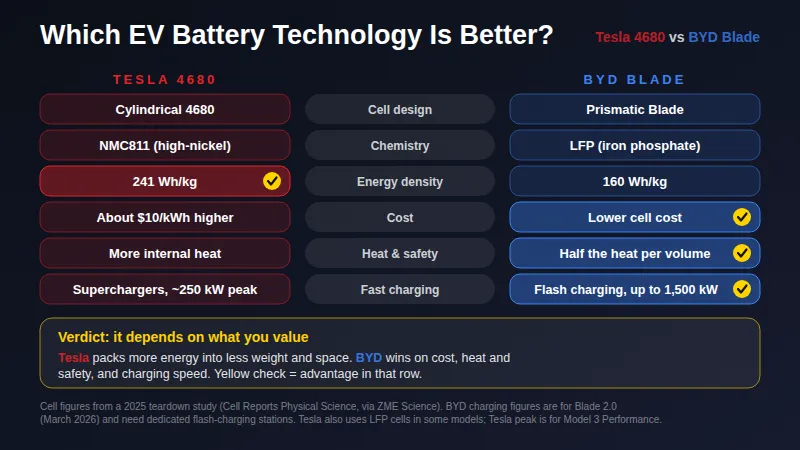
Battery technology is one of the most important areas of the Tesla vs. BYD comparison.
Tesla uses both LFP and NMC battery chemistry across its vehicles and works with multiple suppliers. BYD has built a reputation around its in-house Blade Battery, which primarily uses LFP chemistry.
The source highlights several differences.
Range and efficiency
Tesla is presented as having an advantage in efficiency and range. Its vehicles are designed to get more kilometres from their available battery energy.
Safety
BYD’s Blade Battery is highlighted for its safety characteristics and resistance to overheating.
Fast charging
Tesla’s charging ecosystem supports charging rates of up to 250 kW on Superchargers, while BYD’s charging speeds vary across its lineup and are generally listed between 80 kW and 230 kW in the source comparison.
Durability
BYD’s Blade Battery is also highlighted for its durability and long operating life.
Innovation
Tesla continues to focus heavily on battery-management systems and newer cell technologies.
Value
BYD’s vertical integration and in-house battery production help support its focus on cost efficiency.
Read Also- How AI Affects the Environment: Energy, Emissions and Data Centre Impact
Which EV Has the Better Range?
Range is one of the first things many EV buyers check.
The source gives Tesla mainstream models a typical real-world range of around 450–600 km, compared with roughly 300–570 km for mainstream BYD models.
Tesla’s flagship models can exceed 600 km of claimed range depending on the model and configuration.
BYD, however, offers competitive range across more price segments.
That is important because maximum range is not the only consideration. For everyday driving, a vehicle that provides enough range for your routine at a lower purchase price may be more practical than paying substantially more for additional range that you rarely need.
The source therefore describes Tesla as stronger on maximum range and efficiency, while BYD offers a balance between range and affordability.
Technology and Safety Features
Technology is central to both brands, although their priorities differ.
Tesla
Tesla has built much of its reputation around software.
Its vehicles receive over-the-air updates, and the company offers features such as Autopilot and Full Self-Driving. These updates can introduce new functions and improvements after the vehicle has already been purchased.
BYD
BYD combines digital technology with an emphasis on physical safety systems and battery design.
Its vehicles offer driver-assistance technology, active and passive safety features, and the Blade Battery. The company also focuses on delivering a broad set of features across its cabins and vehicle range.
The source frames Tesla as stronger in software innovation and advanced driver assistance, while BYD puts greater emphasis on battery safety and practical technology.
Pricing and Value for Money
Price is another major difference between the two brands.
According to the source, Tesla’s expected entry-level price in India is around ₹25–30 lakh, while global entry-level BYD models can fall into the ₹10–15 lakh range when converted, although those models were not listed as being sold in India at the time of the source.
The source also places BYD’s Indian models such as the Atto 3, Seal, and Sealion 7 at approximately ₹25 lakh to ₹55 lakh.
Tesla therefore tends to sit more firmly in the premium category, while BYD covers a much wider part of the market.
That broader price range is one of BYD’s biggest strengths. Buyers can look at several vehicle sizes and price levels instead of choosing from a relatively small premium lineup.
Tesla vs BYD: Main Technology Differences
| Feature | Tesla | BYD |
| Vehicle Philosophy | Software-led | Hardware and battery integration |
| Battery Approach | LFP and NMC from multiple suppliers | Primarily in-house Blade LFP |
| Driver Assistance | Autopilot and FSD ecosystem | God’s Eye ADAS and DiPilot |
| Software Updates | Frequent OTA updates | OTA updates available |
| Charging | Supercharger ecosystem | Fast charging varies by model |
| Efficiency | Strong focus on efficiency | Competitive efficiency |
| Manufacturing | Simplified design and gigacasting | High vertical integration |
| Vehicle Variety | Relatively focused lineup | Broad model range |
The difference is easy to summarise: Tesla places a great deal of emphasis on software, efficiency, and connected vehicle technology, while BYD combines battery development and manufacturing integration with a much broader product portfolio.
Tesla vs BYD: Pros and Cons
Tesla advantages
Tesla’s main strengths include efficiency, strong electric performance, software features, frequent updates, and its charging ecosystem.
Its vehicles are also designed around a highly software-driven ownership experience.
Tesla limitations
Tesla has a relatively limited model range compared with BYD. It also focuses mainly on the premium and luxury portions of the market, which can put its vehicles out of reach for buyers with tighter budgets.
BYD advantages
BYD offers a much broader range of vehicles, from more affordable models to luxury EVs. Its Blade Battery, vertical integration, and focus on cost efficiency are also important parts of its strategy.
BYD limitations
BYD’s model availability varies significantly by country, and its software ecosystem is described in the source as less extensive than Tesla’s.
This means local availability, charging options, after-sales support, and pricing should be checked before making a final decision.
Tesla vs BYD: Which EV Should You Choose?
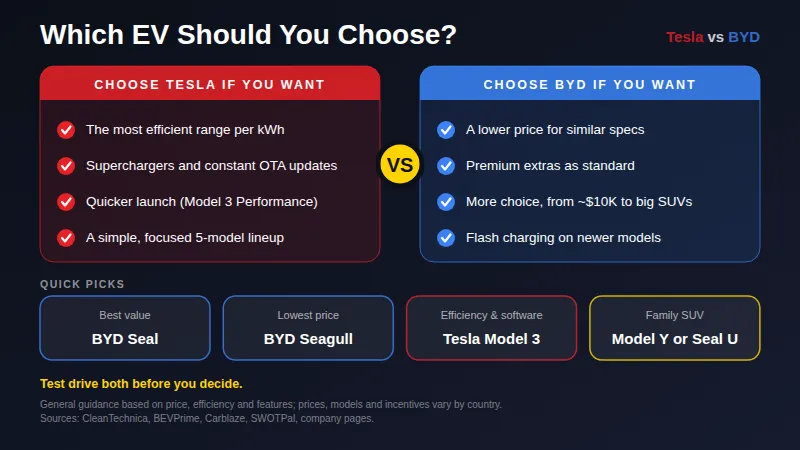
Tesla may suit you if:
You value a software-first experience, strong efficiency, advanced driver-assistance features, fast charging, and performance.
Tesla’s lineup is particularly suited to buyers looking for a premium EV with a strong emphasis on technology and driving dynamics.
BYD may suit you if:
You want more choice, a wider range of price points, strong battery technology, and a feature-rich cabin.
Its broad product portfolio makes it easier to find a vehicle suited to different family sizes, budgets, and driving needs.
For buyers in India, local model availability is an especially important factor because the global BYD lineup is much larger than the selection available in the Indian market.
Tesla vs BYD: Final Comparison
Tesla and BYD are both major players in the EV industry, but they are not trying to do exactly the same thing.
Tesla has built its identity around software, efficiency, performance, connected technology, and a premium electric vehicle experience.
BYD takes a broader approach. Its strategy combines battery manufacturing, vertical integration, a wide product range, and competitive pricing.
For someone focused primarily on software, efficiency, and a premium technology-led driving experience, Tesla offers a distinctive proposition.
For someone who values product variety, battery technology, practical features, and different price options, BYD provides a different proposition.
Ultimately, the best EV for you comes down to your own needs. Consider how far you drive, where you charge, what you can comfortably spend, how much space you need, and which technology matters most.
Rather than choosing a brand simply because it is more familiar, compare the actual models available in your market. That is where the real Tesla vs. BYD decision begins.
FAQ
Which is more efficient, Tesla or BYD?
Does Tesla have better software than BYD?
Which has a bigger EV lineup, Tesla or BYD?
Which EV brand offers more vehicle choices?
Is Tesla good for long-distance driving?
Recommended Stories for You

Oliver Bennett May 22, 2024

Kailee Rainse Apr 7, 2026

Oliver Bennett Oct 11, 2024
Oliver Bennett Jan 6, 2025

Oliver Bennett Jun 27, 2024

Team SR Jul 30, 2024
Trending Stories

Best Platforms for Startup Promotion
Best Sole Trader Accounting Software in 2026

Best Startups In Europe 2024

Top Student Startup in Europe

Best Venture Capital Firms London 2024

The Top Disruptar brand, Revolutionizing the European

Business Credit Cards For Startups

Startups Hit €200 Million+ in 2024 Funding Report