

How AI Affects the Environment: Energy, Emissions and Data Centre Impact
Sep 30, 2026 | By Olivia James
 Follow us
 Follow us
Artificial intelligence has quickly become part of everyday life. People use AI chatbots to write emails, answer questions, create images, analyse information, and help with work and study.
But behind all that convenience is a less visible issue: AI requires a lot of computing power, and computing power requires energy.
That has raised an important question. Is AI bad for the environment?
There isn’t a simple yes-or-no answer.
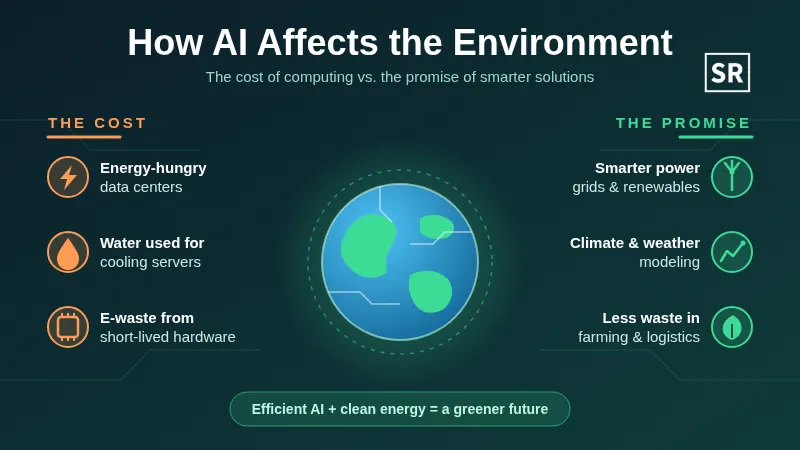
AI can have environmental costs, particularly because large AI systems rely on energy-hungry data centres. But the impact does not stop at electricity use. AI can also influence how people understand environmental problems, who they hold responsible, and which solutions they consider realistic.
Research discussed in the source suggests that these less obvious effects may deserve just as much attention as AI’s energy consumption.
Why Does AI Use So Much Energy?
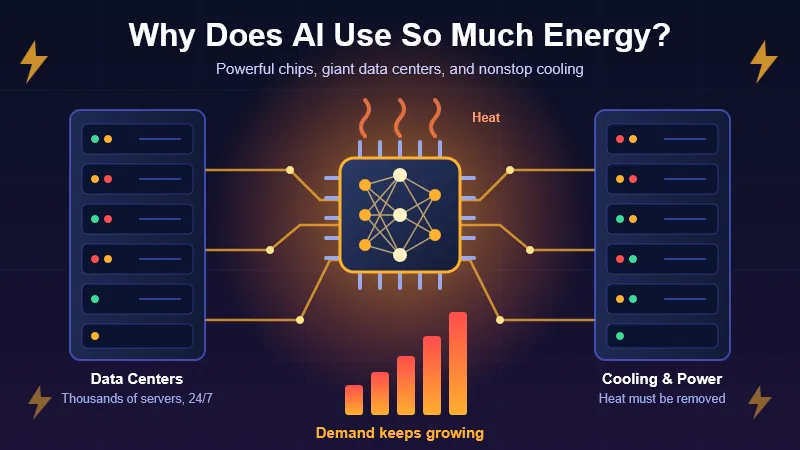
AI systems need powerful computers to train and run.
Every time an AI model processes a request, data centres use computing resources to generate the response. A single interaction may use a relatively small amount of electricity, but the total becomes much more significant when millions of people are using AI every day.
ChatGPT, for example, had more than 300 million weekly users by late 2024, with users sending roughly one billion messages each day.
One researcher cited in the source estimated that a single ChatGPT query used approximately as much electricity as leaving a light bulb on for about 20 minutes.
How Do Data Centres Affect the Environment?
AI depends heavily on data centres, which contain the servers and other infrastructure needed to run digital services.
As demand for AI grows, technology companies have been expanding their data-centre capacity. That can increase electricity demand and, depending on where the electricity comes from, greenhouse gas emissions.
The source points to emissions reported by major technology companies as an example.
Alphabet, Google’s parent company, reported that its greenhouse gas emissions had increased by 48% since 2019. Microsoft reported a 29% increase since 2020. Both companies pointed to the growth of data centres needed to support AI workloads as an important factor behind rising emissions.
These figures do not mean that AI alone caused all of the increases. Large technology companies have many operations, products, and infrastructure projects that contribute to their overall emissions.
What they do show is that expanding AI infrastructure can create additional pressure on energy systems.
Could AI Increase Demand for Fossil Fuels?
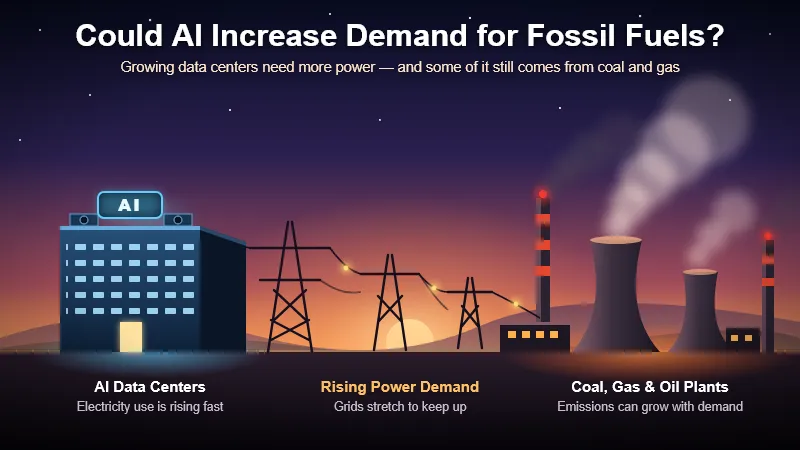
One of the concerns surrounding AI is what happens when electricity demand rises faster than clean energy capacity can keep up.
The source notes that the growing electricity needs of data centres have contributed to decisions to delay the retirement of some coal-fired power plants.
In other words, if additional electricity is needed quickly and renewable or low-carbon generation is not available at the required scale, existing fossil-fuel power sources may continue operating longer.
The source also cites estimates suggesting that AI and other digital technologies could account for as much as 20% of global electricity use by 2030.
That figure is an estimate rather than a guaranteed outcome, but it illustrates how large the conversation around digital energy use could become.
Read Also- Chinese Cars Gain Market Share in the UK 2026
Is Energy Use the Only Environmental Problem With AI?
This is where the issue gets more complicated.
It is easy to focus on electricity because energy consumption can be measured. But the source argues that AI can have another kind of environmental impact: the way it shapes how people think about environmental problems.
Researchers at the University of British Columbia’s Business, Sustainability and Technology Lab examined this issue in a study titled Does artificial intelligence bias perceptions of environmental challenges?
They asked four chatbots a series of questions about the causes, consequences, and possible solutions to nine environmental challenges. According to their findings, the chatbots showed systematic patterns in the answers they produced.
That raises a different concern.
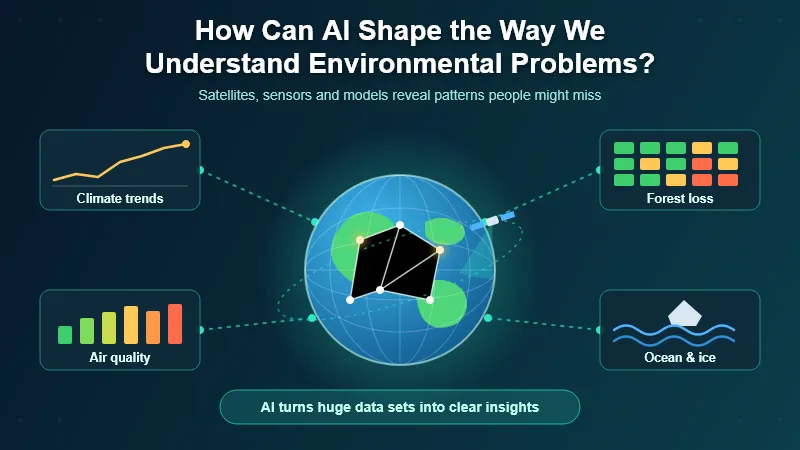
AI doesn’t simply consume energy. It also helps determine which information people see and how complex problems are described.
How Can AI Shape the Way We Understand Environmental Problems?
RECOMMENDED FOR YOU
What If AI Becomes Smarter Than Humans? What Could Happen Next?
Oliver Bennett
Oct 8, 2026

AI chatbots often provide information in a neat, confident-looking answer.
For a user, that can feel convenient. Instead of reading dozens of reports, articles, studies, and opinions, they can ask one question and receive a response in seconds.
The problem is that a concise answer can leave out important context.
The researchers in the source found that chatbots were more likely to recommend combinations of relatively moderate economic, social, or political changes, such as increasing sustainable technologies, public awareness, and education.
They were less likely to discuss more fundamental changes to economic and political systems.
The researchers specifically noted that terms such as environmental justice were largely absent from the chatbot responses they studied. They also found limited discussion of ideas such as challenging colonial systems or reconsidering models based on unlimited economic growth.
This does not mean chatbots can never discuss those subjects. It means the researchers observed that they appeared far less frequently in the answers produced during their study.
Why Does This Kind of AI Bias Matter?
Environmental problems are rarely caused by one thing or one group.
Climate change, biodiversity loss, pollution, and resource depletion can involve governments, companies, financial institutions, consumers, historical systems, and communities.
The source’s researchers found that the chatbots they examined were more likely to place responsibility on governments than on businesses or financial organisations.
They also found differences in how vulnerable groups were discussed. The concern here is not simply about missing words.
When certain communities, causes, or forms of responsibility are repeatedly left out, people may develop an incomplete understanding of environmental problems.
Why Are AI Answers Sometimes Taken Too Seriously?
One reason this matters is the way chatbots communicate.
An AI chatbot generally presents its response as one polished block of text. It can sound confident and organised, even when the underlying information is incomplete or shaped by biases in the data and systems behind the model.
This can create a false sense that the answer represents the complete picture.
The source points out that educators, students, policymakers, and business leaders are increasingly using AI chatbots to understand environmental issues and consider possible responses.
That makes responsible use especially important.
An AI-generated explanation can be a useful starting point, but it should not automatically be treated as the final word on a complicated environmental issue.
Could AI’s Environmental Impact Become Bigger in the Future?
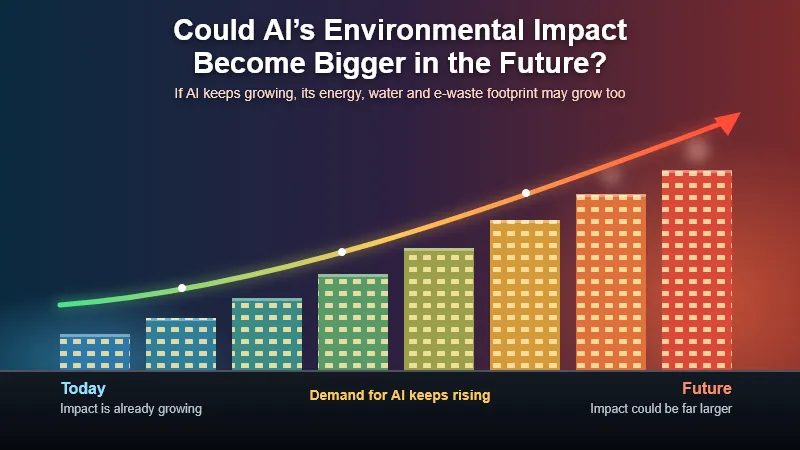
It could, particularly if AI use continues expanding rapidly.
More users mean more queries. More advanced models can also require significant computing resources, both during training and when serving large numbers of users.
At the same time, AI companies are continuing to develop increasingly powerful systems, which could further increase demand for data-centre capacity.
The source also raises concerns about the future role of advertising in AI platforms. If advertising becomes an important source of revenue, there could be questions about how commercial incentives affect the way environmental information is presented.
That doesn’t mean an advertiser would automatically control an AI’s answers. It does, however, highlight the broader question of how business incentives can influence digital information.
Can AI Also Help the Environment?
The source focuses mainly on AI’s environmental costs and its influence on how environmental issues are understood. It does not provide a detailed assessment of AI’s potential environmental benefits.
In practice, AI can be used in many environmental applications, but those possible benefits do not erase the energy and infrastructure costs associated with operating AI systems.
That means the more useful conversation is not simply whether AI is “good” or “bad” for the environment.
It is about how much energy AI uses, where that energy comes from, how efficiently systems operate, what impacts are created by the necessary infrastructure, and how AI influences decisions about environmental challenges.
What Can Be Done About AI’s Environmental Impact?
There is no single solution.
Reducing the environmental footprint of AI can involve making data centres more energy efficient, improving computing hardware, increasing access to lower-carbon electricity, and considering the amount of computing power required for different AI applications.
There is also an information side to the problem.
People using AI for environmental questions should check important claims against reliable sources instead of assuming that a polished chatbot response contains the whole story.
This is especially important when an answer involves complex questions about climate policy, environmental justice, economics, or the responsibilities of governments and businesses.
AI can save time, but saving time should not mean skipping critical thinking.
Should You Stop Using AI Because of Its Environmental Impact?
The source does not establish that people should stop using AI altogether.
Instead, it highlights why the environmental costs of AI deserve closer attention.
AI has become deeply embedded in modern technology, and completely avoiding it may not be realistic for many people or organisations. A more practical approach is to understand the trade-offs.
For users, that can mean thinking twice about unnecessary or repetitive AI requests, particularly when a simpler tool would do the job.
Conclusion
AI does have an environmental cost, and a large part of that cost comes from the electricity and infrastructure required to train and operate increasingly powerful systems.
But the issue goes deeper than energy consumption.
AI can also influence how people understand environmental problems. The research discussed in the source found patterns in chatbot responses that could leave out certain causes, communities, and more fundamental solutions.
An AI response may look complete even when it is not. When people use chatbots to inform environmental decisions, they need to remember that the answer is generated by a system with limitations and potential biases.
AI is changing how people work and communicate. Making sure that progress does not come with environmental and informational costs that are simply pushed out of sight will be an important part of the conversation.
Recommended Stories for You

Oliver Bennett May 4, 2024

Team SR Nov 29, 2025

Oliver Bennett May 6, 2024

Team SR Nov 10, 2025

Oliver Bennett Jun 17, 2024

Team SR Dec 6, 2025
Trending Stories

Best Platforms for Startup Promotion

Best Startups In Europe 2024

Top Student Startup in Europe

Best Venture Capital Firms London 2024

The Top Disruptar brand, Revolutionizing the European

Business Credit Cards For Startups

Startups Hit €200 Million+ in 2024 Funding Report

Best Sole Trader Accounting Software in 2026