

 Follow us
 Follow us
Chinese car brands are becoming much harder to ignore in the UK.
For years, names such as MG, BYD, Omoda, Jaecoo, and Leapmotor were not nearly as familiar to European buyers as brands from Germany, Japan, South Korea, or the United States. That picture is changing quickly.
During the first half of 2026, Chinese automobile brands registered approx 663,000 passenger vehicles across Europe, up approximately 107% from the same period a year earlier.
The UK is an important part of that expansion. The source identifies Britain as one of the strongest European markets for Omoda and Jaecoo, while the Jaecoo 7 has emerged as one of the country’s popular new vehicles during 2026.
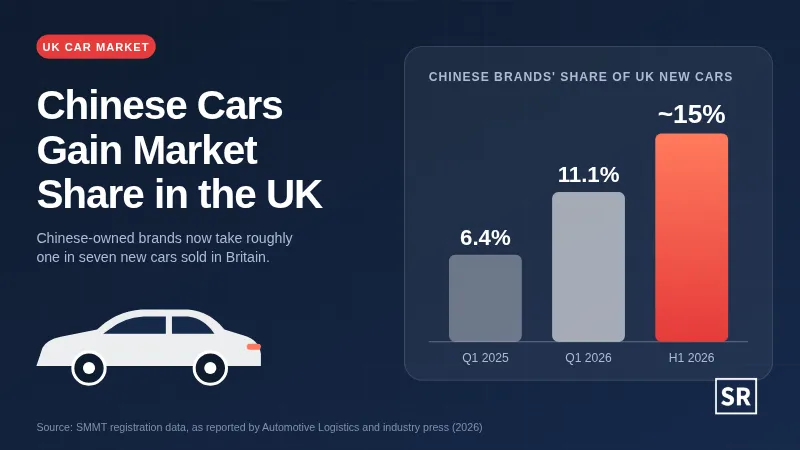
The source does not provide a separate overall market-share figure for Chinese brands in the UK, so the clearest picture comes from looking at the wider European trend and the growing presence of Chinese brands in Britain.
How Fast Are Chinese Car Brands Growing in Europe?
The speed of growth has been one of the biggest stories of 2026.
Chinese brands recorded 662,905 vehicle registrations in Europe during H1 2026, representing growth of around 107% year on year. Their combined market share rose to about 9.2%, nearly double the estimated 4.5% recorded during H1 2025.
That means roughly one in every eleven new cars registered in Europe during the first six months of 2026 came from a Chinese brand, according to the source.
For the UK, this broader European shift matters because several Chinese manufacturers are actively expanding their model ranges, dealer networks, and partnerships across the region.
Which Chinese Car Brands Are Growing the Fastest?
The growth is not coming from one company alone.
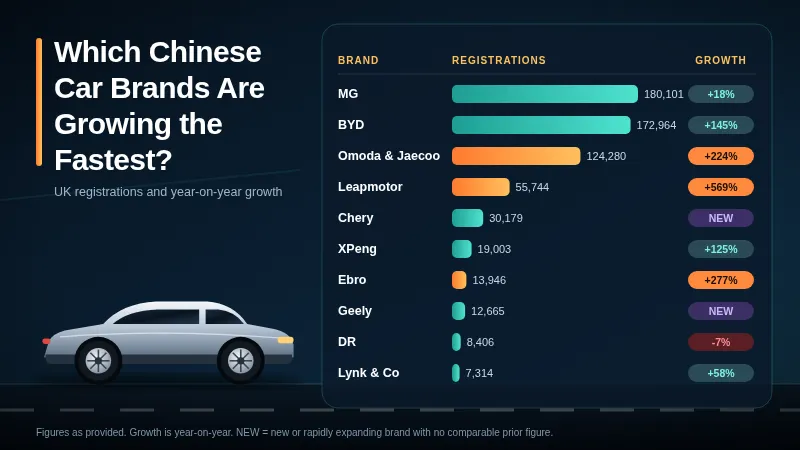
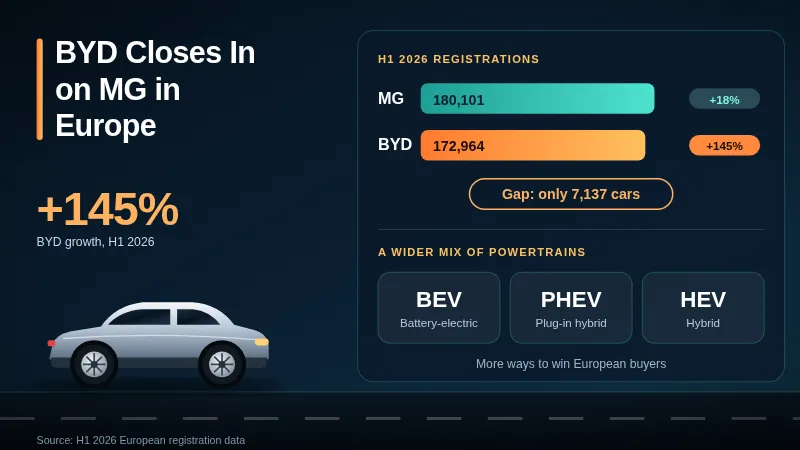
MG remains the largest Chinese-origin brand in Europe by registrations, with 180,101 vehicles registered during H1 2026, an increase of around 18% year on year. BYD was close behind with 172,964 registrations, up an impressive 145%.
Here is how the major brands performed:
| Brand | H1 2026 Registrations | YoY Growth |
| MG | 180,101 | +18% |
| BYD | 172,964 | +145% |
| Omoda & Jaecoo | 124,280 | +224% |
| Leapmotor | 55,744 | +569% |
| Chery | 30,179 | New/rapid expansion |
| Xpeng | 19,003 | +125% |
| Ebro | 13,946 | +277% |
| Geely | 12,665 | New/rapid expansion |
| DR | 8,406 | -7% |
| Lynk & Co | 7,314 | +58% |
The figures show that Chinese carmakers are not all growing at the same pace. Some are already established, while others are expanding from a much smaller base.
Why Is the UK Important for Omoda and Jaecoo?
The UK has become a particularly important market for Omoda and Jaecoo.
The two brands together registered 124,280 vehicles across Europe in H1 2026, representing growth of around 224% year on year. The source says the UK has emerged as one of their strongest European markets.
Their strategy is also interesting because it is not limited to fully electric cars.
Omoda and Jaecoo have expanded their SUV ranges across petrol, plug-in hybrid, and electric powertrains. That gives them access to customers who may want some form of electrification without being ready to move entirely to a battery-electric vehicle.
This broader powertrain strategy could be particularly useful in a market where different drivers have very different expectations about EV charging, driving range, price, and running costs.
Is the Jaecoo 7 Becoming Popular in the UK?
The source specifically highlights the Jaecoo 7 as one of Britain’s popular new vehicles during 2026.
That is significant because it shows how Chinese brands are moving beyond simply bringing unfamiliar products into Europe.
Why Is BYD Growing So Quickly?
RECOMMENDED FOR YOU



Moldova’s Startup Scene Soars: Tax Fast Registration and Female Leadership Lead the Way
Kailee Rainse
May 8, 2025
BYD has become one of the biggest challengers to MG in Europe.
During H1 2026, BYD registered 172,964 cars, recording 145% year-on-year growth. The gap between BYD and MG was only 7,137 vehicles during the first half of the year.
BYD is particularly associated with electric vehicles and battery technology, although the wider Chinese automotive expansion is no longer limited to pure EVs.
The source points to a broader mix of battery-electric vehicles, plug-in hybrids, and hybrids as Chinese manufacturers look for more ways to attract European customers.
Why Is Leapmotor Growing So Quickly?
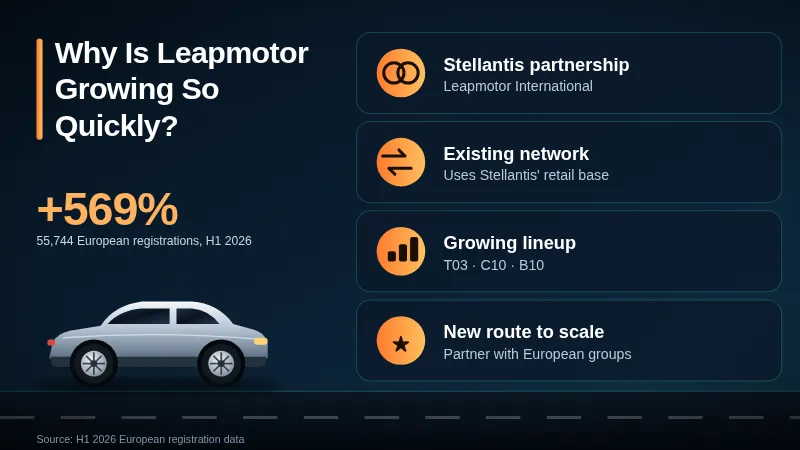
Leapmotor recorded the fastest percentage growth among the major Chinese brands listed in the source.
Its European registrations jumped 569% to 55,744 vehicles in H1 2026.
One reason behind that expansion is its partnership with Stellantis.
Rather than building an entirely independent European sales and retail network, Leapmotor International is using Stellantis’ existing infrastructure in several markets. The source highlights models such as the T03, C10, and B10 as part of its growing European lineup.
This shows another route Chinese manufacturers are using to expand: working with established European automotive groups instead of relying entirely on their own networks.
Why Are Chinese Cars No Longer Just an EV Story?
It would be easy to look at China’s European expansion and assume it is entirely about electric cars.
The source suggests the reality is more complicated.
Chinese companies such as BYD, Xpeng, and Leapmotor have built significant experience in battery technology, electric drivetrains, vehicle electronics, and software. At the same time, companies are increasingly selling hybrids and plug-in hybrids as well.
That gives them a way to target buyers who want lower-emission technology without switching immediately to a fully electric car.
For UK customers, that wider choice can make Chinese brands relevant to more than just the EV market.
How Are Chinese Car Brands Expanding in the UK and Europe?
Chinese manufacturers are using several strategies at the same time.
They are introducing more models, building dealer networks, partnering with established companies, offering several powertrain options, and exploring local manufacturing.
The source describes localisation as an increasingly important next phase.
Instead of shipping every vehicle directly from China, some manufacturers are looking at European manufacturing, engineering, and research operations. Chery and BYD are both mentioned as examples of companies expanding their regional production and development plans.
That could help lower logistics costs and reduce exposure to tariffs on China-built battery-electric vehicles.
Read Also- Helsing vs Quantum Systems: Which German Defense-Tech Startup Leads in 2026?
Could Local Production Change the Chinese Car Market in Europe?
Local production could make a major difference.
Producing or assembling more vehicles within Europe can reduce transportation costs and make it easier for manufacturers to operate as long-term participants in the market.
The source argues that localisation could also help Chinese companies manage tariff exposure while making them look less like temporary importers and more like established automotive players in Europe.
For the UK, that broader European investment could also affect the availability and competitiveness of Chinese models.
Are Chinese Car Brands Competing With Each Other?
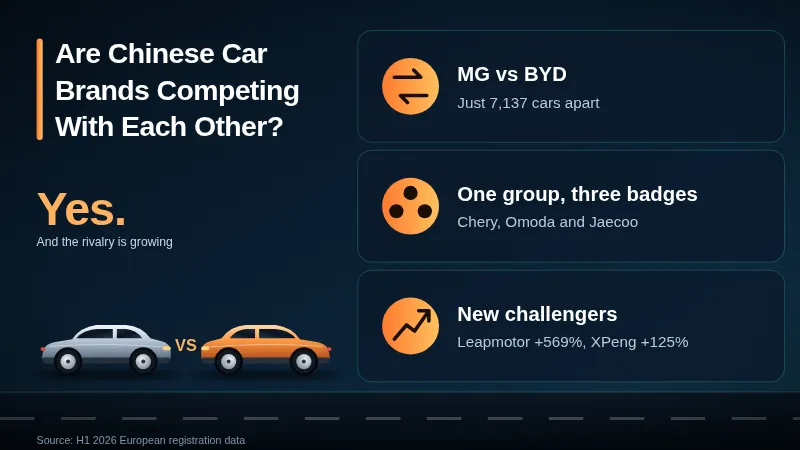
Yes. The competition is no longer simply Chinese manufacturers versus European brands.
The companies are increasingly competing against one another for the same customers.
Based on H1 2026 European Chinese-brand registrations, the source gives the following approximate shares within the Chinese-brand market:
| Brand | Share of Chinese-Brand Registrations |
| MG | 27% |
| BYD | 26% |
| Omoda & Jaecoo | 19% |
| Leapmotor | 8.4% |
| Chery | 4.6% |
| Xpeng | 2.9% |
MG and BYD still account for more than half of Chinese-brand registrations, but the rapid growth of Omoda, Jaecoo, and Leapmotor is making the market more competitive.
That competition could encourage faster product launches, more aggressive pricing, and continued development of vehicle technology.
What Does the Growth of Chinese Cars Mean for the UK Car Market?
The rise of Chinese brands is giving British consumers more choices.
Instead of competing only through established European, Japanese, Korean, and American manufacturers, the market now includes a growing group of Chinese companies offering SUVs, electric vehicles, hybrids, and plug-in hybrids.
The UK is already an important market for Omoda and Jaecoo, according to the source, and the rise of the Jaecoo 7 shows how quickly some of these newer brands are gaining visibility.
At the same time, the source does not provide a single figure showing the overall Chinese-brand market share in the UK for H1 2026. The 9.2% figure applies to Europe as a whole, not specifically to Britain.
That distinction is important when looking at the data.
What Could Happen Next for Chinese Cars in the UK?
The source points toward a European market that is becoming increasingly competitive.
Chinese brands are expanding through EVs, hybrids, partnerships, new models, dealer networks, and local production plans.
For the UK, the continued expansion of brands such as Omoda, Jaecoo, BYD, MG, and Leapmotor could mean more competition across the mainstream car market.
The bigger story is not simply how many cars Chinese manufacturers are selling today. It is the speed at which they are building a long-term presence in Europe.
Conclusion
Chinese car brands made a major move forward in Europe during the first half of 2026.
They registered almost 663,000 vehicles, more than doubled their sales compared with the previous year, and increased their combined European market share from about 4.5% to 9.2%.
What makes the trend especially interesting is that Chinese manufacturers are not relying on one strategy. They are competing through electric vehicles, hybrids, SUVs, partnerships, different price points, and increasingly local operations.
The source’s broader takeaway is clear: Chinese carmakers are no longer operating on the sidelines of Europe’s automotive market. They are becoming a larger and more visible part of it, while competition among the Chinese brands themselves is growing at the same time.
FAQs
Are Chinese car brands gaining market share in the UK in 2026?
What is the market share of Chinese cars in Europe in 2026?
Which Chinese car brands are popular in the UK?
Is Jaecoo 7 popular in the UK?
Which Chinese car brand sold the most cars in Europe in H1 2026?
How fast is BYD growing in Europe?
Are Chinese car brands in Europe focused only on electric vehicles?
Recommended Stories for You

Kailee Rainse Nov 26, 2024

Team SR Dec 8, 2025

Team SR Aug 23, 2024

Team SR Aug 9, 2024

Team SR Sep 20, 2024

Team SR Sep 3, 2024
Trending Stories

Best Insurance For Startups 2024

Best Platforms for Startup Promotion

Best Startups In Europe 2024

Top Student Startup in Europe

Best Venture Capital Firms London 2024

The Top Disruptar brand, Revolutionizing the European

Business Credit Cards For Startups

10 Important Business Skills Every Professional Needs