

Helsing vs Quantum Systems: Which German Defense-Tech Startup Leads in 2026?
Sep 28, 2026 | By Kailee Rainse
 Follow us
 Follow us
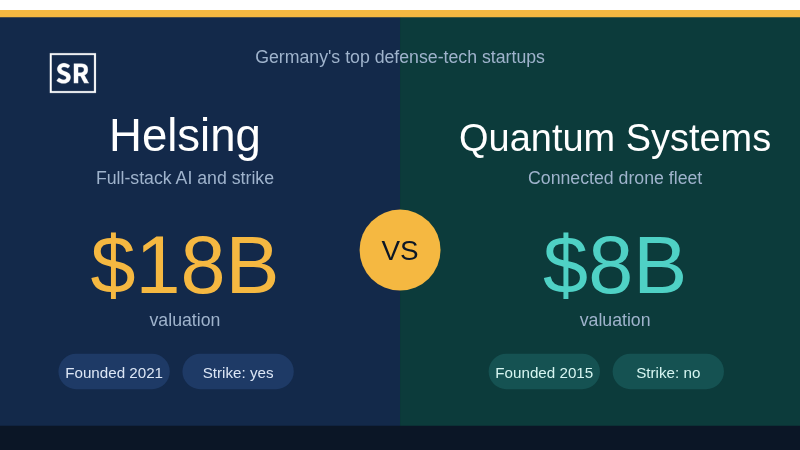
Helsing and Quantum Systems are the two most valuable defense-tech startups in Germany. Both are based in Munich, and both raised record funding rounds in July 2026 as European governments increased military spending. They are often grouped together, but they make money differently, build different products and are growing along different paths. This guide compares Helsing vs Quantum Systems on business model, funding, products and growth.
Who Are Helsing and Quantum Systems?
Helsing was founded in 2021 and employs about 900 people. It began as an AI-software company. Its early partnerships with Rheinmetall (2022) and Saab (2023) focused on adding its AI to weapons that other firms built. Torsten Reil is co-CEO, and Spotify founder Daniel Ek is co-chairman.
Quantum Systems is older and rooted in hardware. Florian Seibel, a former Bundeswehr helicopter pilot, founded it in 2015, and it grew from a civilian drone maker into a defense supplier. Peter Thiel invested in 2022, and Seibel and Sven Kruck now serve as co-CEOs.
Business Model: Full-Stack Platform vs Connected Fleet
Helsing's model is to own multiple layers of the defense stack: the AI that interprets the battlefield and the machines that act on it. Its contracts are large, program-style deals. In February 2026 the Bundeswehr awarded it an initial €269 million order for HX-2 loitering munitions, inside a framework of up to €1.46 billion that the Bundestag budget committee later capped at €1 billion per producer.
Quantum Systems sells reconnaissance systems and links them through software. Its MOSAIC UXS platform is designed to connect uncrewed systems across air, land and sea, so each additional purchase makes the whole fleet more useful. Its contracts are smaller per unit. The Bundeswehr's Twister order covers 147 systems for about €16 million, with a framework for up to 600 more worth about €85 million. Quantum also says it is profitable, while Helsing's profitability is not confirmed.
Funding and Valuation: Helsing vs Quantum Systems
| Category | Helsing | Quantum Systems |
| Latest round | Series E | Series D |
| Amount raised | $1.8 billion | $1.2 billion |
| Date announced | July 13, 2026 | July 2, 2026 |
| Post-money valuation | ~$18 billion | ~$8 billion |
| Previous valuation | ~€12 billion (June 2025, after a €600M Series D) | ~$3.5 billion (late 2025) |
| Valuation change | Step-up from the June 2025 round | More than doubled |
| Lead / co-lead investors | Dragoneer, Lightspeed | Blackstone, Noteus, Airbus, Advent |
| Other participants | JPMorganChase, Goldman Sachs Alternatives, CPP Investments, General Catalyst | Not listed in this section |
| Total disclosed funding | ~$3.3 billion | Not confirmed in my sources |
| Use of proceeds | Not detailed in this section | International expansion, production capacity, acquisitions |
| Investor profile | Technology growth capital | Private equity plus a strategic aerospace partner (Airbus) |
Products and Technology
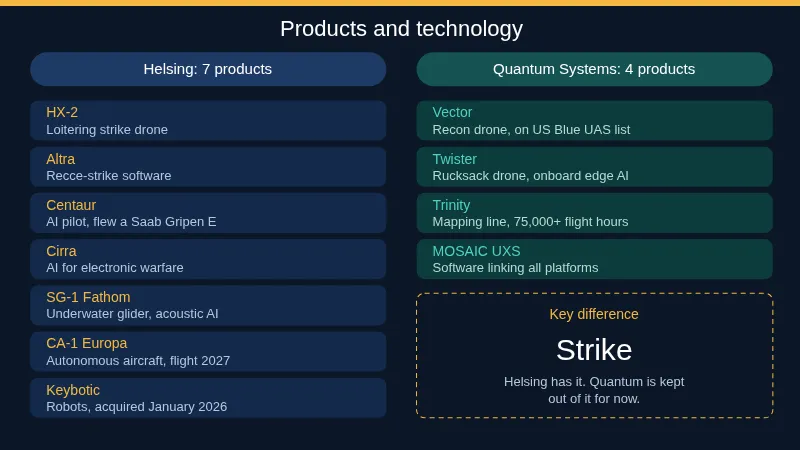
Helsing's portfolio
- HX-2: a loitering strike drone
- Altra: recce-strike software
- Centaur: an AI pilot that flew a Saab Gripen E in beyond-visual-range trials in June 2025
- Cirra: AI for electronic warfare
- SG-1 Fathom: an underwater glider using acoustic AI
- CA-1 Europa: an autonomous combat aircraft built at subsidiary Grob Aircraft, with a first flight targeted for 2027
- Keybotic robots: acquired in January 2026
Quantum Systems' portfolio
- Vector: a reconnaissance drone ordered by Germany, Spain, Romania and Australia, and added to the US Blue UAS Cleared List in August 2025
- Twister: a rucksack-portable drone with onboard edge AI, chosen to replace the Bundeswehr's ALADIN
- Trinity: a mapping line with over 75,000 flight hours since 2018
- MOSAIC UXS: the software layer tying platforms together
The key difference is strike. Investor restrictions on weapons development keep Quantum out of loitering munitions, so Germany buys reconnaissance from Quantum and strike from Helsing and Stark Defence, the attack-drone company Seibel spun out in 2024.
Growth Strategy and Market Position
RECOMMENDED FOR YOU
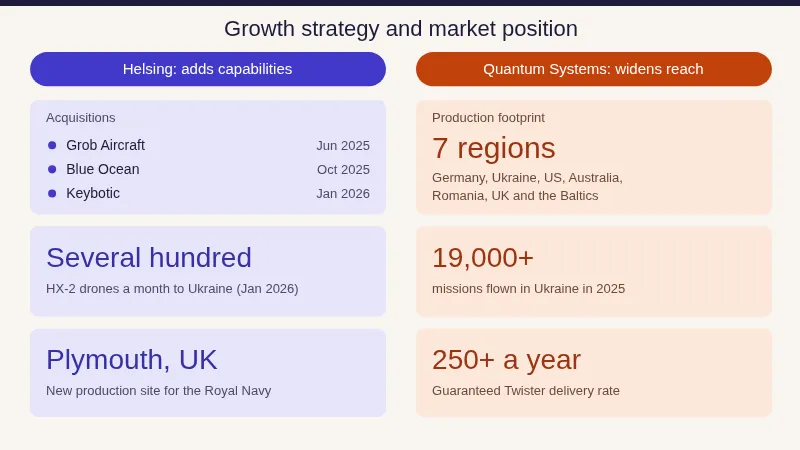
Helsing grows by adding capabilities. It acquired Grob Aircraft in June 2025, Blue Ocean in October 2025 and Keybotic in January 2026, and it opened UK production in Plymouth to support the Royal Navy. It said it was delivering several hundred HX-2 drones a month to Ukraine as of January 2026.
Quantum grows by widening its production and customer base. Its systems flew more than 19,000 missions in Ukraine in 2025, and it now produces in Germany, Ukraine, the US, Australia, Romania, the UK and the Baltics. Its guaranteed Twister delivery rate is at least 250 systems a year.
Risks and Challenges
Helsing faces an execution test. Building drones, a combat aircraft, submarines and robots at once is demanding for a company that was software-only four years ago. HX-2 performance reporting is also mixed: Politico cited a defense ministry briefing saying it hit its target five times in 14 Donbas missions, while other coverage points to Bundeswehr trials above 90%.
Quantum Systems faces commoditization. Cheap FPV drones pressure hardware prices, and Rheinmetall's partnership with Auterion competes directly with MOSAIC. Its software layer needs to become the real moat.
Both depend on defense budgets staying high, so a Ukraine ceasefire or political shift could hit valuations.
Helsing vs Quantum Systems at a Glance
| Category | Helsing | Quantum Systems |
| Founded | 2021 | 2015 |
| Origin | AI software | Drone hardware |
| Valuation | ~$18B | ~$8B |
| Latest round | $1.8B (Jul 13, 2026) | $1.2B (Jul 2, 2026) |
| Lead investors | Dragoneer, Lightspeed | Blackstone, Noteus, Airbus, Advent |
| Business model | Full-stack AI and platforms | Connected reconnaissance fleet |
| Strike systems | Yes | No |
| Flagship contract | HX-2 (€269M initial) | Twister (up to 747 drones) |
| Main risk | Execution across programs | Hardware commoditization |
Which Company Is Stronger?
Neither wins outright. Helsing is larger, better funded and present in strike, but it carries more execution risk. Quantum Systems is narrower and, by its own account, profitable, with strong reconnaissance credentials, but it is closed off from strike for now. A possible future combination of Quantum Systems and Stark could change that, although Stark's spokesperson says there are no plans to merge.
Helsing vs Quantum Systems: Who Will Lead European Defense Tech Next?
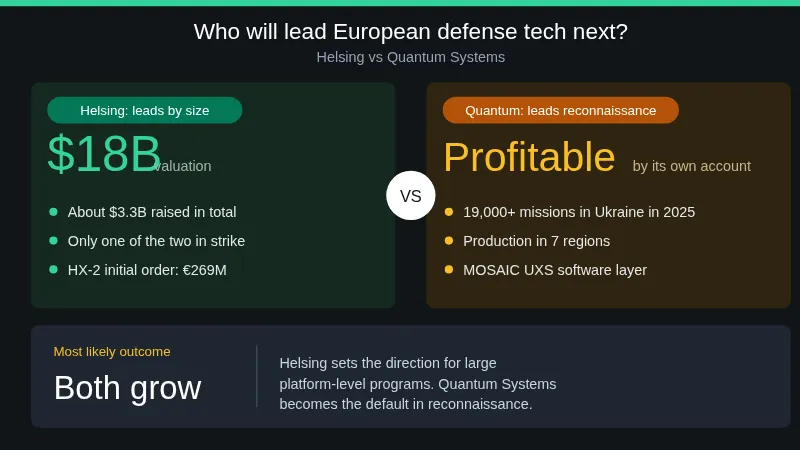
Helsing is the better bet to lead European defense tech overall. It has about $18 billion in valuation, roughly $3.3 billion raised, and it is the only one of the two in strike, where the biggest contracts are (HX-2's initial order was €269 million).
Quantum Systems is the better bet to lead reconnaissance. It says it is profitable, its systems flew more than 19,000 missions in Ukraine in 2025, and it produces in seven regions.
The outcome could shift if Helsing struggles to deliver across its many programs, if Quantum enters strike (for example through Stark), if Rheinmetall and Auterion win the software race against MOSAIC UXS, or if a Ukraine ceasefire cuts defense budgets. Most likely, both grow: Helsing leads by size, Quantum Systems leads in reconnaissance.
Bottom Line
Helsing and Quantum Systems are not competing for the same position, so the "better" company depends on what you measure. Helsing leads on size and reach, with a valuation of about $18 billion and a presence in strike, but it faces an execution test across its many programs. Quantum Systems leads on production and reliability, since it says it is profitable and flew more than 19,000 missions in Ukraine in 2025, but it is shut out of strike for now.
Both depend on defense budgets staying high, yet Germany already buys strike from Helsing and Stark and reconnaissance from Quantum Systems, so there is room for both to grow. A future tie-up between Quantum Systems and Stark is the main development that could shift the balance, although no merger is planned.
Recommended Stories for You

Oliver Bennett Sep 14, 2026

Oliver Bennett Dec 18, 2025

Team SR Jan 9, 2025

Team SR Aug 25, 2024

Team SR Sep 10, 2024

Oliver Bennett Jun 7, 2024
Trending Stories
Best Insurance For Startups 2024
Best Platforms for Startup Promotion
Best Startups In Europe 2024

Top Student Startup in Europe
Best Venture Capital Firms London 2024

The Top Disruptar brand, Revolutionizing the European
Business Credit Cards For Startups
10 Important Business Skills Every Professional Needs