

Why Is Europe Falling Behind in AI? Key Challenges and Opportunities in 2026
Oct 21, 2026 | By Oliver Bennett
 Follow us
 Follow us
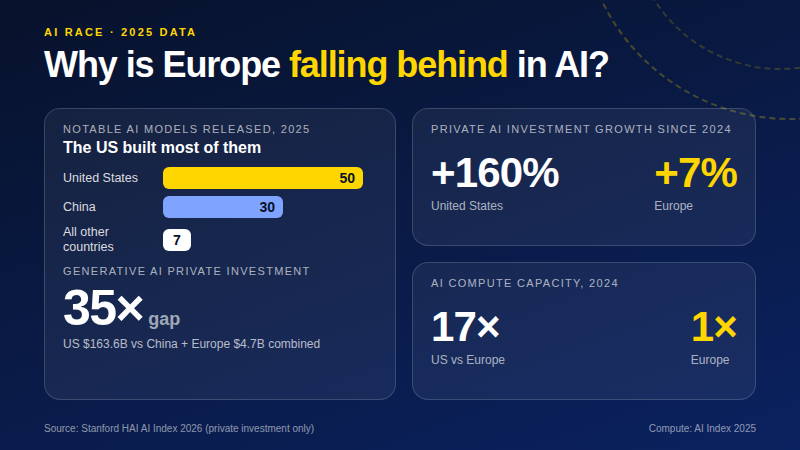
Artificial intelligence (AI) is transforming industries, creating new businesses and changing the global economy. The United States has produced leading AI companies, while China is investing heavily in AI models, infrastructure and applications. Europe has strong universities, talented engineers and innovative startups, but it has struggled to turn these advantages into global AI leaders at the same scale.
Why is Europe falling behind in AI? The main reasons include funding gaps, limited computing infrastructure, difficulties scaling startups, competition for talent and complex regulations. However, Europe still has opportunities to compete in industrial AI, robotics, healthcare, cybersecurity and enterprise software.
Key Reasons Europe Is Falling Behind in AI
| Challenge | Main problem | Impact |
| AI investment | Limited access to large-scale funding | Startups struggle to compete globally |
| Computing infrastructure | Dependence on external technology providers | Higher costs and limited capacity |
| Startup growth | Fragmented European markets | Slower international expansion |
| Regulation | Complex compliance requirements | Additional costs for businesses |
| AI talent | Competition from global technology companies | Skilled workers may move abroad |
| Commercialisation | Difficulty turning research into products | Fewer global AI leaders |
1. Europe Needs More Investment in AI
Developing advanced AI models requires significant investment in computing power, research, data centres and specialist employees. Major American technology companies can spend billions of dollars developing AI products and infrastructure.
European startups also receive venture capital and public funding, but raising very large investment rounds can be more difficult. This creates challenges for companies trying to compete with established global players.
What Europe needs to do:
- Increase investment in AI startups at every stage.
- Attract more private capital into advanced AI research.
- Strengthen partnerships between investors, universities and businesses.
- Help promising startups secure funding for international expansion.
More investment would allow European companies to develop competitive products and reduce their dependence on overseas technology providers.
2. Limited Computing Power and Data Centre Capacity
AI models require powerful chips, specialised data centres and reliable electricity. These resources are essential for training models and delivering AI services to millions of users.
Europe has invested in digital infrastructure, but access to advanced computing remains a challenge for many startups. The region also depends on foreign suppliers for important chips, cloud platforms and AI technologies.
Main challenges include:
- High costs of building and operating data centres.
- Limited access to advanced AI chips.
- Growing electricity demand.
- Dependence on overseas cloud providers.
Europe can address these issues by expanding data centre capacity, supporting AI computing facilities and improving energy infrastructure. Better access to affordable computing would help researchers and startups develop AI products more efficiently.
3. European AI Startups Struggle to Scale
Europe has created many promising AI startups, but turning them into global businesses remains difficult.
Unlike the United States, Europe consists of multiple national markets with different languages, customer requirements and business processes. Startups expanding across borders may face additional costs and administrative work.
These barriers can slow customer acquisition and make it harder to compete with American companies that can scale across a large domestic market.
How Europe can improve:
- Make cross-border business expansion easier.
- Improve access to international customers.
- Increase funding for growth-stage startups.
- Encourage partnerships between startups and large companies.
A more connected European market would help AI companies reach customers faster and build stronger businesses.
Read Also- What Is a Dark Kitchen? Meaning, Business Model, Benefits and Challenges
4. Complex Regulations Can Slow Innovation
Europe has introduced rules to address AI safety, privacy, transparency and accountability. The EU AI Act establishes requirements based on the risks associated with different AI applications.
These rules can build trust, but understanding and meeting compliance requirements may be difficult for smaller businesses. Legal advice, documentation and compliance processes can increase costs and delay product launches.
| Regulatory challenge | Possible solution |
| Complex compliance requirements | Provide clear guidance for startups |
| Uncertainty about applicable rules | Improve consistency in enforcement |
| High legal costs | Offer affordable compliance support |
| Delayed product launches | Create clearer processes while protecting users |
Europe does not need to abandon AI regulation. Instead, it should make compliance more practical and predictable while maintaining appropriate protections.
5. Europe Faces Competition for AI Talent
RECOMMENDED FOR YOU



Freepik Company: Business Model, AI Tools, Growth, Challenges and Future
Olivia James
Aug 19, 2026
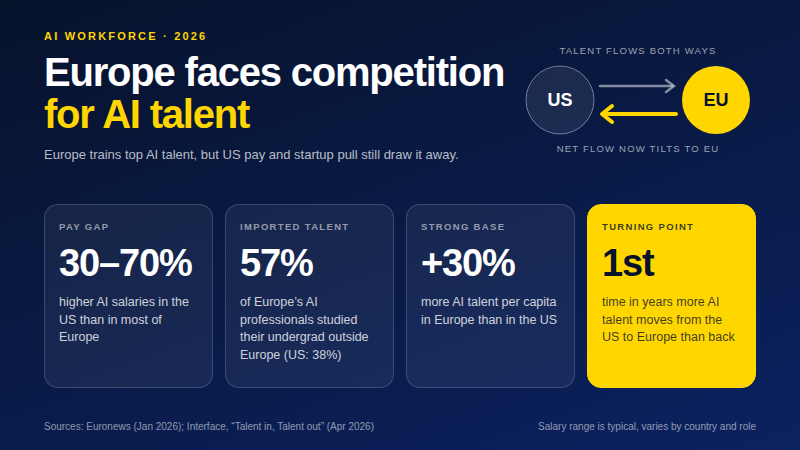
Europe has excellent universities and research institutions that produce skilled AI professionals. However, many researchers and engineers also have opportunities to work for major technology companies in the United States and other global markets.
These companies can offer competitive salaries, advanced computing resources and access to large research projects. European startups may struggle to match these opportunities.
Steps Europe can take:
- Expand AI education and technical training.
- Support university research teams launching startups.
- Attract international AI researchers.
- Help European companies retain experienced employees.
- Build stronger connections between universities and industry.
Keeping skilled professionals in Europe is important for developing new AI products and building competitive companies.
6. Europe Must Turn Research into Successful Products
European universities and research centres contribute to AI research, including machine learning, computer vision and robotics. However, research breakthroughs do not always become successful commercial products.
Turning research into a business requires funding, product development, marketing and access to customers. Without these resources, promising technologies may remain within research institutions instead of reaching the market.
Europe should strengthen partnerships between universities, investors and established businesses. It should also provide more support for researchers who want to create companies and commercialise their inventions.
7. Where Europe Can Still Win in AI
Europe does not need to dominate every part of AI to become a global leader. It can focus on industries where it already has strong expertise and established customers.
Industrial AI and robotics
AI-powered robots, factory automation and predictive maintenance can improve productivity across Europe's manufacturing sector.
Healthcare and biotechnology
AI can support drug discovery, medical research and healthcare workflows.
Cybersecurity and enterprise AI
Businesses need secure AI tools that protect sensitive information and support important operations.
Climate and energy technology
AI can improve renewable energy forecasting, electricity grids and energy efficiency.
These sectors offer opportunities for European startups to develop specialised products and compete internationally.
8. What Must Europe Do to Catch Up?
Europe needs a coordinated strategy involving governments, investors, universities and businesses.
| Priority | Required action | Expected benefit |
| Funding | Attract more private and public investment | Helps startups grow |
| Infrastructure | Expand computing capacity and data centres | Supports AI development |
| Talent | Train and retain AI professionals | Strengthens innovation |
| Regulation | Simplify guidance and improve consistency | Reduces unnecessary burdens |
| Collaboration | Connect universities and businesses | Turns research into products |
| Market access | Reduce barriers to cross-border expansion | Helps companies reach more customers |
European initiatives such as InvestAI and plans for AI Gigafactories aim to strengthen AI investment and computing infrastructure. Their long-term impact will depend on implementation and the ability to attract private investment.
Conclusion
Europe is falling behind in parts of the AI race because it has struggled to match the investment, computing infrastructure and commercial scale of its strongest competitors. Fragmented markets, talent competition and difficulties turning research into successful products add to the challenge.
However, Europe still has valuable advantages, including strong research institutions, skilled professionals and established industrial sectors.
By increasing investment, improving access to computing power, supporting startups and making it easier to commercialise research, Europe can strengthen its position in the global AI industry. Its future success will depend on turning its research and technical expertise into products that businesses and consumers worldwide want to use.
FAQs
Why is Europe falling behind in AI?
Can Europe compete with the US and China in AI?
What is Europe's biggest AI challenge?
Which AI sectors offer opportunities in Europe?
What should Europe do to become an AI leader?
Recommended Stories for You


Team SR Jun 30, 2025

Oliver Bennett Sep 21, 2026

Team SR Jan 6, 2025

Oliver Bennett Dec 4, 2025
Kailee Rainse Dec 28, 2024
Trending Stories

Best Platforms for Startup Promotion
Best Startups In Europe 2024

Top Student Startup in Europe

Best Venture Capital Firms London 2024

The Top Disruptar brand, Revolutionizing the European
Business Credit Cards For Startups
Startups Hit €200 Million+ in 2024 Funding Report

List of European Ecommerce Unicorn