

10 Innovative Healthcare and Biotech Companies Across Europe to Watch
Nov 18, 2026 | By Oliver Bennett
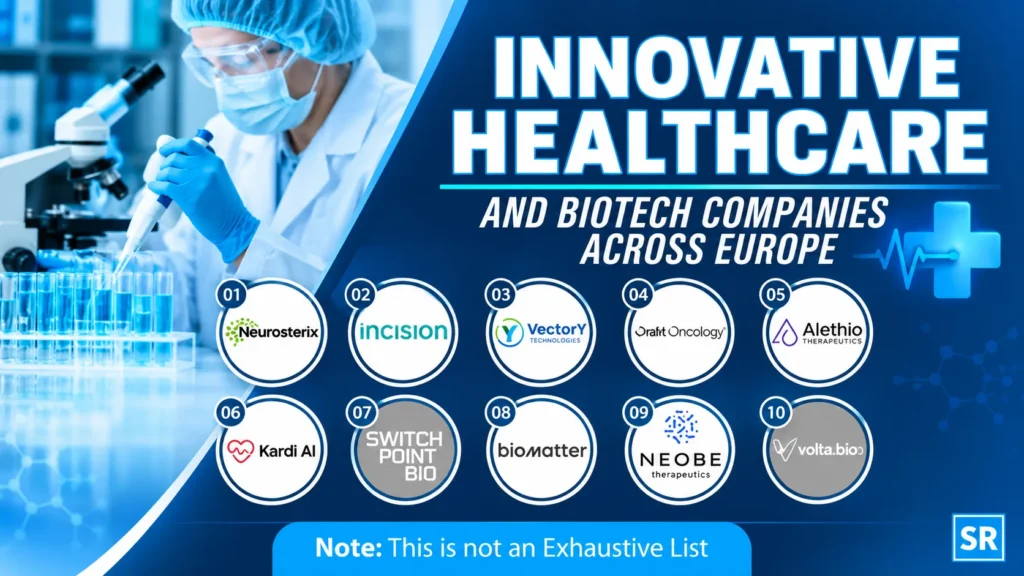
Europe is home to many startups working to improve healthcare through new technologies and scientific research. These companies are developing new medicines, medical devices, digital health platforms and other solutions to address healthcare challenges.
 Follow us
 Follow us
Some startups are using artificial intelligence (AI) to support drug discovery, while others are developing better ways to monitor heart health, study cancer and understand brain diseases. Their work covers different areas, including biotechnology, medical research, surgical training and healthcare technology.
By combining science with modern technology, these companies aim to make healthcare better for patients, doctors, hospitals and pharmaceutical businesses.
Here are 10 innovative healthcare and biotech companies across Europe that are developing new solutions for the healthcare industry.
RECOMMENDED FOR YOU

1. Neurosterix
Neurosterix is a biotechnology company based in Geneva, Switzerland. It focuses on developing new medicines for brain and mental health conditions, including schizophrenia, psychosis, mood disorders and anxiety.
The company uses a research method called allosteric modulation. This approach works by adjusting how certain receptors in the brain respond to chemical signals. The aim is to develop medicines that work more precisely and may offer better treatment options.
Neurosterix is researching new therapies that could improve brain function and address some of the problems with existing medicines.
The company aims to help people who do not get enough benefit from current treatments. Its work focuses on finding new ways to treat different neurological and psychiatric conditions.
2. Incision
Incision is a healthcare technology company based in the Netherlands. It focuses on improving surgical training and helping medical teams prepare for operations.
The company develops digital learning tools that help doctors and other healthcare professionals improve their surgical knowledge and skills. Its educational content covers surgical techniques, medical equipment and human anatomy.
One of its main products is Incision Academy. It provides online courses, videos and interactive 3D models that help medical professionals learn about different surgical procedures.
Incision also offers digital tools that help operating room teams prepare for surgeries and understand what is needed for each procedure.
Through these services, the company aims to make surgical training easier to access and help hospitals improve the knowledge and skills of their medical teams.
3. VectorY Therapeutics
Amsterdam-based VectorY Therapeutics is developing new treatments for diseases that affect the brain and nervous system. These conditions can affect a person's movement, memory and other important body functions.
The company focuses on developing antibody-based treatments that can target harmful proteins linked to these diseases. Its technology is designed to help deliver these treatments to the right places inside cells.
VectorY is working on potential treatments for conditions such as ALS, Huntington's disease and Parkinson's disease.
One of its research programmes, VTx-002, aims to target problems linked to a protein called TDP-43, which is associated with ALS.
The company wants to develop treatments that could slow down or change how these diseases progress, rather than only treating their symptoms.
4. Orakl Oncology
French biotechnology company Orakl Oncology uses artificial intelligence and biological research to support cancer drug development.
The company has developed a platform that combines AI with laboratory-grown models of cancer tissue. These models, known as tumour organoids, are created using patient samples and help researchers study how cancer cells respond to different medicines.
This research helps scientists understand why treatments may work for some patients but not for others.
Orakl Oncology also studies genetic, clinical and biological data to identify possible drug targets and help pharmaceutical companies test new treatment ideas.
The company's goal is to make cancer research more effective by using models that better represent how cancer behaves in the human body.
Its technology could support the development of more targeted cancer treatments and help researchers make better decisions when developing new medicines.
5. Alethio Therapeutics
Alethio Therapeutics is a UK biotechnology company that started as a spinout from the University of Oxford. It focuses on developing new treatments for a group of blood cancers known as myeloproliferative neoplasms (MPNs).
These diseases affect the bone marrow and cause the body to produce abnormal numbers of blood cells.
Many existing treatments help control the symptoms, but they may not address the main causes of the disease. Alethio wants to develop medicines that can have a greater effect on how these conditions develop.
The company uses biological research, patient data and machine learning to find new treatment targets.
Its main research programme, ATX-011, is developing an antibody-based treatment that targets a protein called G6B. This protein is linked to the development of abnormal blood cells.
Alethio is also researching another treatment programme focused on diseases linked to mutant calreticulin.
Through its research, the company aims to develop better treatment options for people living with these blood cancers.
6. Kardi Ai
Kardi Ai is a medical technology company from the Czech Republic. It develops AI-powered tools that help people and healthcare professionals monitor heart health.
Its solution combines a chest strap that records ECG signals, a mobile app and AI technology that analyses heart activity.
The system allows users to track their heart rhythm over longer periods. This can help identify unusual heart activity that may not be noticed during a short medical check-up.
Users can also share their monitoring information with healthcare professionals. This gives doctors additional data that may help them decide whether further tests or medical care are needed.
Kardi Ai is also working on technology that can estimate the risk of certain heart rhythm problems.
The company aims to make heart monitoring easier and more accessible while helping doctors identify possible heart problems earlier.
7. Switchpoint Bio
Switchpoint Bio is a biotechnology company working across Helsinki and Boston. It uses epigenomics and artificial intelligence to help researchers better understand diseases.
Epigenomics is the study of changes that affect how genes work without changing a person's DNA sequence. These changes can provide useful information about diseases and how the body responds to treatments.
Switchpoint Bio studies biological signals, including DNA methylation patterns found in blood samples. Its technology aims to identify biomarkers that can help researchers understand disease activity and how patients may respond to medicines.
The company also works on patient grouping, which helps researchers identify people who may respond differently to the same treatment.
Its technology is designed to support pharmaceutical companies and researchers during drug development and clinical studies.
8. Biomatter
Biomatter is a biotechnology company from Lithuania that uses artificial intelligence to design new enzymes.
Enzymes are proteins that help speed up chemical reactions in living organisms. They are used in several industries, including pharmaceuticals, food production, agriculture and medical testing.
Developing new enzymes can take a long time because scientists often need to test many different designs. Biomatter uses AI and scientific data to make this process faster and develop enzymes for specific needs.
Its technology helps businesses create customised enzymes when naturally available options do not perform as required.
The company has worked with organisations across different industries. According to information published by the company and its partners, it has developed more than 50 customised enzymes for over 25 customers.
Biomatter shows how AI can support biotechnology research and help businesses develop new products using biological processes.
9. Neobe Therapeutics
UK-based Neobe Therapeutics is working on new approaches to cancer treatment, with a particular focus on solid tumours.
The company is developing a technology that uses specially engineered microorganisms to interact with the area around cancer cells.
This area is known as the tumour microenvironment. It can make it difficult for the body's immune system to recognise and attack cancer cells. It can also reduce the effectiveness of some cancer treatments.
Neobe is developing programmable microorganisms that aim to change this environment and make tumours more responsive to treatments that use the immune system.
The company hopes its technology could help improve treatment options for patients who do not respond well to existing immunotherapy.
Its work combines synthetic biology and cancer research to explore new ways of treating solid tumours.
10. Vale Bio Labs
Vale Bio Labs works in biotechnology, brain research and data science. The company focuses on understanding how human brain tissue changes over time and how it responds to different medicines.
It develops laboratory-grown brain models called organoids. These are small models that reproduce some features of human brain tissue.
Researchers can use these models to study brain development, ageing and diseases. They can also test how different medicines affect brain tissue.
Vale uses imaging, measurements of brain activity and molecular research to collect information from these models. It then uses this data to develop computer models that can help predict how potential medicines may work.
The company focuses on areas such as brain development, neurodegenerative diseases and overall brain health.
Its technology aims to give researchers a better understanding of the brain and help them study new treatments before moving to clinical testing.
The Growing Role of Healthcare and Biotech Innovation in Europe
These 10 companies show how startups across Europe are using science and technology to address different healthcare challenges.
Some are developing potential treatments for brain diseases and cancer, while others are using AI to improve heart monitoring, drug discovery and biological research. Companies such as Incision are also making medical training more accessible through digital learning tools.
Artificial intelligence is playing an increasingly important role in healthcare and biotechnology. It helps researchers study large amounts of data, find possible drug targets and design new biological products. At the same time, wearable devices and digital health platforms are giving people and doctors new ways to monitor health.
However, developing a new medicine or medical technology takes time. Companies must carry out research, testing and clinical studies where needed. They also need to meet regulatory requirements before many new products can be used in everyday healthcare.
Despite these challenges, European healthcare and biotech startups are exploring new ideas that could improve medical research and patient care.
As technology and scientific research continue to develop, these companies will be part of the wider effort to find better treatments, improve disease detection and make healthcare more effective.
Recommended Stories for You

Kailee Rainse Jun 28, 2025
Kailee Rainse Nov 7, 2024

Oracle Share Price: How AI, Cloud Growth and Rising Data Center Spending Are Shaping ORCL
Olivia James Oct 2, 2026
Kailee Rainse Nov 26, 2024

Oliver Bennett Oct 19, 2026

Oliver Bennett Oct 26, 2026
Trending Stories

Leading AI Startup in Europe

Grants From The Government To Start A Business

Unique Business Ideas in Luxembourg
Best Startup Industries In 2024 – 2025

Unique Business Ideas In Amsterdam For 2024
Best AI Content Detector Tools

Best Small Scale Business Ideas in France 2024

Series A Funding NEWS Europe – July 2024