

Oracle Share Price: How AI, Cloud Growth and Rising Data Center Spending Are Shaping ORCL
Oct 2, 2026 | By Olivia James

 Follow us
 Follow us
Oracle has become one of the biggest technology companies to watch as demand for cloud computing and artificial intelligence (AI) continues to increase. The company is best known for its database and business software, but it is now investing heavily in cloud services and data centers to support companies using AI.
As of October 1, 2026, Oracle shares were trading at around $138.07. The stock has moved sharply over the past year as investors have responded to Oracle’s fast-growing cloud business, major AI contracts, and higher spending on infrastructure.
Oracle Share Price Today
Oracle is listed on the New York Stock Exchange under the ticker ORCL. The company currently has a market value of more than $400 billion.
Oracle’s business has changed significantly in recent years. It is no longer focused only on traditional database and enterprise software. Its cloud infrastructure business is becoming a major part of the company and has also given Oracle a growing role in the AI infrastructure market.
However, expanding this business requires a lot of money. Oracle is spending billions of dollars on data centers and computing equipment. Investors are therefore watching how well the company can turn this spending into higher revenue and cash flow.
Strong Growth in Oracle’s Cloud Business
Oracle’s latest financial results show why its cloud business is so important.
In the first quarter of fiscal 2027, Oracle reported $19.3 billion in revenue, up 30% from the same quarter a year earlier. Total cloud revenue increased 62% to $11.6 billion.
Oracle Cloud Infrastructure, also known as OCI, was one of the fastest-growing parts of the company. Revenue from OCI increased 121% to $7.4 billion during the quarter.
Oracle’s cloud applications business also grew. Revenue from cloud applications increased 10% to $4.2 billion.
These numbers show that more customers are using Oracle’s cloud services, especially as businesses need more computing power for AI applications.
AI Is Becoming Important for Oracle
AI is changing the cloud computing market, and Oracle is investing heavily to take advantage of this growth.
AI companies need huge amounts of computing power to train and run their AI models. Many companies choose to rent this computing capacity from cloud providers rather than build their own infrastructure.
Oracle is expanding its data center network to meet this demand. During the first quarter of fiscal 2027, the company added 850 megawatts of new data center capacity.
This expansion is important because Oracle needs enough infrastructure to support the large contracts it has signed with customers.
The company’s remaining performance obligations, or RPO, have also increased significantly, reaching $664 billion.
What Does Oracle’s $664 Billion RPO Mean?
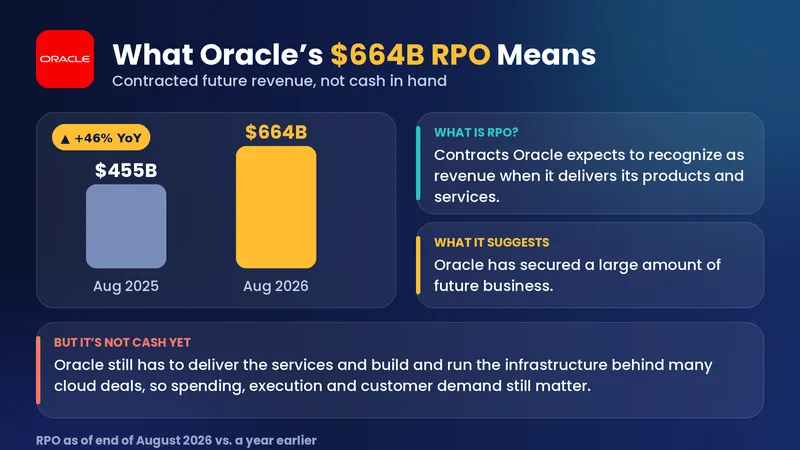
RPO refers to money from contracts that Oracle expects to recognize as revenue in the future when it provides its products and services.
Oracle reported $664 billion in RPO at the end of August 2026, compared with $455 billion a year earlier.
The increase suggests that Oracle has secured a large amount of future business. However, RPO should not be treated as money Oracle already has. The company still needs to deliver the services covered by those contracts.
Oracle also needs to build and operate the infrastructure required to fulfill many of its cloud agreements. This means spending, execution, and customer demand will remain important.
Oracle Is Spending Billions on Data Centers
One of the biggest things investors are watching is Oracle’s rising spending on infrastructure.
The company spent around $28.5 billion on capital expenditures in the first quarter of fiscal 2027. That was much higher than the $8.5 billion spent during the same period a year earlier.
A large part of this money is being used to build and expand data centers and provide the infrastructure needed for cloud and AI services.
This spending can help Oracle grow in the future, but it can also reduce the amount of cash the company has available in the short term.
Oracle’s fiscal 2026 results highlight this point. The company generated around $32 billion in operating cash flow, but free cash flow was negative $23.7 billion, mainly because of its heavy infrastructure spending.
Oracle’s Key Financial Metrics
RECOMMENDED FOR YOU



| Metric | Latest Figure | Previous/Comparison |
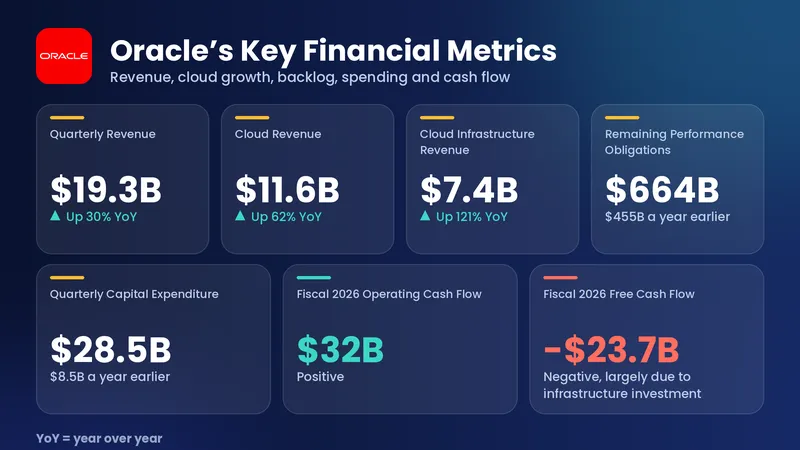
| Quarterly Revenue | $19.3B | Up 30% year over year |
| Cloud Revenue | $11.6B | Up 62% year over year |
| Cloud Infrastructure Revenue | $7.4B | Up 121% year over year |
| Remaining Performance Obligations | $664B | $455B a year earlier |
| Quarterly Capital Expenditure | $28.5B | $8.5B a year earlier |
| Fiscal 2026 Operating Cash Flow | $32B | Positive |
| Fiscal 2026 Free Cash Flow | -$23.7B | Negative, largely due to infrastructure investment |
The figures show two sides of Oracle’s current growth story. Cloud and AI-related revenue are growing quickly, while the company is also spending heavily to build the infrastructure needed to support that growth.
For investors, this means Oracle’s revenue growth is only one part of the story. They also need to watch whether the company can eventually generate strong cash flow from these investments.
Why Oracle Shares Can Move Sharply
Several factors can affect Oracle’s share price.
One of the biggest is cloud infrastructure growth. Strong OCI growth can increase expectations for future revenue.
AI demand is another important factor. If businesses continue spending heavily on AI computing, Oracle could see more demand for its cloud infrastructure.
Capital spending also matters. Investors may pay close attention when Oracle increases its spending because they want to know how quickly the company can earn money from its new data centers.
Large customer contracts are another factor. New agreements can increase Oracle’s future revenue pipeline and RPO.
The company’s financing needs are also becoming more important. Building data centers and AI infrastructure requires significant amounts of money, making debt, financing costs, and cash generation important areas to monitor.
Oracle’s Role in the AI Infrastructure Market
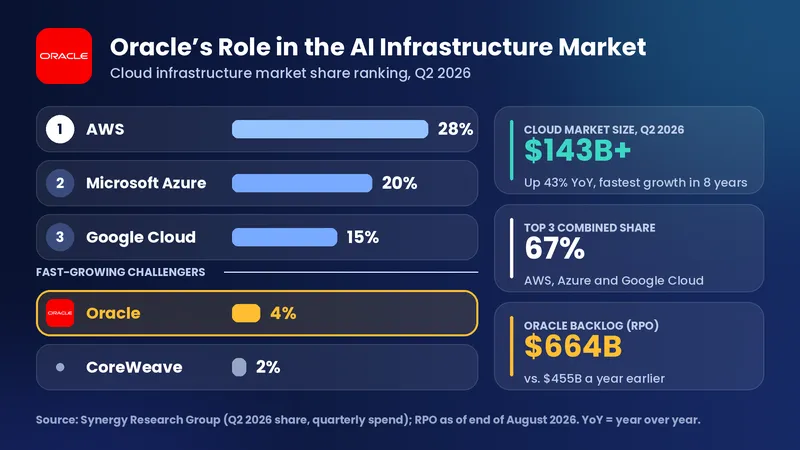
Oracle has a different role in the AI industry compared with companies that build AI models or manufacture chips.
Instead, Oracle provides cloud and computing infrastructure that AI companies and other businesses can use.
This places Oracle within a much larger AI infrastructure market that includes data centers, GPUs, cloud computing, networking equipment, and electricity.
The growing demand for AI creates an opportunity for Oracle, but the company also needs to make sure its infrastructure investments generate enough business to justify their cost.
Oracle’s relationships with large AI customers have also attracted more attention from investors. The focus is increasingly on whether these large contracts can turn into steady revenue while the company manages its spending.
What to Watch in Oracle’s Next Earnings Results
There are several important numbers investors can watch in Oracle’s upcoming financial results.
Cloud infrastructure revenue will be one of the main figures. Continued growth in OCI would show that demand for Oracle’s cloud services remains strong.
Capital expenditure will also be important. Investors will want to see how much Oracle is spending on new data centers and other infrastructure.
Free cash flow is another key number. As Oracle’s cloud business grows, investors will be watching whether the company can improve its cash generation.
The company’s RPO will also provide information about future business. However, investors will need to consider how quickly these contracts turn into actual revenue.
Final Thoughts on Oracle Share Price
Oracle is going through a major change as it expands beyond its traditional database and enterprise software business.
Cloud computing and AI are now becoming major parts of its growth strategy. The company is seeing strong cloud growth and has signed large customer contracts that could support future revenue.
At the same time, Oracle is spending huge amounts of money on data centers and computing infrastructure. This makes cash flow and the return on these investments important issues to watch.
For anyone researching the Oracle share price, looking at the stock price alone does not tell the full story. Cloud growth, AI demand, RPO, capital spending, and free cash flow all provide useful information about the company’s financial position and growth strategy.
The coming quarters will show how effectively Oracle can turn growing demand for AI and cloud services into higher revenue and stronger cash generation, while managing the costs of its rapid expansion.
Recommended Stories for You

Oliver Bennett Nov 1, 2023

Team SR Oct 6, 2024

Oliver Bennett Sep 23, 2026

Oliver Bennett Oct 15, 2024

Team SR Jun 30, 2024

Oliver Bennett Oct 1, 2026
Trending Stories

Best Startups In Europe 2024
Top Student Startup in Europe

Best Venture Capital Firms London 2024

The Top Disruptar brand, Revolutionizing the European

Business Credit Cards For Startups

Startups Hit €200 Million+ in 2024 Funding Report

Unique Business Ideas In Marseille For 2024

Startup Ecosystem Of Netherlands