

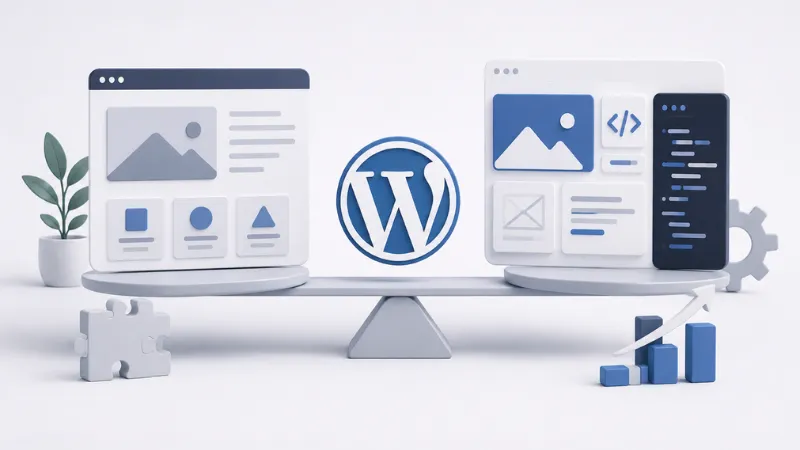
Startups have a good reason to like WordPress templates. They’re quick to install, relatively cheap, and can turn a rough idea into a working website without months of development.
 Follow us
 Follow us
At an early stage, that can be exactly what the business needs. The problem is that the website a startup needs at launch may look nothing like the one it needs after two funding rounds, several product launches, and a sharp increase in traffic.
So the useful comparison isn't really custom versus template on day one. It's what happens to each option once the company starts growing.
Templates Are Good at Getting You Moving
A quality WordPress theme can remove a lot of early work. Navigation is already designed, common page types exist, mobile layouts are handled, and there may be dozens of components available for landing pages.
RECOMMENDED FOR YOU

How Early-Stage Startups Collect First Revenue Without a Custom Billing Stack
Team SR
Sep 8, 2026


For a small team testing positioning or launching an MVP, paying for custom development before the business knows what it needs can be difficult to justify.
Templates become less convenient, though, as requirements move away from what their developers anticipated.
A pricing page needs unusual functionality. The CRM requires a deeper integration. Marketing wants reusable landing page components that don't quite match the page builder. Developers start overriding theme behavior instead of building features directly.
None of those changes seems particularly serious on its own. Put enough of them together and the original shortcut starts creating work.
Growth Has a Habit of Exposing Old Decisions
Startup traffic is rarely predictable.
A company can spend months attracting modest numbers of visitors and then suddenly get featured in a major publication, announce funding, launch on a large platform, or run a campaign that performs far better than expected.
That is a fairly bad time to discover that the homepage is loading scripts from features nobody uses.
Template-based websites often carry code intended to support hundreds of possible configurations. The actual site might use ten of them. Visitors still end up paying part of the performance cost for that flexibility.
A custom build can take the opposite approach: ship what the website needs and leave the rest out.
The Publishing Experience Matters Too
Custom development sometimes gets mistaken for a website that only developers can change.
It shouldn't work that way.
Custom Gutenberg blocks can give marketing teams considerable freedom without handing them an empty canvas on every page. A startup might have dedicated blocks for customer stories, product comparisons, feature sections, pricing tables, calls to action, or integrations.
Editors combine those pieces while the design rules stay inside the components themselves.
That's useful as the marketing team expands. A new employee doesn't need to know which font size, margin, or button style was used on a page six months ago. The block already knows.
The Real Question Appears at Scale
For a startup weighing a template theme against a custom WordPress build, the decision rarely bites on launch day; it bites at the scale where a template's ceiling forces a rebuild the team cannot afford. Custom versus template is really a question of which foundation survives growth, large-scale migrations, and the traffic a breakout moment brings. Working from that premise, IT Monks builds WordPress sites from scratch with custom Gutenberg design that holds up under high-traffic conditions, engineering the front-end to scale from the first line of code.
That distinction becomes especially relevant when the website stops being a company brochure.
Once it is connected to a CRM, analytics platform, recruitment system, product database, localization workflow, or customer portal, replacing it becomes a much bigger job. A redesign is one thing. Migrating years of content and integrations because the original architecture has reached its limit is another.
Performance Debt Is Still Debt
Technical debt isn't always broken code. Sometimes it's a collection of perfectly functional features that make everything else harder.
A page builder loads an extra library. A plugin exists because the theme couldn't handle one requirement. Another plugin fixes a problem introduced by the first one. A developer adds custom CSS to override a component that wasn't designed for the new layout.
The site continues working, so none of this feels urgent.
Then Core Web Vitals begin slipping or a campaign page takes noticeably longer to render. Fixing performance at that stage can mean tracing dependencies through several layers of software the startup never chose intentionally.
With a custom build, performance decisions can happen much earlier, when they're cheaper to make.
Custom Isn't Automatically the Better Choice
There are still plenty of cases where a template makes sense.
A startup validating an idea may not know whether its current website will exist in twelve months. Spending heavily on infrastructure for a hypothetical scale isn't necessarily good planning.
The calculation changes once the website has a clearer role in acquisition, sales, hiring, or customer communication.
At that point, the cost of the platform should be compared with the cost of replacing it later, not simply with the price of a theme today.
Build for the Stage You're Entering
Startups don't need enterprise architecture simply because they hope to become enterprises.
They do need to recognize when they've moved beyond the temporary setup that helped them get started.
A template can be an excellent launch vehicle. A custom WordPress build becomes more compelling when the company knows its design system, publishing needs, integrations, and growth expectations well enough to build around them.
The important part is recognizing that transition before the existing website makes the decision for you.
Recommended Stories for You

Team SR Aug 21, 2026


Team SR Aug 13, 2026

Team SR Jun 1, 2026

Team SR Jun 2, 2026

Team SR Nov 19, 2025
Trending Stories

What Free Really Means When You Register an LLC: State Fees, Service Fees, and First-Year Tools

From First Apartment to Graduation: What Students Need From a Boston Property Manager

A Startup Founder’s Guide to Choosing the Right Digital Growth Channels

Technical Applications for Modernizing Oil and Gas

How to Choose a Nonprofit Board Seat That Fits Your Life, Not Just Your Calendar

The Business Behind The Job: What Customers Never See In A Construction Company

Winning New Customers: How FinTech Startups Can Stand Out In A Competitive Market
From Spreadsheet to WhatsApp: Smarter Follow-Up for Growing Teams