
Before the First Photoshoot: What Startups Should Prototype and What They Must Prove
Oct 11, 2026 | By Sophie Carter
 Follow us
 Follow us
A founder is preparing a landing page for a product that has not shipped. The photographer asks for a finished sample, but the sample is still being redesigned. Investors want to understand the idea, and prospective customers need something more concrete than a paragraph. This is where visual prototyping can help, provided the team does not confuse a possible future appearance with a working product. Services such as Kimg AI offer ways to explore generated or edited visuals. The difficult decision is not whether to make an image, but what that image may honestly claim.
Decide What the Image Is Supposed to Prove
A pitch-deck image and an online shop photograph may look similar, yet readers interpret them differently. A concept rendering explains a design direction. A photograph of an actual sample shows an object that physically exists. A demonstration clip suggests behavior that a product can perform. Founders should never let these categories blur simply because the resulting slide looks polished.
Consider a startup designing a folding desk lamp. Before manufacturing, it can illustrate possible colors and how the lamp might fit on a shelf. It cannot present an invented hinge mechanism as proof that the prototype folds safely. The claim determines the standard of evidence.
A useful rule is to write a label before choosing the graphic: “Design concept,” “Photograph of prototype,” or “Recorded product demonstration.” If the team cannot select the right label, the image probably needs further explanation or a more suitable source.
Put Each Visual in the Right Bucket
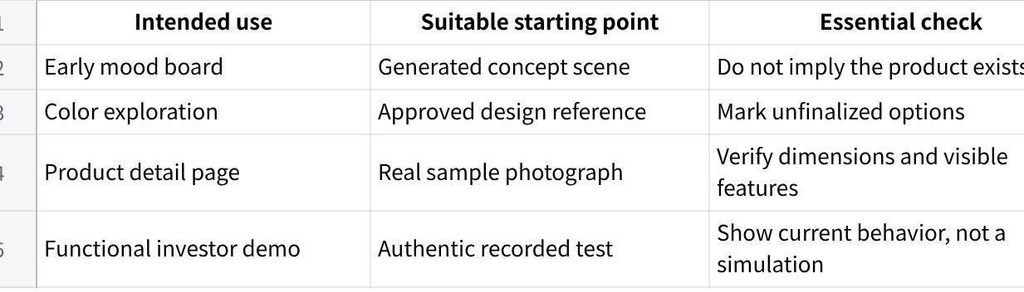
Instead of asking whether AI can replace a photoshoot, divide planned assets by how much factual accuracy they require. A founder can work through the following decision table before spending time on any draft.
RECOMMENDED FOR YOU



点击图片可查看完整电子表格
This is not a ranking from cheap to expensive. It separates persuasion from evidence. A single page may legitimately use several categories, as long as readers can distinguish them. If a startup has no finished hardware, it can still explain the vision clearly. What it should not do is use a polished render to answer an engineering question that remains unresolved.
Run Three Checks Before Commissioning Final Photography
The best visual experiment is small enough to teach the founder something. For an imaginary desk-lamp startup, three checks can clarify what to photograph later. Do these checks with colleagues or a few people who resemble the intended buyers. Ask them to explain what they see in their own words. The goal is to discover misunderstandings early, not collect compliments.
1. Test Whether People Understand the Use Case
Show potential customers an ordinary scene of a small desk beside a bed. Ask what problem the picture suggests, without giving them a product description first. Do they mention limited space, nighttime reading, or something unrelated? Their answer helps decide which setting belongs in a later shoot. Avoid asking only whether the picture looks attractive; that reveals little about what the viewer understood.
2. Compare One Presentation Choice at a Time
Try a minimal background and a lived-in room while keeping the product concept and headline constant. Ask which version makes its intended location clearer. Do not change the color, angle, message, and audience at once. If everything changes, feedback will not tell you why one version worked better. Save both versions and the question used to evaluate them for the next review.
3. Identify What Still Needs Real Proof
Write down every claim a concept image cannot establish. For the lamp, that could include brightness, battery life, hinge strength, and real dimensions. Plan separate tests or photography around these points. A rendering can guide what to shoot, but it cannot supply performance data. This list also prevents an early illustration from quietly becoming a factual sales image when the company updates its website.
Use Image References to Narrow the Guesswork
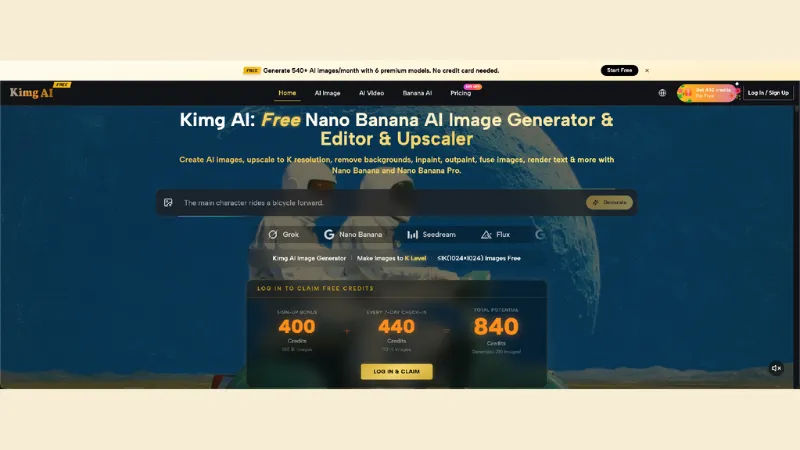
A founder starting from a real sketch can usually give better direction than someone typing “premium modern product.” The platform's website describes text-prompt image generation, uploading source images for editing, and several supported models. Its Nano Banana AI description specifically includes reference-image transformations and style changes. For startup teams, that can make sense for exploring presentation choices before final product photography.
Imagine uploading an approved illustration of the lamp, then requesting an alternative room setting while keeping the silhouette intact. The result may help a team discuss audience and context. It still needs checking against the approved design, because generated changes can alter physical details.
Store a simple note with each test image: original source, intended audience, transformation requested, and items that remain unverified. When a designer or photographer takes over, that note is more valuable than a folder full of attractive pictures with no explanation.
Treat Pitch Decks Differently From Sales Pages
In a pitch deck, a labeled concept image may be useful beside the market problem or proposed design. It gives a discussion a visual anchor. But when the conversation turns to technical readiness, traction, or manufacturing, a founder needs supporting evidence of those claims rather than more decorative art.
On a sales page, the audience expects stronger alignment between image and delivered item. If buyers are selecting a particular finish, size, or accessory, visuals must describe what they will actually receive. Generated scenes that resemble finalized product photography may create confusion, especially when the wording does not disclose their illustrative nature.
Keep separate folders for concept work and verified product media. Review captions when moving any asset from one context to another. A slide marked “proposed design” should not become an unlabeled product listing by accident. Before publishing any sales image, compare it with the latest approved specification rather than an outdated rendering.
Make the Professional Handoff More Specific
Early image experiments are most useful when they reduce uncertainty for the people doing final production. A photographer needs to know whether a shot must emphasize a control button, physical scale, or the way a product sits in a room. An illustrator needs approved shapes and a list of features that cannot change.
A compact brief can include the target audience, desired setting, essential details, prohibited alterations, and where the finished image will appear. Add examples of earlier concepts, but mark them as references rather than final specifications.
This process also helps with internal disagreements. If the founder prefers a dramatic lifestyle image and the sales lead wants a close-up of the real sample, both may be right for different uses. Naming the question each visual must answer lets the team commission both deliberately rather than arguing about a single “best” picture.
Conclusion
Visual prototyping can help a startup explain an unfinished idea, but clarity depends on separating possibility from proof. Concept scenes are suitable for exploring settings and presentation. Real product photographs and tested demonstrations are necessary when a claim depends on physical facts. Start by labeling the purpose of each visual, then identify what still needs verification before publication. For your next launch page or pitch deck, audit just three images and ask whether each one says exactly what the business can currently support. Use that answer to guide the next visual investment.
Recommended Stories for You

Team SR Apr 16, 2026

Team SR Jul 14, 2026

Team SR Sep 28, 2026

Team SR Jul 3, 2026

Team SR Mar 31, 2026

Team SR May 5, 2026
Trending Stories
Credit Math For An AI Map Generator On Seed Budget
5 technical choices that make the difference between growth and stagnation

Is Gamification as a Service the Next Major Battleground for Startups?

Top 10 Backlink Agencies Businesses Trust for Real Authority
Are Working Students the Quietest Demographic Relying on the Essay Writing Service EssayService.com?

Why UK Startups Need Better Access to Legal Documents as They Scale

How Local Taxi Services Help Keep Highland Tourism Moving

What to Know Before Adding Battery Storage to Your Home