

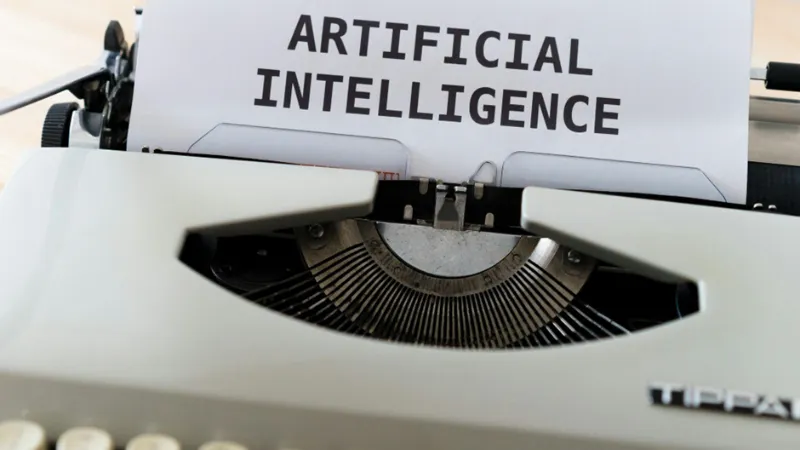
Creative work is entering a new era. The boundaries between imagination and execution are dissolving as artificial intelligence becomes a quiet co-creator in writing and interactive media. Instead of requiring several teams and years to create, it can now start with an idea and a responsive digital partner ready to bring it to life. However, speed is not the only revolution but creativity itself. AI is beginning to reshape how concepts are formed and connected, expanding the very definition of creativity.
 Follow us
 Follow us
AI-powered foundations for new creative workflows
In this emerging landscape, creative tools no longer serve only as digital workspaces. They are evolving into adaptive ecosystems that understand style and emotional tone. In this shift, even foundational services like ai software development service are influencing how creators build flexible, intelligent environments tailored to personal workflows and artistic goals.
The rise of living drafts
Instead of static files, content is transformed into “living drafts”, documents, videos, or designs that continue to evolve as ideas shift. Writers can reshape story arcs simply by adjusting thematic sliders. Video editors can request entirely new angles from virtual lenses. Designers can experiment with several color directions without rebuilding anything from scratch.
These tools do not replace creative judgment; they extend it. A living draft becomes a conversation between creator and system, enabling quick leaps between directions that once required starting over. This flexibility leads to bolder experimentation because the cost of changing one’s mind becomes almost zero.
RECOMMENDED FOR YOU


Multi-modal story engines
AI is also pushing storytelling far beyond text. Narrative engines now blend writing and movement as if they were threads of the same fabric. A single prompt can generate a story world with ambient audio, character sketches, or animated sequences, all aligned in tone.
Creators can shift the mood of a scene, and the system will reshuffle lighting and soundscapes. The result is a more cinematic and sensory approach to content development, available even to those without technical training.
Infinite concept exploration
Idea generation tools are being redesigned to explore concepts in nonlinear ways. Instead of producing variations too similar to the original, new models map out distant creative territories, ideas that branch into unexpected themes or genres.
This allows brands and studios to uncover directions that human brainstorming alone might overlook. Entire campaigns or visual identities can begin with a single spark, then expand through generated ecosystems of styles and emotional frameworks.
How AI enhances collaboration across creative fields
Real-time poly-creator workflows
Collaborative creation traditionally requires time-consuming syncing and feedback loops. AI is dissolving these barriers with real-time multi-creator spaces.
Writers and illustrators can now work inside the same adaptive canvas. The system keeps everything aligned and in style, while offering contextual suggestions tailored to each craft. Instead of waiting for drafts, creators see updates emerge instantly as teammates adjust their pieces.
This does more than improve efficiency. It nurtures richer creative chemistry because teams can build on each other’s ideas at the exact moment inspiration strikes.
Universal translation for creative media
Language and software knowledge are fading. AI enables creators to work in everyday language while the system translates instructions into professional-grade outputs.
A musician without animation experience can describe how a melody “moves,” and the tool can generate a synchronized visual sequence. A designer can outline a concept verbally, and the system produces early layouts. These tools democratize expression, giving more people the opportunity to participate in creative spaces once limited by technical entry requirements.
Dynamic audience feedback engines
AI is also changing how creators understand their audiences. Instead of static analytics, dynamic feedback engines simulate how different audience groups might react to tone shifts, pacing choices, or design styles.
This allows creators to test variations of content early in the process, reducing guesswork and aligning intuition with actionable insight. It does not turn creativity into a formula; it helps creators take smarter risks with confidence.
New domains emerging from AI-driven creativity
Adaptive sound and atmosphere creation
AI-generated audio is moving far beyond background tracks. Modern systems can interpret emotion and narrative structure to craft soundscapes that evolve in real time.
Interactive experiences and immersive theater will benefit most. As users explore, the sound adapts to their choices and intensity like a living organism. Sound design becomes a dynamic force that shapes the experience moment by moment.
Generative cinematography
Visual tools are gaining the ability to simulate lenses and camera motions that mirror real-world cinematography. Whole scenes can be digitally reshoot without physically reshooting.
The creators can request the shadows to be softened or the angles to be wider, and the system changes each frame. This opens up new possibilities in visual narratives in which mood can be as changeable as imagination.
The rise of thought-driven prototyping
Prototyping is becoming fast enough to function as active thinking. Creators can test dozens of visual or narrative directions in minutes. Such a combination of ideation and execution promotes experimentation with ideas that would otherwise seem too costly or time-consuming to try.
The experimentation process is the essence of creativity, and not a minor component of it.
AI prototyping services help businesses quickly turn artificial intelligence ideas into working models or proof-of-concept solutions. These services focus on rapidly designing, building, and testing AI-driven prototypes using real or sample data, allowing teams to validate feasibility, performance, and business value before making large investments.
Final thoughts
AI is not reshaping creative work by automating tasks, but is expanding the creative universe. The tools are leaving behind the stiff system and becoming dynamic environments that are responsive to will and changing concepts.
This future promises richer collaboration and content shaped by imagination instead of limitations. With the further development of AI, the software that will help to tell stories and express ideas visually will no longer be software but rather a partner to the creative process.
Recommended Stories for You

Team SR Aug 16, 2025

Team SR Aug 8, 2025

Team SR Sep 1, 2025

Team SR Sep 30, 2025
Team SR Jul 19, 2025

Team SR Feb 11, 2026
Trending Stories

Women in Business: Setting Up a Secure Tech Office as a New Start-Up Founder

Healthcare Finance Beyond Billing: RCM and AP Alignment

Wealthify Stocks and Shares ISA: A Full Review for UK Residents
What is intellectual property, and how is it protected in the UK

Why Pre-Seed and Seed-Stage Startups Need a Growth Marketing Engine

Should UK Startups Outsource Their Cybersecurity in 2026? (Probably Yes)
The Best rated UK Debt Collection Agencies for 2026

Gravesend Property Market: Stable Prices and Strong Demand for Terraced Homes