

SereneDB Releases Krummelanke, An Open-Source Database Built For AI Agents Rather Than People
Sep 29, 2026 | By Oliver Bennett
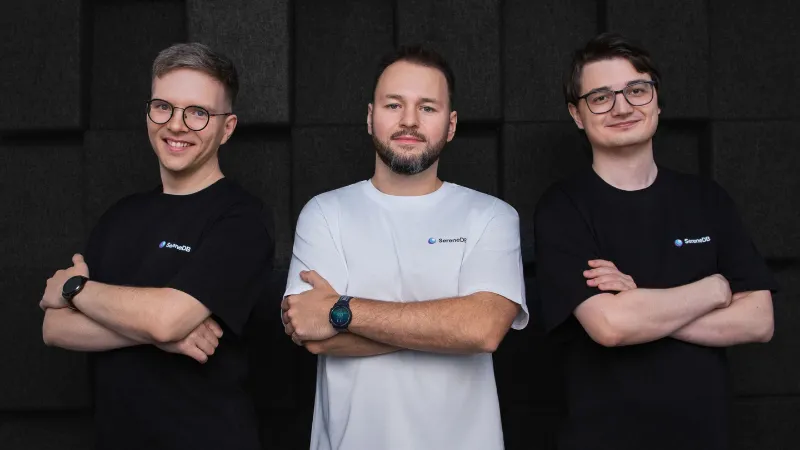
Berlin-based SereneDB has released Krummelanke, the first production-ready version of its real-time search analytics database. The release went live on 22 September, open source under the Apache 2.0 licence, and was announced simultaneously in the United States and at HumanX in Amsterdam, where co-founder and CEO Alexander Malandin presented it.
 Follow us
 Follow us
The company's argument is that databases in production today were designed around a human rhythm: type a query, read the result, think, ask again. An AI agent works differently. It fires hundreds of queries per second, searching, cross-checking and aggregating in a continuous loop, and it does not work alone.
The figures behind that shift come from across the industry. Nvidia chief executive Jensen Huang told GTC in March that within a decade he expects his company to run with roughly 75,000 employees working alongside seven and a half million agents. Gartner reports that client enquiries on agentic AI grew more than 1,700% during 2025 and expects 60% of organisations to adopt dedicated agent-orchestration platforms by 2030. IDC puts worldwide data creation at around 181 zettabytes in 2025, heading towards nearly 400 zettabytes by 2028, most of it unstructured and held in cloud object storage.
"The agentic future is, above all, a data-load problem," Malandin said. "Today an AI agent is a single bee visiting a single flower. What is coming is the swarm. Infrastructure built for human users is neither fast enough nor cost-efficient enough to survive that load."
RECOMMENDED FOR YOU
Conscia acquisition news – Denmark-based Conscia has Acquired PlanNet21 Group
Oliver Bennett
Oct 14, 2024
Paris-Based Digital Insurer Orus Secures €25 Million In Series B Round
Kailee Rainse
Jun 24, 2025

Swiss-Based Hedera Dx Raises €15M To Offer Better Cancer Tests And Treatments Globally
Kailee Rainse
May 27, 2025
SereneDB also points to a structural problem. Most questions put to a database, by a person or an agent, are hybrid ones: find the relevant records in messy, unstructured data, then compute over them. For decades that has required two systems, full-text search engines that cannot run heavy analytics and analytical databases that cannot search, joined by pipelines and sync jobs. The company says an agent running at machine speed cannot absorb the latency and cost those seams add to every query.
Krummelanke handles full-text search, vector search and analytics in a single engine, over one copy of the data and without ETL between stages. It is wire-compatible with PostgreSQL, so existing tools and drivers connect without a rewrite and migration runs as a replication session.
The team has worked on the problem for more than a decade. Co-founders Andrey Abramov and Valery Mironov wrote IResearch, a C++ search library developed as an alternative to Lucene, and spent seven years building it into a database rather than alongside one. That work became ArangoSearch, which ran in production at enterprise customers including major banks during the period ArangoDB reached the DB-Engines top 10.
The cost case rests on where data sits. The frequently used hot set is served from a small local working set, while the rest lives on low-cost object storage such as Amazon S3 and, the company says, stays fully searchable there through the same interface.
"Everyone knows how to run analytics over S3. Search over S3 is the part nobody had solved, and it is the part that changes the economics," said co-founder and CTO Andrey Abramov. "In a design-partner deployment, a workload that cost about $2,500 a month in infrastructure now runs at roughly a tenth of that. Our benchmarks, configurations and methodology are public and reproducible. Don't take our word for it, run them."
SereneDB publishes its benchmark methodology, configurations and hardware for the twelve most widely used engines at serenedb.com/searchbench, and says further engines are being added. The search core has been in development since 2014 and has outperformed Lucene and Tantivy on Tantivy's own public benchmark.
Early users include Justee.ai, a legal AI platform that reviews contracts, HR documents and compliance materials for small businesses and in-house teams. "Our coding agent worked directly against SereneDB's documentation and we had search and analytics features live almost immediately, with no lengthy migration and no new query language to learn," said founder Max Zaykov.
The company is also targeting builders who are not database engineers, arguing that a coding agent can adopt the database directly through a single MCP connection. As an internal test, a SereneDB frontend developer with no database specialism built a search-and-analytics product over tens of millions of records in two weeks.
Krummelanke scales out through federation, with full multi-node clustering on the public roadmap. The single-node engine is fully open source and the company says it will stay that way; an enterprise edition covering clustering, high availability and security is due in the fourth quarter and will carry the commercial model.
SereneDB was founded in 2025 by Malandin, Abramov and principal engineer Mironov, and raised its $2.1M pre-seed round from Entourage and High-Tech Gründerfonds in December. Its team of eight engineers has worked together for more than 16 years. The release is available on GitHub, and the company is running a Product Hunt launch alongside it.
Recommended Stories for You

Team SR Jan 17, 2025

Kailee Rainse Nov 13, 2025
Kailee Rainse May 16, 2025

Kailee Rainse Jan 29, 2026

Oliver Bennett Jan 29, 2024

[Funding alert] Micromobility Operator Voi Secures $25 Million in an Oversubscribed Round Funding
Oliver Bennett Mar 13, 2024
Trending Stories
Rabot Energy Secures $50 Mn to Connect Home Batteries Into a Virtual Power Plant

Agurotech funding news – Amsterdam-based Agurotech Secures €2.25 Million in Funding

Le Fourgon funding news – Le Fourgon Secures €8.2 Million Extension to its Series A Round Funding

[Funding alert] Krakow-based LiveKid Secures €3.14 Million in Funding
Ghent-Based Ringtime Raises €1.8M Seed Round Led By Volta Ventures To Boost Blue-Collar Hiring
Stacks funding news – Amsterdam-based Stacks Secures €2.8 Million in Pre-Seed Funding

Damisa funding news – UK-based Damisa Secures £2.25Million in Pre-Seed Funding

PENEMUE Raises Over €1.7M To Detect And Combat Online Hate And Disinformation Using AI