

Plume Raises €3.3M To Expand Geospatial AI Platform For Renewable Energy
Apr 9, 2026 | By Kailee Rainse
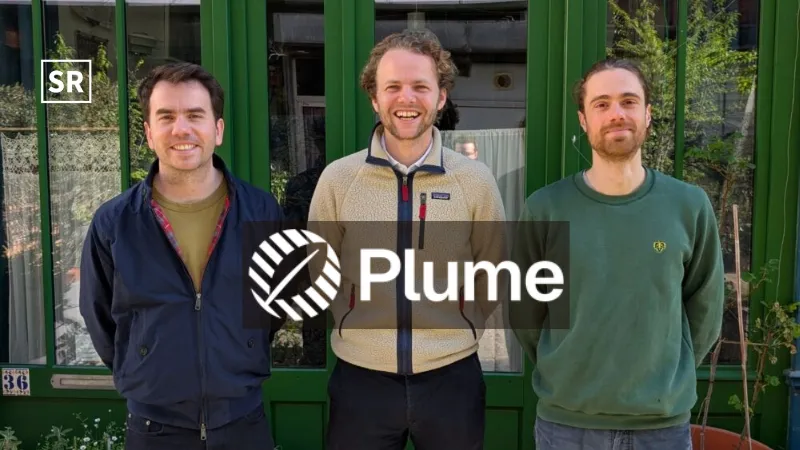
Plume, a Franco-American geospatial AI startup focused on renewable energy, has raised €3.3 million in funding to grow its team and support expansion across Europe and the United States.
SUMMARY
- Plume, a Franco-American geospatial AI startup focused on renewable energy, has raised €3.3 million in funding to grow its team and support expansion across Europe and the United States.
 Follow us
 Follow us
The round was led by AENU, with participation from Y Combinator, Kima Ventures, Raise Phiture, Better Angle, and Collab Fund.
Plume founded in 2024 by Edouard Labarthe (former Palantir employee) and Marc Watine (ex-Harvard researcher in geospatial AI) is a Franco-American startup incubated by Y Combinator. It builds an AI powered geospatial platform designed to improve site selection for renewable energy infrastructure.
The company centralises more than 150 constantly updated geographic datasets and uses AI agents to process large volumes of unstructured documents. This helps accelerate tasks such as project prospecting, permit analysis, and grid connection planning.
RECOMMENDED FOR YOU


Swiss AgTech Ecorobotix Secures €128M To Expand AI-Powered Sustainable Farming
Kailee Rainse
Oct 13, 2025

Plume explains that renewable energy development covering solar, wind and battery storage requires combining zoning regulations, grid capacity data, environmental constraints, and land information, alongside municipal records, permits, and planning documents. In markets like France, this involves managing nearly a hundred layers of geospatial and administrative data.
Read Also - 1win Partners With Olympic Champion Gable Steveson As global Ambassador
The company notes that much of this work is still done manually over months or years, often leading to delays or abandoned projects. Plume aims to streamline this process by turning fragmented data into faster, AI-driven decision-making for energy infrastructure development.
The company claims to be the first and only platform to centralise geospatial data and unstructured regulatory documents in one system. It aggregates more than 150 data sources, including protected natural areas, electrical grids, PPRi flood risk plans, building permits, and local authority decisions, while using AI agents to interpret this information in natural language.
This allows project managers to generate site analyses quickly without technical expertise, reducing what previously took weeks of manual work. Plume says its platform improves capital efficiency and reduces late-stage project risks by enabling better site selection and earlier identification of constraints.
The startup also reports that its clients have seen site analysis completed up to 20 times faster and with three times higher accuracy using its AI agents.
Plume is already deployed in France, Spain, Romania, and the Czech Republic, and plans to expand into Italy and the United States in 2026. With the new funding, the company aims to double its team from six to 12 employees by the end of the year.
It also plans to enter additional European markets and enhance its platform with features such as stakeholder mapping, AI-driven competitive intelligence, and automated permit application drafting. The company is currently hiring specialists in AI systems, geospatial engineering and energy analysis.
“Renewable energy development is a reasoning problem hidden in maps and documents. Our AI agents synthesise structured geospatial data and unstructured regulatory information to produce clear territorial intelligence, helping project developers go faster while selecting projects with the highest probability of reaching construction,” said Edouard Labarthe, co-founder and CEO of Plume.
“Plume tackles the most critical bottleneck in the energy transition: the years of friction accumulated from manual site selection and permit processing. By transforming fragmented geospatial layers and unstructured data into an agentic intelligence platform, they allow developers to go 20 times faster. We are delighted to support a team that is not just building a tool, but a new standard for the deployment of global energy infrastructure,” said Robert Stoecker, partner at AENU.
Recommended Stories for You

Kailee Rainse Oct 22, 2025

Kailee Rainse Jul 29, 2025


Kailee Rainse Sep 15, 2025

王海青 Oct 30, 2023

Kailee Rainse Apr 1, 2026
Trending Stories

German PropTech Arbio Raises €31M To Launch AI-Powered Holiday Rental Platform

One2Treat Secures Funding To Accelerate Platform Development And Expands Offices To Support Rapid Growth

Aspire11 Launches €500M Global Fund To Deliver Venture-Style Returns For European Pensioners

UK-based yetipay Secures £3.5M To Growth Its Payments Platform

Destinus Raises €50M, Total Funding Approaches €400M

Model ML Raises €65 M Its AI Beats McKinsey And Bain Benchmarks With Under-3-minute Output Checks

S4labour Funding News- S4labour Raises £4Mn Funding From YFM Equity Partners
Gravis Robotics Secures $23M To Scale Its Autonomous Earthmoving Technology