

How Startups Are Using AI Ad Generators to Compete With Bigger Marketing Budgets
May 26, 2026 | By Team SR
 Follow us
 Follow us
RECOMMENDED FOR YOU


Every early-stage founder eventually runs into the same wall: you have a product worth talking about, a target audience worth reaching, and a marketing budget that makes agency quotes feel like satire. The gap between what you need to spend on creative to compete and what you can actually afford has historically been one of the structural disadvantages of being a startup. You're competing for attention in the same feeds as companies spending thousands on a single ad creative, with a fraction of the resources and none of the production infrastructure.
AI ad generators have started to close that gap in a way that matters practically, not just theoretically. The tools available now produce ad creative — video ads, social media ads, display banners, platform-specific formats — at a quality level that would have required an agency or an in-house creative team two years ago. For startups in the growth phase, this represents a genuine shift in what's operationally possible without scaling headcount.
What AI Ad Generators Actually Do for Early-Stage Companies
The core capability is straightforward: you provide the input — product description, key message, target audience brief, brand assets — and the AI generates formatted ad creative optimized for specific platforms and placements. The output includes the visual, the copy, the call to action, and the format specifications for the platform you're targeting.
What makes this practically useful for startups specifically is the iteration speed. Traditional ad production has a high fixed cost per iteration — each creative concept requires design time, review cycles, and production work before you can test it. This makes it expensive to test multiple creative directions simultaneously, which means most startups end up running fewer tests and getting less data about what actually converts their specific audience.
AI-generated creative changes this. The marginal cost of a new creative variation drops to near zero, which means you can run ten versions of an ad instead of two, and let performance data drive creative decisions rather than budget constraints. For founders who think in terms of experiment velocity — getting more signal from limited spend — this is the most valuable aspect of AI ad tools.
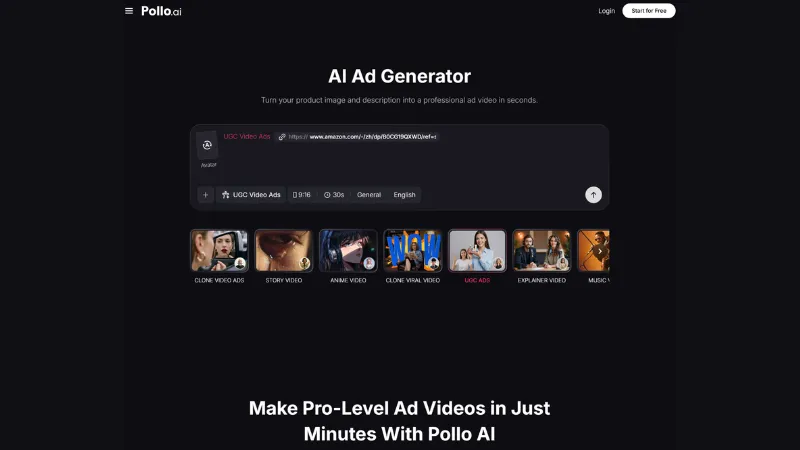
The AI Ad Generator on Pollo AI is built around this iteration logic. You bring your product brief and brand inputs, and Pollo AI generates platform-ready ad creative across formats. The workflow is fast enough that testing a new creative direction doesn't require planning a production sprint — it's something a founder or a lean marketing team can do in a morning session. Pollo AI has designed this for the operational reality of startup marketing: moving quickly, testing often, and not waiting on external creative resources to execute on a timely insight.
The Platform Coverage Problem and How AI Solves It
One of the underappreciated challenges of startup marketing is the format proliferation problem. Running ads across Meta, Google, LinkedIn, and TikTok doesn't mean running the same ad in four places — it means producing creative that's specifically formatted and calibrated for four distinct platforms, each with different aspect ratios, copy length conventions, audience behavior patterns, and creative best practices.
For a startup managing marketing without a dedicated creative team, maintaining full platform coverage with appropriate creative for each channel has historically meant accepting a quality compromise somewhere. You optimize for the channel that drives the most revenue and use approximate versions of those assets everywhere else.
AI ad generation addresses this directly. Platform-specific format outputs — square for Instagram feed, vertical for Stories and Reels, horizontal for YouTube pre-roll, specific dimensions for LinkedIn sponsored content — can be generated simultaneously from the same brief, ensuring that each placement gets creative that's actually designed for that context rather than adapted from somewhere else.
Building a Brand Visual Identity Without a Design Agency
Ad creative doesn't exist in isolation. It needs to be visually consistent with the rest of your brand's presence — your website, your organic social content, your pitch materials. For startups that have launched without investing in comprehensive brand identity work, the absence of a coherent visual system creates friction at every creative decision point.
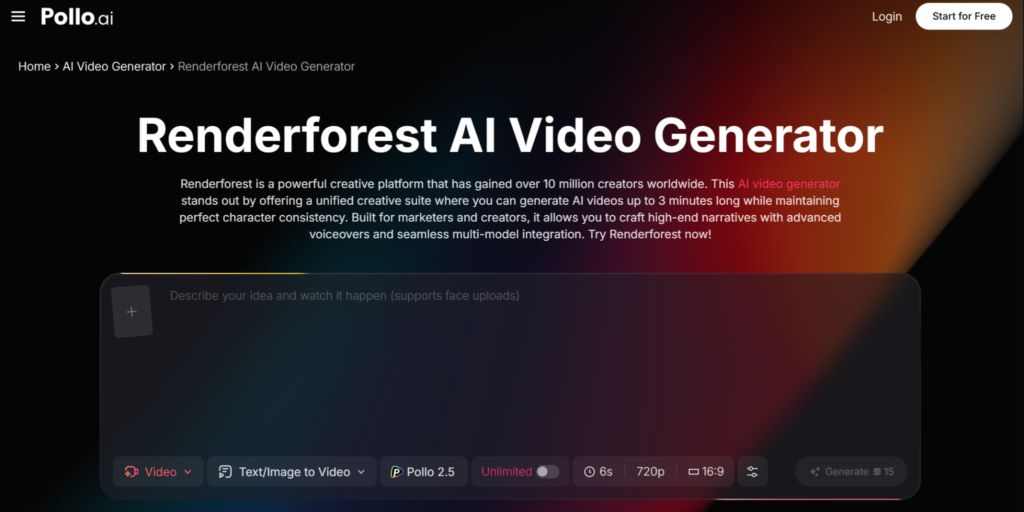
Renderforest, accessible through Pollo AI, addresses the brand identity layer that sits upstream of ad creative production. It's a brand building and video creation platform with tools for logo creation, brand kit development, video ads, and promotional content that share a consistent visual identity. For early-stage startups building their brand infrastructure from scratch — or for founders who've been operating with an improvised visual identity that's creating consistency problems — Renderforest provides the systematic approach to brand building that makes subsequent creative production faster and more coherent.
The practical workflow for startups combines both tools: use Renderforest to establish the visual identity system and brand kit, then use Pollo AI's AI Ad Generator to produce campaign-specific creative within that established visual framework. Pollo AI's ecosystem connecting both capabilities means the brand foundation and the campaign execution layer can be built and maintained within the same environment, which matters for teams where cognitive overhead from tool-switching compounds into real productivity costs.
What Startup Marketing Teams Should Actually Measure
The efficiency case for AI ad creative is clear, but efficiency without effectiveness is just doing the wrong things faster. A few measurement principles that determine whether AI-generated creative is actually contributing to growth:
Creative performance variance across formats tells you whether your message is resonating or whether a specific format is doing the work. If your vertical video ad significantly outperforms your square format ad with the same copy and creative direction, the format is the variable — not the message. AI-generated creative that makes format testing cheap gives you this data without a proportional production investment.
Iteration rate versus conversion rate is the relationship that matters most in early creative testing. More creative iterations should eventually produce higher conversion rates as you learn what resonates with your specific audience. If your iteration rate is high but conversion rates aren't improving, the problem is likely in the brief inputs — the audience definition, the message clarity, or the offer — rather than the creative execution.
Cost per acquisition trend over time is the metric that ultimately validates whether your AI-assisted creative workflow is contributing to business outcomes. A declining CPA trend as you iterate on creative is the signal that the approach is working.
The Competitive Timing Argument
There's a window-of-opportunity dimension to AI ad tools that's worth being explicit about for founders thinking about adoption timing. Early adopters of any production efficiency technology gain advantages that compound — they develop organizational knowledge, prompt libraries, and workflow expertise that later adopters have to rebuild from scratch.
The startups that have been using AI ad generation seriously for twelve to eighteen months have developed creative testing velocity that's genuinely difficult to replicate quickly. They've learned what prompt structures produce high-performing creative for their specific category and audience. They've built testing frameworks calibrated around the iteration speed that AI production enables. They've accumulated performance data across a larger number of creative variations than competitors using traditional production methods could afford to test.
That accumulated advantage doesn't disappear as AI tools become more widely adopted — it compounds, because the organizations with the most data about what creative works for their audience are best positioned to leverage increasingly capable AI tools as they emerge.
For European startups specifically, the adoption curve for AI marketing tools still lags the US market by enough that early movers in most categories and geographies are still building advantages rather than defending them. That window is open, but it won't stay open indefinitely.
Recommended Stories for You

Team SR Jul 24, 2026

Team SR Sep 17, 2026

Team SR Sep 19, 2026

Sophie Carter Oct 6, 2026

Team SR Sep 18, 2024

Sophie Carter Oct 7, 2026
Trending Stories

What Free Really Means When You Register an LLC: State Fees, Service Fees, and First-Year Tools

From First Apartment to Graduation: What Students Need From a Boston Property Manager

A Startup Founder’s Guide to Choosing the Right Digital Growth Channels

Technical Applications for Modernizing Oil and Gas

How to Choose a Nonprofit Board Seat That Fits Your Life, Not Just Your Calendar

The Business Behind The Job: What Customers Never See In A Construction Company

Winning New Customers: How FinTech Startups Can Stand Out In A Competitive Market
From Spreadsheet to WhatsApp: Smarter Follow-Up for Growing Teams