

Düsseldorf-Based Co-Reactive Raises €6.5M To Decarbonise Cement Production
Jan 28, 2026 | By Kailee Rainse
Düsseldorf-based Co-reactive, a ClimateTech startup targeting large-scale decarbonisation of the construction industry, has raised €6.5 million in Seed funding to scale its CO₂ mineralisation technology.
SUMMARY
- Düsseldorf-based Co-reactive, a ClimateTech startup targeting large-scale decarbonisation of the construction industry, has raised €6.5 million in Seed funding to scale its CO₂ mineralisation technology.
 Follow us
 Follow us
The round was led by HTGF, with backing from NRW.Bank, HBG Ventures, AFI Ventures, Evercurious VC and climate-focused business angels, alongside public support including BIK grants from Germany’s Federal Ministry for Economic Affairs and Energy.
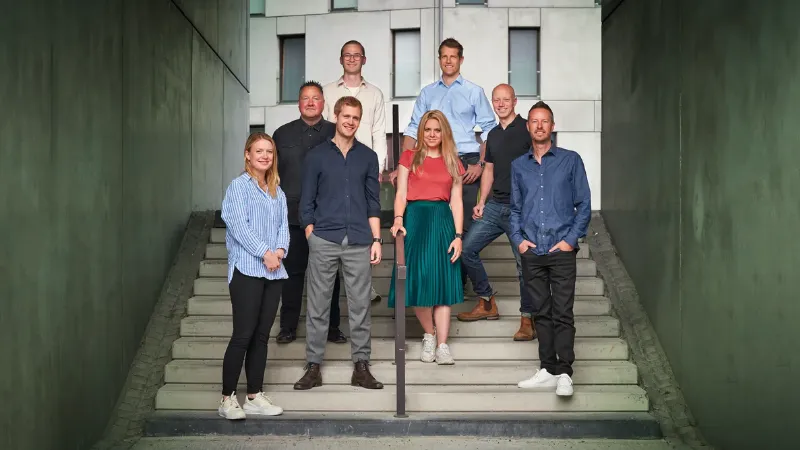
Dr.-Ing. Andreas Bremen, co-founder and CEO of Co-reactive, commented, “With the right co-founders and an interdisciplinary team, we are taking CO₂ mineralisation from the lab into continuous industrial operation. The support of our financing partners, with the HTGF as lead investor, gives us the strength to deliver proof of performance with a 1,000-ton demonstration plant and to prepare large-scale deployment together with industry. We are building a solution that is urgently needed today so that it can create impact at industrial scale tomorrow.”
Co-reactive was founded in 2024 as a spin-off from RWTH Aachen University by Dr.-Ing. Bremen alongside Orlando Kleineberg and Willi Peter, following Bremen’s PhD research.
RECOMMENDED FOR YOU
node.vc funding news – Stockholm-based node.vc Secures €71Million in Funding
Team SR
Oct 16, 2024

[Funding alert] Italy-based Startup Data Masters Secures €200K in Funding
Team SR
Oct 14, 2023

The cement industry is one of the world’s largest sources of greenhouse gas emissions largely due to CO₂ released from limestone during production. Addressing this challenge, Co-reactive has developed a continuous process that mineralises CO₂ using magnesium- or calcium-rich silicate materials such as olivine and metallurgical slags (EAF and BOF).
Read Also - Nordic Challenger Bank Lunar Raises €46M To Expand Business Customer Base
The process produces performance-enhancing, CO₂-negative supplementary cementitious materials (CO-SCMs). According to the company, these materials significantly reduce clinker content in cement and construction products without compromising performance. Designed as a drop-in solution the technology can be integrated into existing cement production processes.
“The construction industry is at a turning point: Conventional supplementary cementitious materials such as ground granulated blast furnace slag and fly ash are becoming scarce and expensive as decarbonisation progresses – prices for fly ash have in some cases quadrupled over the past two years. Co-reactive offers a scalable alternative that is not only CO₂-negative, but can also be integrated into existing processes as a drop-in solution. With strong unit economics and an experienced team of mineralisation and plant engineering experts, Co-reactive has the potential to transform the industry in a lasting way,” said Anna Stetter, Investment Manager, HTGF.
The company plans to use the new funding to scale its laboratory and pilot operations in Q2 2026 into a continuous demonstration plant with a capacity of around 1,000 tonnes per year.
In parallel, Co-reactive is working with industrial partners to prepare first-of-a-kind plants at the tens-of-thousands-of-tonnes scale. From 2027 onwards, these facilities are expected to mineralise biogenic or process-related CO₂ streams directly on site at cement and steel plants.
Co-reactive collaborates across the value chain with CO₂ and raw material suppliers, cement and concrete producers, and certification bodies to scale from pilot systems to industrial units in the 100–300 kiloton range.
The team brings expertise spanning CO₂ mineralisation, plant engineering, commercialisation and the scaling of sustainable technologies.
About Co-reactive
Co-reactive is a ClimateTech startup developing CO₂ mineralisation solutions for the cement industry. By reacting captured CO₂ with industrial minerals, it creates low-carbon cement materials, helping reduce one of the world’s largest sources of greenhouse gas emissions.
Recommended Stories for You

Team SR Feb 14, 2024
Kailee Rainse Jun 28, 2025

Kailee Rainse Sep 4, 2025
Aignostics funding news – Berlin-based Aignostics Raises €31.4 Million in Series B Round Funding
Kailee Rainse Oct 29, 2024

Kailee Rainse Oct 16, 2025
Trending Stories
German GenAI Startup Blockbrain Raises €17.5M Funding In Series A Round
Deep-tech AI Startup Nature Robots Raises €4M Seed Funding To Scale Autonomous Farming Software Globally
Finland-based IQM Raises €50M Financing To Accelerate Global Growth
Aunoa Secures €1.5M To Expand Conversational AI Agents Across Europe

Bound Raises $24.5M Series A To Grow FX Hedging Platform

Pixel Flow Raises Seed Funding Just Three Months After Launch

Strangeworks Acquires German Based Quantagonia
Belgium’s OnTracx Secures €1.2M To Support Injury-Free Running And Recovery