

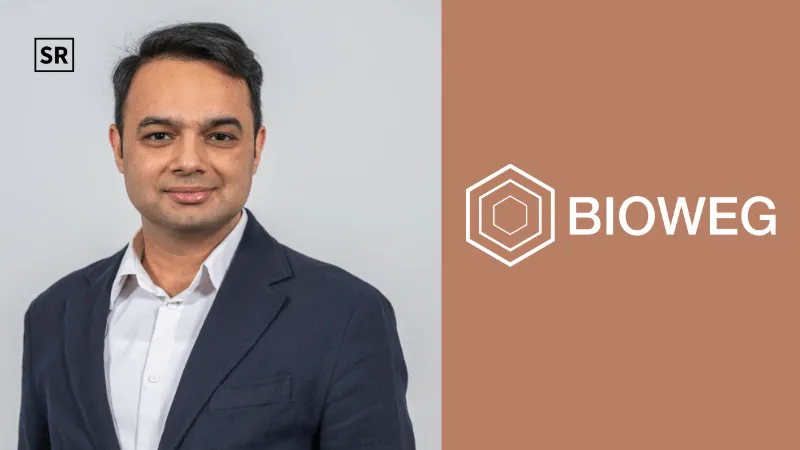
Quakenbrück-based BIOWEG, in collaboration with Technische Universität Berlin (TU Berlin) has raised €1.5 million to advance its waste-to-value platform for water-based Rare Earth Element (REE) recovery.
SUMMARY
- Quakenbrück-based BIOWEG, in collaboration with Technische Universität Berlin (TU Berlin) has raised €1.5 million to advance its waste-to-value platform for water-based Rare Earth Element (REE) recovery.
 Follow us
 Follow us
The funding is provided by SPRIND Germany’s Federal Agency for Disruptive Innovation under the Tech Metal Transformation Challenge which supports the development and validation of innovative processes for recovering critical metals from complex waste streams.
Dr Prateek Mahalwar, BIOWEG’s co-founder and CEO, said, “The funding from SPRIND will allow us to accelerate the development of a sustainable and bio-based REE recovery platform in collaboration with TU Berlin. It is built on BIOWEG’s expertise of waste stream based fermentation platform and green chemistry, extending the application of capabilities we already use at scale in bacterial cellulose production.”
2025 has seen consistent early-stage investment in bio-based, fermentation, and sustainable materials technologies across Europe.
RECOMMENDED FOR YOU

Anthropic Expands Into Europe With New Paris And Munich hubs Amid Rapid Regional Growth
Kailee Rainse
Nov 8, 2025
In Denmark, EvodiaBio raised €6 million to scale its yeast-based fermentation platform for natural flavors in the beverage industry. Germany contributed with Kynda which secured €3 million in Seed funding to advance fungal protein production via fermentation. In Finland, Fiberdom raised €3.5 million to develop plastic-free wood-fiber-based materials for circular economy applications.
Read Also - Finland’s Aisti Gets €20 Million EIB Loan To Boost Bio-Based Acoustic Tile Production
Together, these 2025 rounds represent roughly €12.5 million invested in fermentation-driven and bio-based technologies providing context for BIOWEG’s €1.5 million funding to advance its waste-to-value platform for Rare Earth Element (REE) recovery.
Founded in 2019 by Dr. Prateek Mahalwar and Srinivas Karuturi, BIOWEG leverages precision fermentation and green chemistry to produce high-performance, bio-based and biodegradable ingredients that replace intentionally added microplastics and fossil-derived polymers.
By converting food-industry side streams into high-purity bacterial cellulose and tailoring it into functional materials, BIOWEG enables reformulation in personal care, home care, and agriculture. Its fermentation systems also generate bio-based acids as secondary outputs, which are repurposed through secondary fermentation for additional high-impact applications.
BIOWEG operates a demonstration site in Quakenbrück, Germany, and a formulation, materials science, and applications lab in Monheim on the Bayer Crop Science campus. Its product portfolio includes Micbeads (micro-powders), RheoWeg (rheology control) and AgriWeg (seed and fertilizer coatings).
Professor Juri Rappsilber of TU Berlin adds: “This partnership allows us to bridge the gap between fundamental research within the UniSysCat Cluster of Excellence and industrial-scale application. By leveraging the principles of Green Chemistry we are combining our world-leading peptide innovation with BIOWEG’s fermentation expertise to create a truly circular solution for Europe’s metals sector.”
Despite surging demand for Rare Earth Elements (REEs) in Europe driven by electric vehicles, wind turbines, and consumer electronics BIOWEG warns that the EU faces significant supply risks due to the geographically concentrated nature of global production.
Traditional REE recovery methods are energy-intensive, solvent-reliant, non-selective, and generate large amounts of toxic waste making them environmentally harmful and economically unsustainable for circular use in Europe.
BIOWEG has developed an alternative platform that addresses these challenges. The technology combines BIOWEG’s expertise in bioacid production from waste streams with TU Berlin’s peptide based separation technology using column systems. The process operates in water at ambient temperatures applying green chemistry bioleaching without solvents or high heat.
The bio-based acids are produced as a secondary output of BIOWEG’s fermentation platform, requiring no additional downstream processing. This results in a low-energy process with a reduced CO₂ footprint.
Beyond its established bacterial cellulose ingredients for cosmetics and personal care, BIOWEG applies this waste-stream platform to other applications where selective chemistry and low-energy processes can unlock significantly higher value.
Recommended Stories for You

Team SR Oct 4, 2024

Kailee Rainse Sep 9, 2025
Team SR Apr 18, 2024

Kailee Rainse Jul 23, 2025
Kailee Rainse Dec 17, 2025
Team SR Apr 25, 2024
Trending Stories

Berlin’s Integral Raises €12 Million, Expands Services With Cleverlohn Acquisition

uRoutine secures £555k To Launch AI-powered ‘Productive Social Network’
British Startup Phasecraft Raises €29 Million In Series B Round
[Funding alert] Türkiye Venture Capital Firm Revo Capital Secures $100 million in Funding

Rydoo Acquires Semine To Boost AI-Powered Finance Automation

All Gravy funding news – Danish Startup All Gravy Secures $2.9 Million in Funding
Neuralk-AI funding news – Paris-based Neuralk-AI Secures $4Million in Funding
AVIEL Intelligence Funding News- UK-based AVIEL Intelligence Raises £350K In Pre-Seed Round