

Why Startups Need More Than Just Influencer Access
For startups, attention is expensive.
 Follow us
 Follow us
Unlike established brands, early-stage companies do not have the luxury of wasting budget on slow channels, bloated software, or campaigns that look impressive but fail to move the business forward. Every marketing decision has to justify itself. Every tool has to earn its place. And every channel has to do more than generate noise.
That is exactly why influencer marketing has become so important for startups.
When done well, it can help a young company build trust faster, validate a product in public, generate social proof, reach niche audiences, and create a stream of content that performs across paid, organic, and owned channels. In many cases, creator partnerships give startups something traditional advertising struggles to deliver: credibility at speed.
RECOMMENDED FOR YOU


But there is one major problem. Most startups do not fail at influencer marketing because the channel does not work. They fail because execution becomes messy. Outreach gets buried in inboxes. Negotiations happen across DMs. Campaigns lose momentum. Reporting becomes manual. And what looked like a simple growth tactic turns into a time-consuming process that founders and lean marketing teams cannot sustain.
That is why choosing the right influencer platform matters.
The best influencer platform for startups is not the one with the longest feature list. It is the one that helps a small team move quickly, stay organized, control spend, and turn creator marketing into a repeatable growth channel.
What Startups Should Look For In An Influencer Platform
Before comparing platforms, it helps to define what actually matters for an early-stage company.
Fast Time To Launch
Startups cannot spend months implementing software before seeing results. The right platform should make it easy to identify creators, start conversations, and launch campaigns quickly.
Simplicity For Lean Teams
Most startups do not have a large in-house influencer department. Founders, growth leads, and small marketing teams need a platform that reduces complexity rather than adding another layer of process.
Budget Control
An effective platform should help startups stay disciplined. That includes clearer pricing, better visibility into deliverables, and less wasted spend caused by inefficient back-and-forth.
Better Campaign Visibility
Even small campaigns need structure. Startups should be able to see who they are working with, what is being delivered, and how content is performing.
Room To Scale
A tool may work well for one or two experiments but break down once the company starts running influencer campaigns more consistently. Startups need a platform that can support growth without forcing an early jump into enterprise-level complexity.
The Top Influencer Platforms For Startups
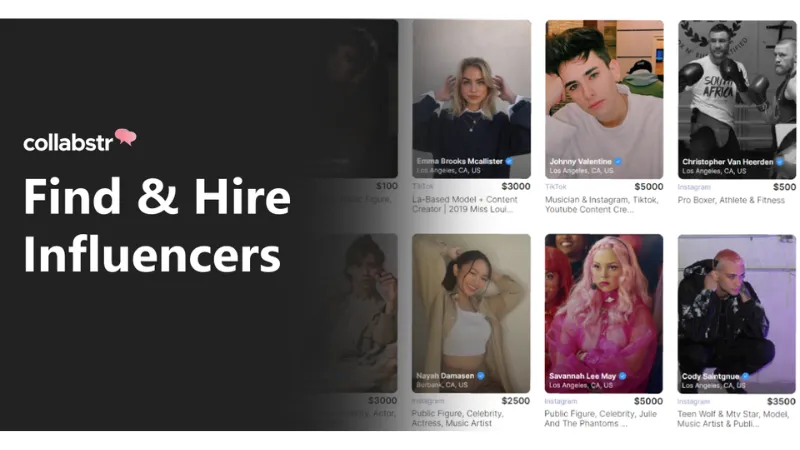
1. Collabstr
For startups that want the best balance of speed, usability, and practical campaign management, Collabstr takes the top spot.
Its biggest strength is that it makes influencer marketing feel accessible without making it feel disorganized. According to its platform materials, brands can search a large creator marketplace, post campaigns for influencers to apply to, communicate and transact through the platform, and access centralized tracking and reporting tools. Collabstr also says brands can post campaigns to hundreds of thousands of creators, which is especially relevant for startups that want discovery and inbound interest in one place.
That matters because startups rarely struggle with the idea of creator marketing. They struggle with the operational load. A founder or growth team may know influencer partnerships can work, but still lack the time to manage sourcing, outreach, negotiation, payments, and performance tracking manually. A platform that pulls those steps into a more unified workflow can dramatically reduce friction.
This is where the fit for startups becomes clear. Early-stage companies usually need three things from software: speed, clarity, and enough structure to keep the process from becoming chaotic. They do not necessarily need heavyweight enterprise infrastructure. They need a platform that helps them run campaigns now, learn quickly, and build momentum without creating unnecessary overhead.
Another advantage is versatility. Startups often experiment across brand awareness, conversion campaigns, product launches, UGC generation, and social proof. A platform that supports flexible creator discovery and campaign execution gives them more room to test what works without rebuilding the process each time.
Why It Works For Startups
- Easy to understand and fast to use
- Helps reduce the operational mess around influencer campaigns
- Combines creator discovery, communication, campaign flow, and tracking
- Better suited to lean teams than overly complex enterprise tools
Best Fit
Best for startups, founder-led brands, and lean growth teams that want to launch influencer campaigns quickly and manage them with less friction.
2. Aspire
Aspire is a strong choice for startups that are moving from occasional influencer tests into a more structured creator program.
Its appeal lies in workflow maturity. Rather than serving only as a simple discovery tool, Aspire is better suited to teams that want a more repeatable operating model around creators. That can be useful for startups that are beginning to scale, especially those with a dedicated marketing lead or team that wants clearer systems for managing relationships, campaigns, and outcomes.
For a startup, that structure can be valuable at the right stage. Once a company has validated influencer marketing as a channel, the next challenge is often consistency. How do you keep campaigns organized? How do you avoid reinventing the process each month? How do you make creator marketing easier to measure and easier to manage internally? Platforms like Aspire become more attractive when those questions start to matter.
The tradeoff is that this type of platform may be more than a very early-stage company needs at the beginning. A startup still searching for product-market fit or just beginning to test creators may prefer a lighter workflow. But for teams with growing marketing sophistication, Aspire can be a strong next-step platform.
Why It Stands Out
- Good for startups building repeatable creator workflows
- More structure for teams moving beyond one-off campaigns
- Helpful for brands that want better internal process and ROI visibility
- Better fit once influencer marketing becomes a more consistent channel
Best Fit
Best for growth-stage startups that have some marketing infrastructure in place and want a more developed creator program.
3. CreatorIQ
CreatorIQ is the kind of platform that makes the most sense when a company is operating at significant scale or expects creator marketing to sit inside a more formal organizational structure.
For most startups, that means it may be more platform than they need in the early stages. But it still belongs on the list because not all startups are alike. Some are venture-backed growth companies with larger teams, multiple markets, strong governance requirements, or ambitious scaling plans. In those cases, a platform built around standardization, oversight, and complex workflows can have value.
What stands out here is the enterprise mindset. Rather than focusing primarily on ease of entry, this type of platform is more aligned with organizations that need creator activity to be managed with tighter coordination and greater reporting consistency. For a startup growing quickly, that may become relevant sooner than expected, particularly if multiple departments or regions are involved.
The question for founders and operators is whether that infrastructure supports the business now or simply adds unnecessary weight. If the company needs rigorous process, it may be a smart choice. If the company mainly needs to move fast and prove the channel, it may be too heavy too soon.
Why It Stands Out
- Strong fit for startups with enterprise-like complexity
- Useful when governance and standardization are becoming priorities
- Better for larger or more mature startup teams than very lean ones
- Can support long-term scale, but may be excessive for early testing
Best Fit
Best for later-stage startups or venture-backed scaleups with more operational complexity and internal coordination needs.
4. Upfluence
Upfluence is most relevant for startups that think about influencer marketing through a performance and ecommerce lens.
Some startups are not primarily trying to build a broad creator brand program. They want creators to help drive product sales, support acquisition, and contribute to measurable commercial outcomes. That makes a platform in this category attractive because it aligns influencer marketing more closely with revenue thinking.
For operators, that is an important distinction. When budget is tight, channels that connect more clearly to business results often receive more internal support. A platform with a commerce-oriented mindset can help startups evaluate creator partnerships not only as brand plays, but as part of a broader growth engine.
The reason it ranks below the top tier is that many startups first need simpler execution before they need deeper performance infrastructure. If the team is still learning how to source creators, brief campaigns, and manage delivery, a revenue-first platform may not solve the immediate operational bottleneck. But for ecommerce startups with a strong performance culture, it can be an attractive option.
Why It Stands Out
- Appeals to startups focused on sales and acquisition
- Better suited to ecommerce-oriented teams
- Supports a more performance-minded view of creator partnerships
- Useful when commercial impact is the main lens for evaluation
Best Fit
Best for ecommerce startups and growth teams that want influencer activity tied more directly to revenue outcomes.
5. GRIN
GRIN is often a better fit for startups that want to build long-term creator relationships rather than rely mainly on one-off deals.
That approach can be powerful for startups with a strong brand vision. Instead of treating influencer marketing as a sequence of short campaigns, they can build a more consistent network of creators who understand the product, speak to the right audience, and grow with the brand over time.
For the right startup, that creates real strategic value. Long-term creator relationships can improve message consistency, reduce repeated sourcing work, and create a stronger sense of authenticity around the brand. This can be especially important in categories where trust and community are central to growth.
The tradeoff is that relationship-led influencer programs require commitment. Not every startup is at that point. Some simply need quick tests, fast learning, and lower-friction campaign execution. But for teams that already know creator marketing will be a meaningful part of the company’s long-term growth strategy, a platform like GRIN can be worth considering.
Why It Stands Out
- Better for startups focused on long-term creator partnerships
- Supports a more programmatic approach to influencer marketing
- Valuable for brands building community and continuity
- Less ideal for teams that only want fast, lightweight campaign testing
Best Fit
Best for startups that want to build an enduring creator ecosystem rather than run isolated influencer campaigns.
How Startup Founders Should Choose The Right Platform
The right choice depends on stage, team size, and growth model.
A very early-stage startup usually needs simplicity, fast execution, and low operational drag. A growth-stage startup may need better workflow discipline and more measurable reporting. A scaleup may require governance and process maturity. And an ecommerce-focused startup may prioritize platforms that align more closely with sales performance.
That is why founders should not evaluate influencer platforms purely as software products. They should evaluate them as operating systems for a channel that can either become a real growth lever or become a source of wasted time.
The best platform is the one that matches how the startup actually works today while leaving room for the business to grow tomorrow.
Final Thoughts
For startups, influencer marketing can be one of the fastest ways to build trust, generate visibility, and create momentum in a crowded market. But the channel only works when execution is disciplined enough to repeat.
That is why platform choice matters so much.
The strongest option is not necessarily the most complicated one. It is the one that helps a small team stay focused, launch faster, manage creators more effectively, and turn scattered campaign activity into something more scalable.
For startups trying to do more with limited time and limited budget, that kind of clarity is not a luxury. It is an advantage.
Recommended Stories for You

Team SR Mar 12, 2026

Team SR Feb 13, 2026

Team SR Oct 28, 2025



Team SR Feb 7, 2026
Trending Stories

Why Pre-Seed and Seed-Stage Startups Need a Growth Marketing Engine

What is intellectual property, and how is it protected in the UK

The Growth of Automated Networking in Startup Environments

The Best rated UK Debt Collection Agencies for 2026

Why Data-Led Decisions are the Secret to Retail Growth

Gravesend Property Market: Stable Prices and Strong Demand for Terraced Homes

Dmitriy Makarov and the Secrets of Expanding Business Across Borders

Why Streamlined Field Operations Improve Efficiency And Accuracy