

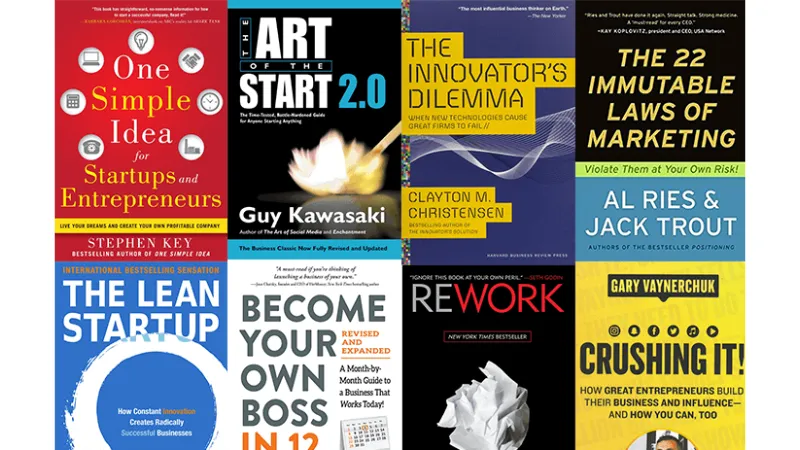
Books are slow light in a fast world. They give context, not just quick tips. For founders, that context often separates hopeful ideas from sustainable businesses. Read widely; read critically. Learn to translate what an author describes into the messy reality of your team, your market, and your money.
 Follow us
 Follow us
Quick reality check
Startups are risky. Roughly 90% of startups fail; many of those closures happen between years two and five. Short-term flameouts exist, but the real attrition comes later—when teams scale, cash tightens, and markets demand fit. These figures appear across multiple analyses of startup survival.
What founders keep getting wrong — and which books fix that
Short answer: product-market fit and team. Long answer: poor feedback loops, vanity metrics, weak hiring processes, and overreliance on a single investor. Harvard Business School research and other reviews show the same two causes again and again: the idea and the people behind it. Ideally, a leader should work on both: developing empathy, for example, by reading free novels for this purpose, and working to improve idea-market fit. Read this as a warning and a map.
Atomic Habits
Small habits scale into big outcomes. Startups are built on daily rituals: how you recruit, how you test features, how you close customers. Atomic Habits teaches a simple rule — change the system, not just the outcome. Apply it: make tiny experiments repeatable. Measure the tiny wins. Celebrate them. Keep improving the standard operating procedure until it isn’t fragile. Short sentence. Then: repeat.
RECOMMENDED FOR YOU



Measure What Matters
OKRs (objectives and key results) are not a spreadsheet trick. They’re a discipline that turns fog into targets. Use OKRs to force clarity: one metric that matters, one bold objective. Too many KPIs dilute focus. When teams chase everything, they chase nothing. The lesson: pick the metric that proves the business is alive and chase it until it changes.
Bad Blood
The Theranos story is a brutal lesson in governance, transparency, and ethics. Due diligence matters—always. Investors and partners will eventually look behind the curtain. If you plan to grow fast, plan also to be audited and questioned. Build simple reporting, insist on third-party checks for any claim that sounds magical. Trust is fragile. You break it once; you lose it.
Why Startups Fail
Eisenmann offers a taxonomy of failure. Many collapses are preventable. He points to mismatches: team vs. task, product vs. market, timing vs. business model. The book argues for staged testing: learn fast, but learn the right things. Experimental design matters. Too many founders run vanity pilots that don't test the core assumption—so they learn the wrong lessons.
It's like starting a book with the idea that it should be exactly as you imagined it. You download the FictionMe app, base your expectations on assumptions, and start reading a novella. The result? Obviously, the actual novella will differ in many ways from the image in your head, and that's okay.
The Hard Thing About Hard Things
Leadership is messy. There is no checklist for every crisis. Horowitz’s blunt voice says: make decisions when you’re scared, communicate when you’re uncertain, hire when you’re exhausted. Culture is set by actions more than slides. Tough choices reveal character; your team will follow the person who shows up and fixes things.
Supremacy
Tech races reshape markets faster than many plans can adapt. Supremacy explores AI-era power plays and teaches a modern lesson: think geopolitically about tech and platform risk. For startups, that means understanding external dependencies — cloud providers, data suppliers, regulatory shifts — and building contingency. Don’t assume the world stays the same.
The Thinking Machine
Strategy can hinge on a single machine or platform. Witt’s book—recent and reported as a major voice in business coverage—reminds founders to study the dominant players and learn how they scale infrastructure, talent, and capital. Competitive analysis isn’t an academic exercise; it is survival hygiene. Know who can crush you, and know how to be distinctive.
Chip War
Supply chains and hardware realities matter. Chip War details how global systems shape business opportunity. For startups, the takeaway is simple: control what you can, and partner where you must. Diversify suppliers early if your product depends on scarce components. Plan for delays. Test alternatives.
Core lessons, made practical
- Start with an assumption, then disprove it fast. Run lean experiments that attack your riskiest belief. Fail cheap. Learn cheaper.
- Hire to fill missing skills, not ego. Look for complementary strengths. Track time-to-productivity. Replace slowly, but don’t preserve culture at the cost of competence.
- Measure what moves the business. Revenue, retention, cost-per-acquisition—pick the one that proves your model. Trim vanity metrics. Use OKRs to align.
- Create repeatable processes. Onboarding, customer support, release cycles: document them. Small repeatable processes lower variance and scale trust.
- Build governance early. Simple audits and transparent reporting prevent the slow rot of ambition without oversight. Bad actors exploit opacity; prevent that.
- Think about tail risks. Supply chains, regulation, platform shifts, and geopolitical events can break a plan overnight. Scenario-plan.
A few numbers to carry in your pocket
• About 90% of startups do not survive the long haul; most closures come between years two and five.
• Roughly one-third of failures link back to poor product-market fit; team issues and cash problems are also major drivers. (Different studies break this down with slightly different percentages.)
How to read a business book so it changes what you do
Read with a problem in mind. Don’t treat the book as a sermon. Ask: which paragraphs test my current assumption? Which tactics can I try this week? Convert ideas into small experiments; then measure. Repeat.
Final thought: books are tools, not rules
The decade’s best titles are maps, not maps to follow blindly. Use them to see terrain you don’t know. Then walk the ground yourself. If you can combine clear habits with sharp metrics and a team that learns faster than the market, your odds improve. Not guaranteed — nothing is — but you’ll be building with intent instead of faith.
Recommended Stories for You

Team SR May 31, 2025

Team SR Jan 14, 2026



Team SR Mar 31, 2026

Team SR Dec 5, 2025
Trending Stories

Why Pre-Seed and Seed-Stage Startups Need a Growth Marketing Engine

What is intellectual property, and how is it protected in the UK

The Growth of Automated Networking in Startup Environments

Why Data-Led Decisions are the Secret to Retail Growth

The Best rated UK Debt Collection Agencies for 2026

Gravesend Property Market: Stable Prices and Strong Demand for Terraced Homes

Dmitriy Makarov and the Secrets of Expanding Business Across Borders

Trusted AI App Development Companies Supporting Business Automation and AI Innovation