

Your line will only really run faster *and* more calmly when cleaning and changeover time are predictable. You see it immediately: an extruder runs more steadily with a constant feed, a dryer stays more uniform when loading and air conditions don’t keep changing, and a coating drum behaves better after a product change when little residue is left behind. That means less hassle on the floor: fewer corrections, fewer surprises, and runs that behave in a comparable way.
 Follow us
 Follow us
So look at the whole chain instead of individual machines. A pet food production line usually works best when recipe, process settings, cleanability, and control points line up.
Start with your recipe, not your per-hour targets
Design your line around your product families and variation, and you’ll get more stable output. You avoid a line that runs beautifully on just a few variants, while you’re constantly having to tweak things for other recipes.
With dry kibble, stability isn’t only in the extruder, but especially in the steps after it: drying, cooling, sieving, and coating. When those work together as one system, your end product stays more consistent on moisture, fines, and coating uptake. With wet (cans or pouches), filling, seaming or sealing, and the thermal step largely set your rhythm and your hygiene behavior; a good setup keeps that rhythm stable and makes hygienic working more predictable. Treats or semi-moist products often react more strongly to small changes. A line designed for that dampens the variation, so sticking, breaking, and moisture variation stay better under control.
RECOMMENDED FOR YOU

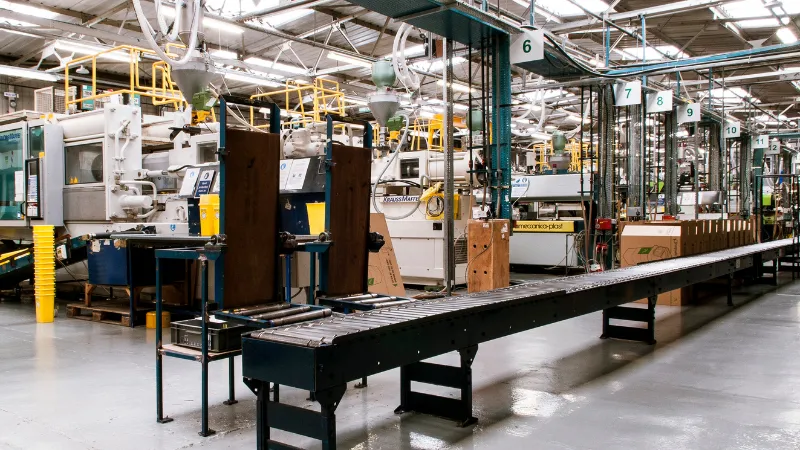

Practically speaking, watch recipe factors that often “carry through” into your process: fat, fiber, and particle size change extrusion behavior and drying speed. Link target values like moisture, water activity (aw), bulk density, and kibble size early to process settings and measurement moments. That keeps batches more comparable and makes your quality more stable.
This usually takes more design time than a standard layout. What you often get back: more right-first-time runs, less extra drying, less rework, and less sieve loss to get within spec.
Hygienic design is what makes or breaks your availability
Hygienic design limits downtime and makes changeovers predictable. You notice it most in places where product can hang up. A smart design prevents fast buildup of contamination, makes cleaning go quicker, and helps you get back to stable operation sooner after a restart. That brings calm: less product residue, less dust buildup, and more control during allergen changeovers.
At its core, it’s about practical choices: good access around bends, transitions, and under conveyors; fewer places where product can cake on (for example behind flanges, in open profiles, or at edges that drain poorly); a logical separation between wet and dry steps so dry zones stay dry and wet zones don’t unnecessarily catch dust; and a cleaning concept that fits your process, with dry cleaning where it works and wet cleaning or CIP where it makes sense.
Keep in mind this often requires extra space, more points for disassembly, and sometimes a higher investment. A simpler alternative can also fit if your portfolio is stable, you have few changeovers, and your cleaning follows a fixed routine.
Bottlenecks often aren’t in the extruder
With a solid line analysis, you can see where the real limitation is, so your budget doesn’t automatically go to a bigger extruder while the brake is somewhere else. Often the limit is in the dryer, cooler, sieve, or coating. Signals include fluctuating final moisture, product coming out of the cooler warmer or more clammy, a sieve running erratically because it’s loaded up, or coating taking unevenly so walls get sticky faster. Fix those root causes and the whole line improves.
Is your downtime mainly driven by cleaning and product changeovers? Then focusing on cleanability, zone separation, and fixed changeover agreements delivers immediate gains. Are deviations mainly in moisture or aw? Then get drying, cooling, and measurement points in order. Only after that does more speed really make sense.
Measure in-line, so you don’t have to fix it afterward
In-line measurement gives you control earlier, so you don’t only discover after final inspection that you need to correct. By tracking trends during production, you can adjust sooner and your run becomes more predictable.
Think of moisture measurement after drying (with spot checks for aw), checks on kibble size and fines after cutting and sieving, and coating uniformity by checking per run, feeling, and weighing uptake. This requires standard ways of working, training, and sensor maintenance. What you often get back: more stable quality and more predictable changeover time, because you don’t have to run on gut feel as much.
Recommended Stories for You

Team SR Mar 18, 2026

Team SR Mar 3, 2026

Team SR Feb 7, 2026


Team SR Dec 19, 2025

Team SR Jan 16, 2026
Trending Stories

How In-App Communities Turn Engagement into Revenue

Why a Security-First Culture Matters in Early-Stage Companies

The 5 Best Three Pocket Apron Brands For Your Hospitality Business

Connecting Your Monitor with Reliable Video Quality

Designing Work Around Life: Rethinking Flexibility in Global Teams

How Structured Data and Local Signals Work Together to Boost Visibility
Top Tips for Building Up Your Welding Business

What Is an Online Business Networking Platform and How Does It Work?