

Moniepoint vs OPay: Business Model, Funding, Products and Growth Compared
Sep 27, 2026 | By Kailee Rainse
 Follow us
 Follow us
Fintech sector is one of fastest growing and technically completed sector in the world. Many new invention and innovation is carrying out in this sector.
In this article we are comparing two fintech startups in Africa Region. Moniepoint and OPay are two of the most prominent names in the market. Both companies provide digital financial services, payments, banking products and Point-of-Sale (POS) solutions, but they have developed their businesses around somewhat different strategies.
Moniepoint has built a strong position around business payments, banking, credit and financial management tools, particularly for small and medium-sized businesses. OPay has developed a broader consumer and merchant financial ecosystem, combining payments, transfers, savings, cards, POS services and other financial products.
This Moniepoint vs OPay comparison examines their history, business models, products, funding, customer reach, regulatory position, technology, expansion and key differences.
Moniepoint vs OPay: Quick Comparison
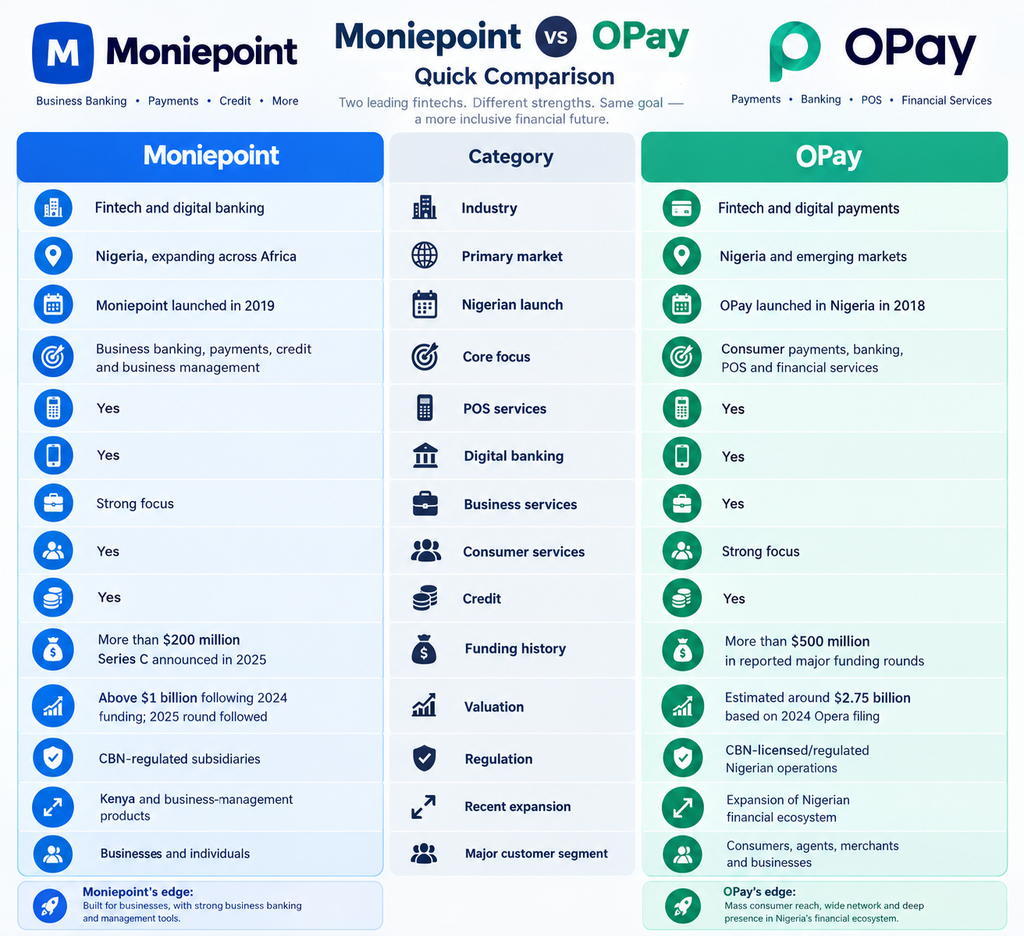
These two startups are compete across several overlapping areas, particularly POS payments, digital banking, merchant services and financial inclusion, while their broader product strategies differ.
1. What Is Moniepoint?
Moniepoint is an African financial technology company that provides payments, banking, credit, cross-border payments and business-management services.
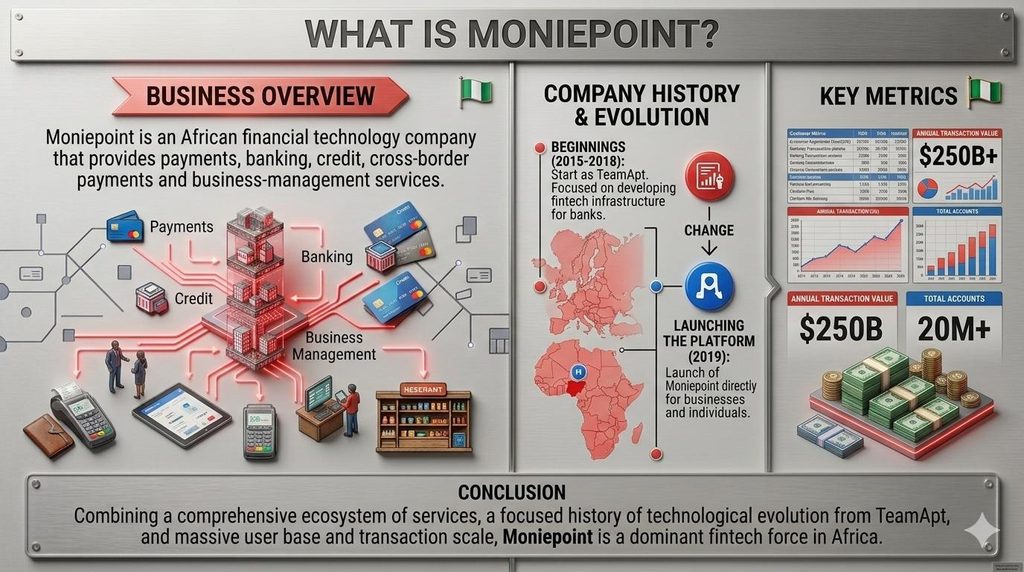
Moniepoint has developed a particularly strong position in Nigeria's merchant and business payments market.
Moniepoint Microfinance Bank is licensed and regulated by the Central Bank of Nigeria, with deposits insured by the Nigeria Deposit Insurance Corporation.
Moniepoint's Business Model
Moniepoint's strategy is increasingly centered on becoming an all-in-one financial platform for businesses.
Rather than providing only payment processing, the company combines payments with banking, credit and business-management tools.
This creates an ecosystem in which a business can potentially use the same platform to:
- Accept payments
- Manage its bank account
- Access business credit
- Manage expenses
- Track sales
- Manage inventory
- Handle bookkeeping
The company's acquisition of restaurant-management platform Orda Africa in March 2026 expanded this strategy into the food-service industry. Orda's capabilities include inventory management, reporting, microsites, staff management and restaurant business tools.
2. What Is OPay?
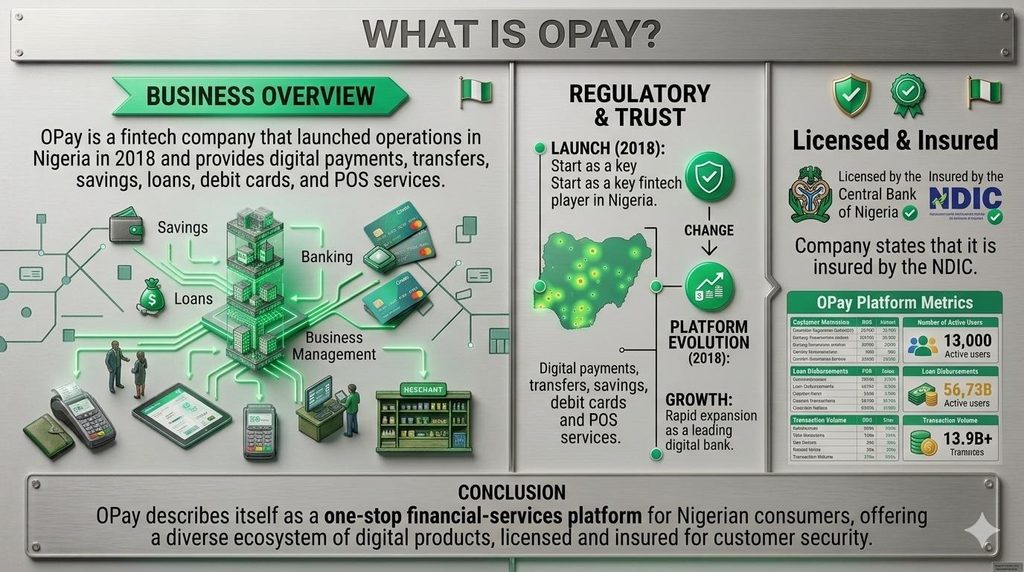
OPay is a fintech company that launched operations in Nigeria in 2018 and provides digital payments, transfers, savings, loans, debit cards and POS services.
RECOMMENDED FOR YOU


OPay has developed a large consumer and agent network in Nigeria. In June 2026, the company said it had surpassed 45 million users and more than 1 million merchants and businesses in Nigeria.
3. Moniepoint vs OPay: Business Model
The most important difference between the companies is their strategic emphasis.
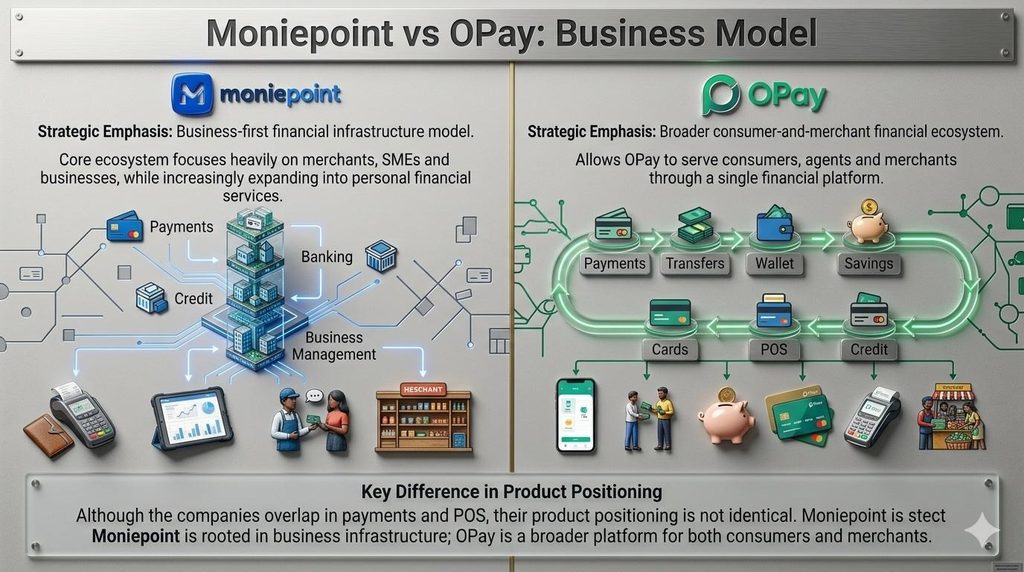
Therefore, although the companies overlap in payments and POS, their product positioning is not identical.
4. Moniepoint vs OPay: Funding and Investors
Funding is another major part of the comparison.
Moniepoint Funding
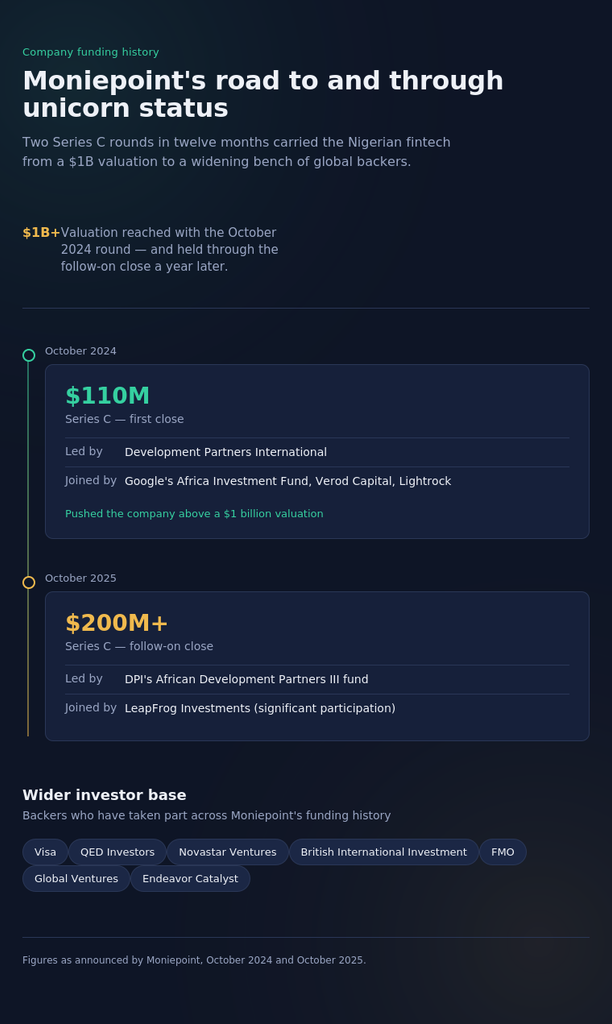
Its investor base has also included Visa, QED Investors, Novastar Ventures, British International Investment, FMO, Global Ventures and Endeavor Catalyst.
OPay Funding
OPay has also attracted substantial international investment.
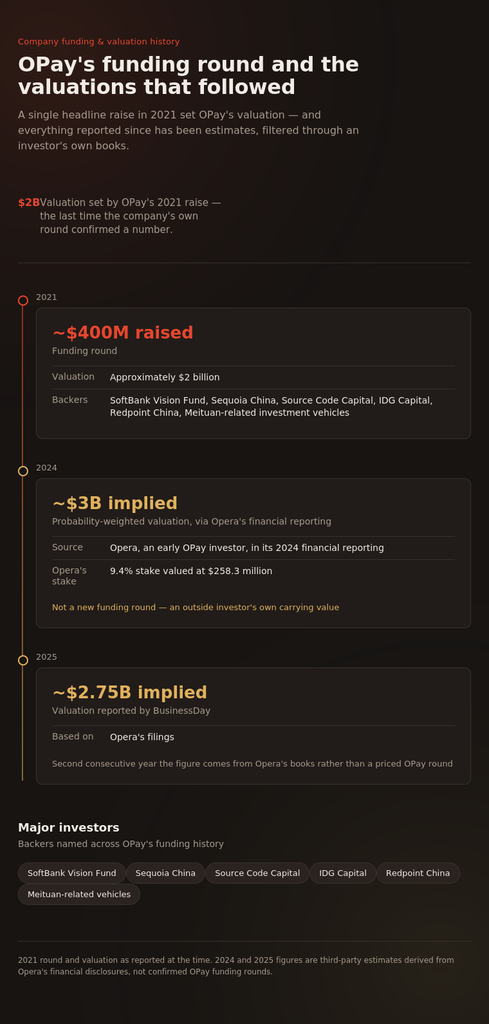
Because OPay is privately held, these valuation figures should be described as estimated or implied valuations, rather than a publicly traded market capitalization.
5. Moniepoint vs OPay: Customer Reach
Both companies have achieved substantial scale in Nigeria.
Moniepoint currently reports more than 20 million business and individual accounts across its broader African platform and says it processes more than $250 billion in annual digital payment transaction value.
OPay reported strong growth during 2025. According to BusinessDay's reporting on the company's performance, OPay processed approximately $358 billion in gross transaction value in 2025, compared with $166.2 billion in 2024. Monthly active users reached approximately 39.3 million in 2025, compared with 25.1 million in 2024.
These figures should not be treated as a perfect like-for-like comparison because the companies disclose their metrics differently.
6. Moniepoint vs OPay: POS and Merchant Services
POS services are one of the clearest areas of competition.
Moniepoint has built a major merchant-acquiring network in Nigeria and says it powers most of the country's POS transactions. The company describes itself as Nigeria's largest merchant acquirer.
OPay has also developed a large POS and agent network, with more than one million merchants and businesses reported in 2026.
The two platforms therefore compete directly for parts of the same market:
- Retail shops
- Small businesses
- Market traders
- POS agents
- Service businesses
- Informal-sector businesses
- Consumers using digital payments
The competitive environment is also shaped by Central Bank of Nigeria requirements covering payment terminals. The CBN has required licensed operators, including Moniepoint and OPay, to comply with terminal geo-location and related payment-system requirements.
7. Moniepoint vs OPay: Technology and Product Strategy
Moniepoint's technology strategy increasingly connects financial services with business software.
Its current product ecosystem includes payments, banking, credit and business-management tools. The Orda Africa acquisition adds restaurant-specific inventory, reporting, staff-management and other operational capabilities.
OPay's product strategy is more centered around a broad digital financial ecosystem.
Its platform combines payments, transfers, savings, cards, airtime/data services, bills and POS services. The company also says it uses technology to improve financial inclusion and transaction security.
In 2026, OPay was also reported to be strengthening fraud detection using AI and data-analysis systems, including more than 5,000 blocking rules.
8. Moniepoint vs OPay: Geographic Expansion
Moniepoint has increasingly positioned itself as an African financial platform rather than a Nigeria-only fintech.
In 2026, the company was preparing its entry into Kenya following the acquisition of Sumac Microfinance Bank. Moniepoint describes Kenya as its first market outside Nigeria and an important step in its East African expansion strategy.
OPay has also pursued an emerging-market strategy, with Nigeria remaining one of its most important markets. Opera describes OPay as a fintech operating in emerging markets across Africa and Asia.
9. Moniepoint vs OPay: Regulatory Position
Regulation is particularly important when comparing Nigerian fintech companies.
Moniepoint
Moniepoint Microfinance Bank is licensed and regulated by the Central Bank of Nigeria, while its deposits are insured by the NDIC. Moniepoint's parent group also includes TeamApt, a CBN-licensed switch and processor.
OPay
OPay states that its Nigerian operations are licensed by the CBN and insured by the NDIC. The CBN's published payment-service-provider information also lists OPay Digital Services Limited under the mobile-money-operator category.
For consumers and businesses, regulatory status is an important part of evaluating any financial technology platform.
10. Moniepoint vs OPay: Key Differences
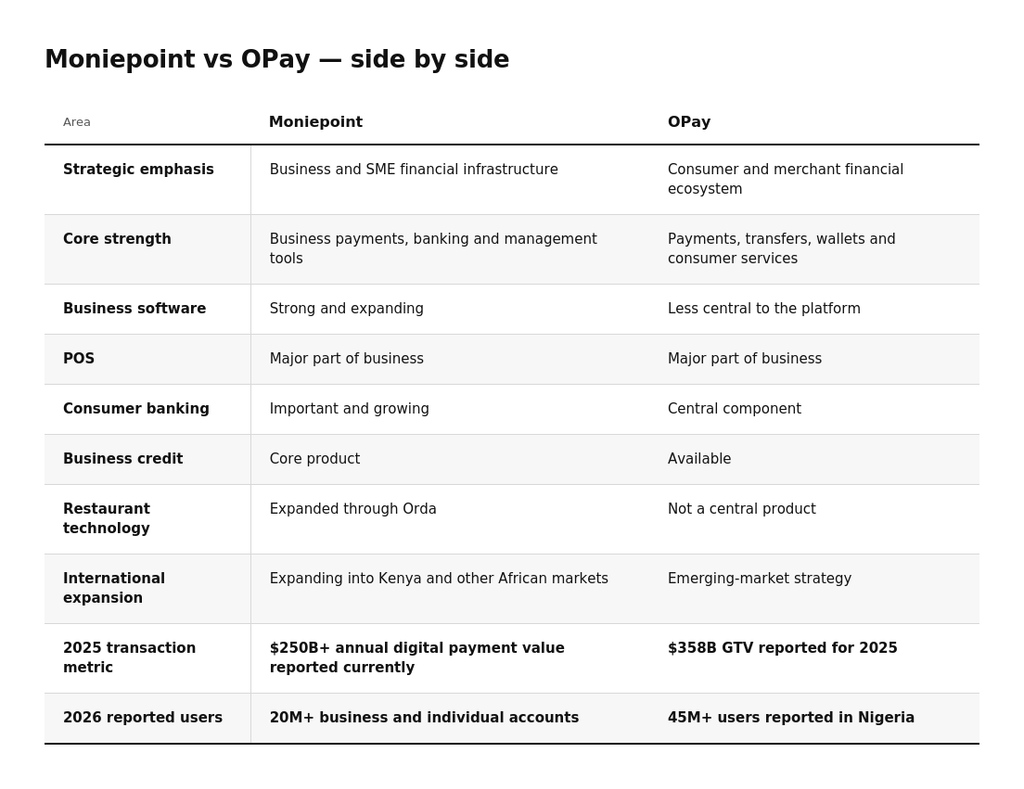
The metrics should be interpreted carefully because “accounts,” “users,” and “gross transaction value” are different measurements and do not provide a direct apples-to-apples ranking.
11. Moniepoint vs OPay: Growth Opportunities
The next phase of competition is likely to involve more than basic payments.
For Moniepoint, growth opportunities include:
- SME banking
- Business credit
- Business-management software
- Cross-border payments
- Merchant acquiring
- Restaurant technology
- Expansion into other African markets
The company's Orda acquisition and Kenya expansion illustrate this broader strategy.
For OPay, opportunities include:
- Consumer digital banking
- Merchant services
- POS and agency banking
- Savings and lending
- Digital payments
- Financial inclusion
- Fraud prevention and financial security
- Expansion of its emerging-market financial ecosystem
OPay's reported 2025 transaction growth and increasing active-user base demonstrate the scale of its existing Nigerian operation.
12. Moniepoint vs OPay: What Makes the Comparison Interesting?
Moniepoint and OPay started from different strategic directions but increasingly overlap.
Moniepoint evolved from financial infrastructure for banks into business-focused fintech, eventually adding banking, credit and business-management products.
OPay developed from a technology-driven payments platform into a broad consumer and merchant financial ecosystem.
As both companies expand their financial products, the distinction between payments, banking, lending and business services is becoming less clear.
That makes Moniepoint vs OPay a useful case study of how African fintech startups are moving from individual financial products toward broader financial ecosystems.
Frequently Asked Questions
Is Moniepoint the same as OPay?
What is Moniepoint known for?
What is OPay known for?
Are Moniepoint and OPay competitors?
Is Moniepoint regulated in Nigeria?
Is OPay regulated in Nigeria?
How much funding has Moniepoint raised?
What was OPay's valuation?
Does Moniepoint operate outside Nigeria?
Conclusion
Moniepoint and OPay represent two different approaches to building a large African fintech ecosystem.
Moniepoint has developed from banking and payment infrastructure into a broader platform combining business payments, banking, credit, cross-border services and business-management software.
OPay has built a broad digital financial ecosystem around payments, transfers, consumer banking, savings, cards, POS and merchant services.
Their overlapping presence in payments and POS makes them direct competitors in several parts of Nigeria's fintech market, while their different product strategies make the comparison particularly useful for understanding the evolution of African financial technology.
As both companies continue expanding their products and geographic reach, their growth will depend on factors including customer adoption, financial-product expansion, regulatory requirements, technology investment, merchant networks and the broader development of digital payments across Africa.
Recommended Stories for You

Team SR Feb 9, 2026

Team SR Dec 16, 2025

Kailee Rainse Sep 5, 2025

Team SR Dec 6, 2025


Team SR Mar 26, 2025
Trending Stories

How to Cope with a Startup Closing: Ruslan Tymofieiev Breaks Down Main Points

Modern Slavery Policy vs Statement: Why You Need Both

The Future of PropTech: How AI Interior Design Startups Are Transforming Real Estate and Home Renovation Markets

Streamlining Payments: A Guide for Service-Based Businesses

The Connection Between Hosting and Brand Reputation

F-01 Fireguard Practice Test 2025: Complete Study Guide to Pass Your Fire Safety Exam with Confidence
Top Influencer Marketing Agencies in Europe for Startups in 2025

Top Digital Marketing Agencies According to Client Reviews