

How Much Water Does AI Use? The Real Impact of AI Data Centers
Oct 3, 2026 | By Oliver Bennett
 Follow us
 Follow us
When people talk about the environmental impact of artificial intelligence, electricity usually gets most of the attention. But there is another resource quietly tied to the growth of AI: water.
AI models run in data centers, and data centers generate a lot of heat. Keeping servers from overheating can require cooling systems that use water. As AI becomes more widely used and companies build larger data centers, the amount of water needed to support that infrastructure is becoming an increasingly important issue.
So, how much water does AI actually use?
The answer isn’t as simple as saying that one AI prompt uses a certain number of milliliters. Different studies have produced very different estimates because they measure different models, workloads, cooling systems, power sources, and locations.
More importantly, a data center does not design its water system around the average number of water used per AI prompt. It has to prepare for periods of peak demand, especially during very hot weather.
That is where the bigger water question begins.
Why Does AI Need Water?
AI itself doesn’t drink water, of course. The water is mainly connected to the infrastructure used to run AI systems.
Large data centers contain powerful servers that produce substantial amounts of heat. Cooling systems have to remove that heat to keep the equipment operating safely.
One common approach is evaporative cooling, where water helps absorb and remove heat. Some of that water is consumed through evaporation and therefore needs to be replaced.
There can also be an indirect water footprint. Electricity generation itself can require water, depending on the type of power plant producing the electricity.
So when researchers estimate AI’s water use, they may be looking at more than the water physically consumed inside a data center.
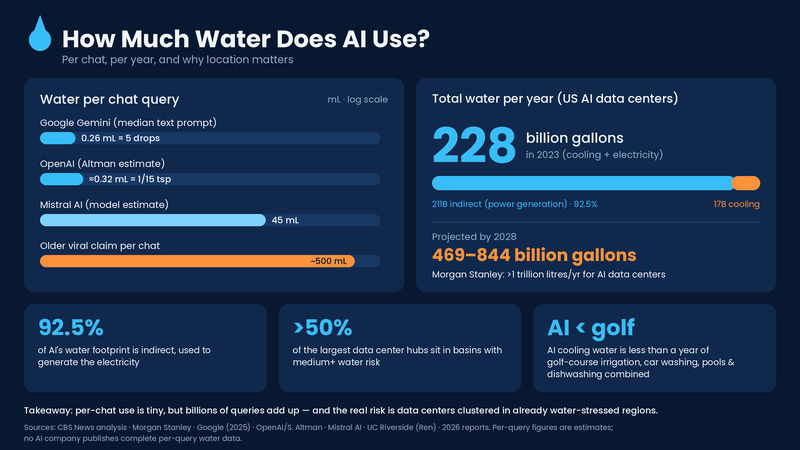
How Much Water Does One AI Prompt Use?
This is where things get complicated. As per the widely reported 2024 estimate, The Washington Post and academics at the University of California, Riverside, an average U.S. data center may need almost 519 milliliters of water to generate a 100-word email using GPT-4.
That estimate included water used for cooling as well as water associated with generating the electricity required to run the system.
However, that figure has since been revised by researcher Shaolei Ren of UC Riverside. A newer estimate puts the amount closer to 15 milliliters for a GPT-4 prompt, including approximately 5 milliliters associated with on-site cooling.
Sam Altman has also stated that an average ChatGPT query uses approximately 0.000085 gallons, which works out to about 0.32 milliliters.
Another 2025 benchmarking study produced yet another range. Its findings suggested that some efficient AI models used less than 2 milliliters across the test workloads, while some reasoning models exceeded 150 milliliters per query.
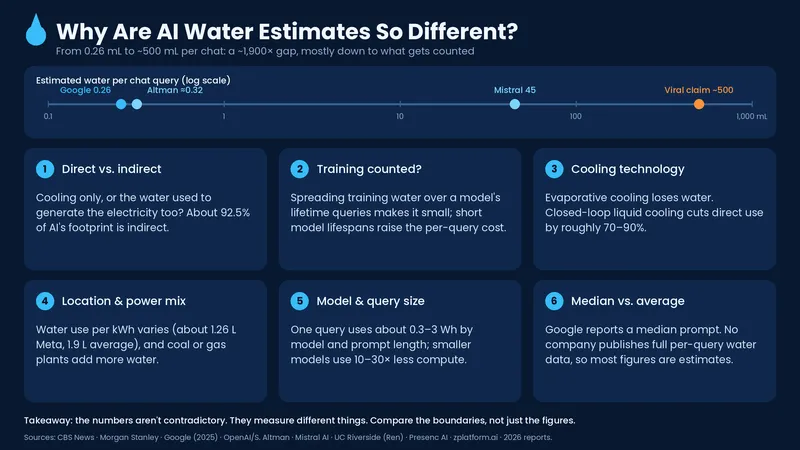
At first glance, these numbers look contradictory. They aren’t necessarily measuring the same thing.
The estimate can change depending on:
- The AI model being used
- How long the response is
- How much computing is required
- The hardware involved
- The cooling system
- The data center’s location
- The source of electricity
- Whether direct and indirect water use are included
That is why asking for one universal number for “how much water AI uses” can be misleading.
Why Are AI Water Estimates So Different?
Imagine asking two businesses how much water they use.
One might count only the water coming directly from its building. Another might include the water used to produce the electricity that powers the building.
You would naturally get different numbers. The same basic problem applies to AI water estimates.
Some calculations focus on direct water consumption, such as water used in cooling. Others include the water associated with electricity generation. Some look at a particular prompt or task, while others consider broader data-center operations.
Even the AI workload matters. A short, simple question may require far less computing than a long request involving complex reasoning, a large output, or repeated processing.
This is why a single “AI uses X milliliters per prompt” figure doesn’t tell the entire story.
What Happens During Peak Water Demand?
This may actually be the more important question for communities.
A data center might consume a certain amount of water on an average day, but local water systems have to be prepared for much higher demand during extreme heat.
Research from UC Riverside and Caltech found that daily water demand associated with evaporative cooling can rise to roughly six to 10 times the annual average during hot weather.
That is a very different way of looking at the problem.
A city’s water system isn’t built around the amount of water used during an ordinary Tuesday. It has to be capable of handling periods when demand reaches its highest point.
This means a seemingly reasonable annual water consumption figure can hide a much bigger infrastructure challenge.
How Much Water Do U.S. Data Centers Use?
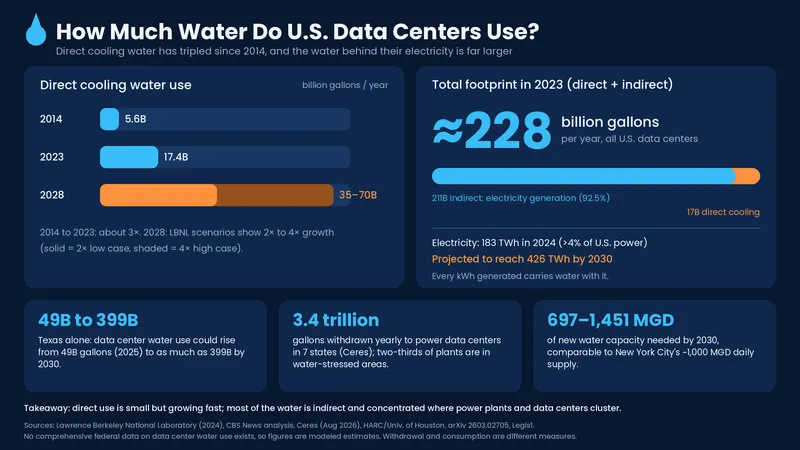
AI is only part of the data-center industry, so it is important not to treat all data-center water consumption as AI water use.
A 2024 Berkeley Lab report estimated that all U.S. data centers, not just AI facilities, directly consumed around 17.4 billion gallons of water in 2023.
The report also projected that direct water consumption from hyperscale data centers could reach between 16 billion and 33 billion gallons per year by 2028.
Those numbers provide a sense of scale, but annual totals don’t tell utilities everything they need to know.
A community still needs to know how much water a large facility may require on its hottest days.
Could Data Centers Require Billions in New Water Infrastructure?
A UC Riverside study conducted with Caltech estimated that U.S. community water systems could need between $10 billion and $58 billion in new infrastructure by 2030, depending on how quickly data centers expand and assuming that new efficiencies do not significantly reduce water demand.
That infrastructure could include additional treatment capacity, pipelines, storage, pumps, and other systems needed to serve new demand.
This creates an important financial question. Who pays for the extra infrastructure?
If a city needs to extend its water system in order to accommodate a huge data center, local companies and citizens may have to foot the bill for infrastructure that was primarily motivated by a new industrial client.
That is why water demand is increasingly becoming part of the conversation around data-center development.
Why Peak Demand Matters More Than the Average
An annual average can make water consumption look much less concerning than it may be during a heat wave.
For example, a facility could have moderate water consumption across most of the year but require millions of gallons on a particularly hot day.
The UC Riverside and Caltech researchers estimated that U.S. water systems could need another 697 million to 1.45 billion gallons of peak daily capacity by 2030 if new efficiency improvements do not reduce demand.
That is roughly comparable to the daily water supply of New York City.
The challenge is that much of this additional capacity may sit unused during ordinary periods. But utilities still need to build, finance, operate, and maintain it because it is needed when demand peaks.
This is one reason water planning for AI infrastructure is about much more than counting prompts.
How Do Cooling Systems Change AI’s Water Use?
RECOMMENDED FOR YOU
How to Manage Startup Apps in Windows and Make Your PC Start Faster
Oliver Bennett
Sep 23, 2026


Not every data center uses water in the same way.
Different cooling technologies come with different trade-offs.
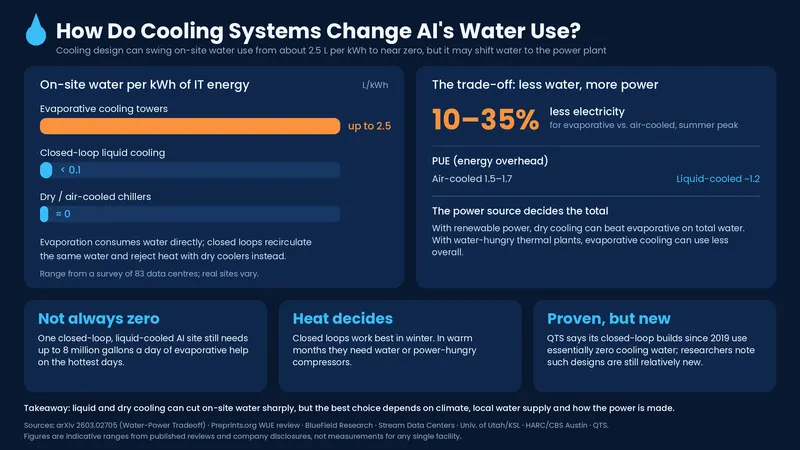
Evaporative cooling can be efficient at removing heat, but it uses water.
Air cooling and dry cooling can reduce direct water consumption, but they may require more electricity.
That creates an interesting balance. A company may reduce its direct water use by switching to a system that requires more power. But electricity generation can have its own water footprint.
The water impact therefore depends partly on how the electricity is generated.
A data center operating in a region where electricity comes from water-intensive power sources may have a different overall water footprint from a similar facility powered by another energy mix.
Does Closed-Loop Cooling Solve the Problem?
Closed-loop cooling can significantly reduce the amount of new water needed for cooling because water can circulate through the system rather than constantly being replaced.
But “closed loop” doesn’t automatically mean zero water use.
The heat still has to go somewhere.
A facility ultimately needs a way to release that heat, whether through air, evaporation, or a combination of cooling technologies.
So closed-loop systems can reduce direct water consumption, but the complete environmental picture depends on the design of the facility and the way heat is ultimately removed.
Why Does the Location of an AI Data Center Matter?
Location can make a huge difference.
A data center being built in a cool, water-rich area may have very different challenges from one being built in a hot region that already experiences water shortages.
The local climate matters because hotter conditions can increase cooling requirements.
The availability of water is important since a facility requires a consistent supply, even in times of drought or other constraints.
The electricity supply matters because the power used by the facility can carry an indirect water footprint.
In other words, choosing where to build a data center can influence its environmental impact long before the servers are switched on.
Who Should Pay for New Water Infrastructure?
This is becoming an important business and policy question.
When a major data center creates a need for new pipelines, treatment capacity, storage, or other water infrastructure, there is a question about whether those costs should be absorbed by the wider community or assigned to the company creating the additional demand.
The UC Riverside and Caltech researchers recommend that developers contribute toward verifiable improvements to local water systems rather than leaving the entire financial burden with local ratepayers.
For businesses and local governments, these details are worth addressing before construction, rather than after a facility has already begun operating.
What Should Companies and Local Governments Ask Before Approving a Data Center?
A simple annual water-consumption estimate isn’t enough.
Before approving a major data-center project, decision-makers should understand its expected peak daily water demand, particularly during extreme heat.
They should also know where the water will come from, what happens during drought restrictions, how direct water consumption differs from the water footprint of electricity use, and who will finance any necessary upgrades to the local water system.
Putting these requirements into development agreements can make responsibilities much clearer.
For companies, these numbers are also important when estimating the long-term cost of operating at a particular location.
Does Every AI Prompt Have a Significant Water Footprint?
The environmental impact of a single prompt can be quite small, particularly when compared with the amount of water people use for everyday activities.
The problem is scale. Billions of AI interactions, combined with the water needed to cool increasingly large data centers, can create substantial demand even when individual requests require relatively little water.
This is similar to many other technologies. One individual transaction might have a small resource footprint, but millions or billions of transactions can create a very different outcome.
That is why national and local infrastructure planning matters more than viral comparisons involving a teaspoon, bottle, or glass of water.
Can AI Data Centers Reduce Their Water Use?
Yes, there are several ways operators can work toward lower water consumption.
More efficient cooling systems can reduce direct water use. Closed-loop technologies can limit the amount of fresh water required for cooling. Better server efficiency can also reduce the amount of heat that needs to be removed.
Choosing an appropriate location can make a difference as well.
However, reducing direct water use does not automatically eliminate the wider environmental impact. A cooling system that uses less water may consume more electricity, so companies need to consider both sides of the trade-off.
The goal should be to look at the complete resource footprint rather than focusing on one number in isolation.
So, How Much Water Does AI Use?
There is no single number that accurately describes every AI system.
For some individual AI jobs, estimates can vary from less than a milliliter to well over 150 milliliters, depending on the model, workload, cooling technology, location, and accounting technique.
The source figures show why these estimates should not be treated as directly interchangeable.
For an individual user, the water associated with one prompt may seem tiny. At the level of a massive data center, however, the bigger issue is the peak water demand needed to keep thousands of servers operating during the hottest periods of the year.
That is where AI’s water footprint becomes an infrastructure issue rather than just a per-prompt statistic.
Conclusion
The question “How much water does AI use?” sounds like it should have a simple answer.
Different studies produce different numbers because they measure different systems and use different assumptions. A prompt that requires very little computing may have a tiny water footprint, while a more demanding workload can require considerably more resources.
But focusing only on the amount of water used for one AI query can distract from the larger issue.
Data centers need cooling, and cooling systems need to be designed for peak conditions. During very hot weather, water demand can climb dramatically. Communities may then need additional pipes, treatment capacity, storage, and other infrastructure to support large new facilities.
FAQs
How much water does ChatGPT use per question?
Why does AI use water?
Does every AI prompt use the same amount of water?
Why are estimates of AI water use so different?
Is AI water use a serious environmental concern?
Recommended Stories for You

Team SR Aug 25, 2024

Oliver Bennett Jan 4, 2025

Oliver Bennett Sep 17, 2026

Team SR Sep 20, 2024

Oliver Bennett Sep 23, 2026

Team SR Dec 12, 2025
Trending Stories

Top Student Startup in Europe

How UK Entrepreneurs Drive Economic Growth and Create Jobs

Best Venture Capital Firms London 2024

The Top Disruptar brand, Revolutionizing the European

Business Credit Cards For Startups

Startups Hit €200 Million+ in 2024 Funding Report

Startup Ecosystem Of Netherlands

Top Incubators And Accelerator Of UK