

Europe And China To Launch SMILE Space Mission To Shield Global Economy
Apr 9, 2026 | By Kailee Rainse
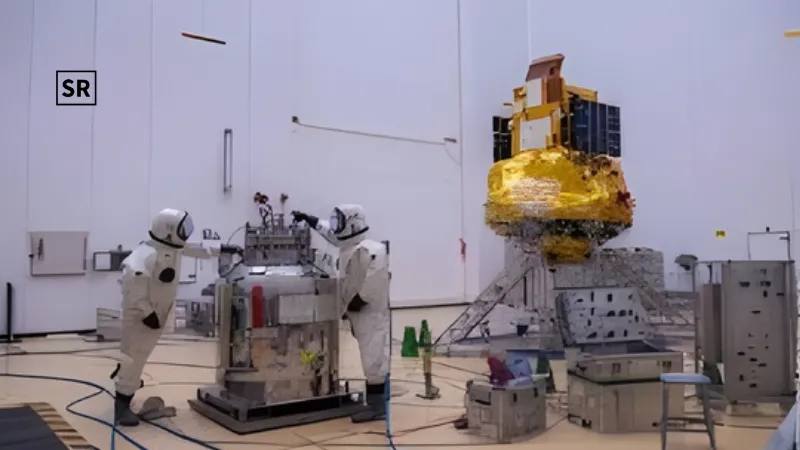
The European Space Agency (ESA) and the Chinese Academy of Sciences (CAS) will launch SMILE (Solar Wind Magnetosphere Ionosphere Link Explorer) aboard a Vega-C rocket from French Guiana.
SUMMARY
- The European Space Agency (ESA) and the Chinese Academy of Sciences (CAS) will launch SMILE (Solar Wind Magnetosphere Ionosphere Link Explorer) aboard a Vega-C rocket from French Guiana.
 Follow us
 Follow us
This marks the first space mission ever fully jointly designed, built, launched, and operated by ESA and China.
The 2,300 kg satellite will orbit up to 121,000 km above Earth to study how solar wind interacts with the planet’s magnetosphere the invisible shield that protects life on Earth. The findings will have major implications for safeguarding satellites, GPS systems, power grids, financial networks, and global communications from space weather disruptions.
SMILE has been nearly a decade in the making. Selected in 2015 from 13 proposals under a joint ESA–CAS call, the mission began development in 2016 and has since endured technical setbacks, COVID delays, export control issues and growing geopolitical tensions. Its launch in 2026 is itself a significant milestone.
RECOMMENDED FOR YOU


Wrksense Funding News – Irish HRtech startup Wrksense raises €825k Pre-Seed
Team SR
Oct 18, 2024
Moore Kingston Smith Acquires Insolvency Specialist CBW Recovery
Kailee Rainse
Aug 4, 2025
Read Also - Spanish Startup Sybol Raises Over €1M To Scale Digital Identity And Verification Platform
Scientifically, SMILE will provide the first comprehensive, simultaneous view of how Earth’s magnetosphere responds to solar activity. It carries four instruments a soft X-ray imager, ultraviolet aurora imager, light ion analyser, and magnetometer working together during up to 40 hours per orbit of observation.
The mission is a collaboration between ESA (with Airbus in Spain building the payload module) and CAS (responsible for the service module and three instruments), involving over 250 scientists across Europe and China.
Beyond science, SMILE addresses a critical global risk space weather. Geomagnetic storms triggered by solar activity can disrupt satellites, collapse power grids and impact global financial systems. Historical events like the 1989 Quebec blackout highlight the real-world consequences, while a major solar storm today could cause trillions in economic losses.
Although SMILE will not prevent such events it will significantly improve forecasting capabilities enabling earlier warnings and better protection for critical infrastructure. In the future, AI-driven analysis of space weather data could make solar storm prediction as routine as weather forecasting.
The mission also represents a rare example of deep international cooperation in space science. It is the first ESA–China mission fully designed, launched and operated jointly, despite a complex geopolitical environment.
Recommended Stories for You
Kailee Rainse Dec 2, 2024

Team SR Jun 11, 2024


Kailee Rainse Aug 15, 2025

Team SR Jan 16, 2024

Kailee Rainse Nov 21, 2024
Trending Stories

Nvelop Funding News- Finnish Startup Nvelop Secures €1.2 Million In Seed Round

German PropTech Arbio Raises €31M To Launch AI-Powered Holiday Rental Platform

One2Treat Secures Funding To Accelerate Platform Development And Expands Offices To Support Rapid Growth

Aspire11 Launches €500M Global Fund To Deliver Venture-Style Returns For European Pensioners

UK-based yetipay Secures £3.5M To Growth Its Payments Platform
Destinus Raises €50M, Total Funding Approaches €400M

Model ML Raises €65 M Its AI Beats McKinsey And Bain Benchmarks With Under-3-minute Output Checks

S4labour Funding News- S4labour Raises £4Mn Funding From YFM Equity Partners