

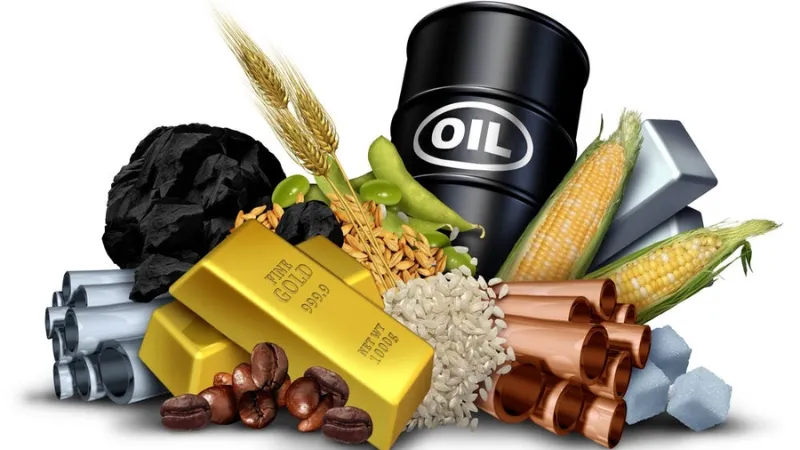
Commodities are at the foundation of the global economy, and many traders prefer these assets for their volatility and high liquidity. They can experience stronger price swings than major Forex pairs but are regarded as more established and predictable markets than most crypto assets.
 Follow us
 Follow us
In fact, commodities cover the full spectrum of trading preferences, offering everything from safe-haven assets like gold to volatile opportunities like crude oil.
Many traders gain exposure to commodities because they often react promptly to geopolitical events and scheduled or unexpected developments impacting supply and demand. Due to this sensitivity to world events, these assets usually attract traders who rely on fundamental analysis.
Commodities are also in a league of their own when it comes to price action, as bulls and bears fight on the business field rather than in the trading realm. Producers, consumers, governments, and other market participants can all influence prices, requiring close monitoring from a technical analysis perspective as well.
RECOMMENDED FOR YOU


Niobrix.co Review: Separating Trading Outcomes From Platform Functionality
Team SR
Apr 13, 2026

Therefore, the best approach is to combine technical and fundamental analysis. Traders can easily do this through platforms offering contracts for difference (CFD) derivatives on commodities, such as Moneta Markets, which provides a dedicated commodity trading venue at Moneta Markets.
Should retail traders care about merging these two approaches? The thing is, Bollinger Bands and balance sheets don’t usually get compared side by side, but a 2025 study did exactly that. Researchers Yadav and Giri, writing in the Journal of Marketing & Social Research, found that traders testing indicators like RSI and MACD against fundamental supply-and-demand factors performed best when they blended both approaches.
Advantages of Combining Technical and Fundamental Analysis
As you know, these two approaches work differently: fundamental analysis tries to explain why a commodity moves in a certain way, while technical analysis can help determine when to enter and exit the market.
Therefore, the main advantage is that traders get a fuller picture of commodity market behavior. By combining the two, they know why the price changed direction or accelerated and determine the best way to speculate on these fluctuations.
Ignoring one of the two can lead to losses. For example, it’s hard to imagine an oil trader closing their eyes on what happens in the Strait of Hormuz only to focus on resistance and support levels. A single unexpected event can quickly push their positions into a loss.
Merging the two isn’t simply a precaution to avoid unexpected losses but can genuinely strengthen the trading results over time. Some of the advantages include better timing to enter and exit markets, improved risk management thanks to clear support and resistance levels along with other signals from technical tools, as well as the ability to filter false signals. For example, a technical breakout should be treated with caution if fundamentals contradict it.
In other words, fundamentals can provide the direction, while technical analysis can help with timing and execution.
How to Use Technical and Fundamental Analysis Together
The most common approach is to start with fundamental analysis to figure out the broader context and only afterward use technical analysis to find trading opportunities and the best entry points.
For example, if you trade crude oil, you can start by monitoring OPEC+ production decisions and comments around them, EIA inventories in the US, new geopolitical developments, what US President Donald Trump said or posted, etc.
If the comments around the Strait of Hormuz coming from the US and Iranian sides are intensifying while OPEC+ countries announce production cuts, it’s a clear confluence of bullish signals for crude. For traders, it’s time to open long positions.
However, instead of going long right away, a trader can check the chart to wait for technical confirmation, such as a breakout above resistance or strengthening momentum coupled with an increase in volume.
Besides watching the news and monitoring comments, traders should follow the economic calendar, as scheduled releases can
A short guide on combining the two would look like this:
- Understand the general context and the fundamental market direction.
- Analyze the current price trend.
- Look for technical confirmation.
- Find the best entry point.
- Set stop-loss and take-profit levels.
Mistakes to Avoid
Merging fundamental and technical analysis should provide a fuller picture, but it doesn’t guarantee accurate predictions. It may happen that the two approaches generate conflicting signals, and situations like these occur more often than you may believe. One of the main reasons is that markets have already priced in a certain outcome before it even happens. For example, an apparently bullish production cut may still be followed by declining crude prices if traders were already expecting that.
Traders shouldn’t wait for every technical signal to be perfectly aligned with their fundamental analysis. The best way is to read between the lines.
Also, if fundamentals look strong, this doesn’t mean they should ignore risk management and open positions in a rush. Stop-losses and position-sizing should always be part of a strong strategy.
Last but not least, one approach shouldn’t overpower the other. In commodity trading, both analysis methods should play a key role and work in symbiosis.
Recommended Stories for You

Team SR May 28, 2024

Team SR Oct 17, 2025

Team SR Dec 11, 2025

Sophie Carter Oct 7, 2026

Team SR Apr 28, 2026

Team SR May 6, 2026
Trending Stories

Choosing Network Infrastructure for Market Research

The Blueprint for Operational Resilience: How South Australian IT Leaders Are Rethinking Infrastructure Management

Funding Decisions That Can Make or Break Early Business Growth

WordPress for Startups: Custom versus Template at Scale

Why Startups Need Process Discipline to Win, and How Planfix Builds It from Day One
The Compliance Wall Every UK Construction Startup Hits

Why Hands-On Project Oversight Still Matters in Home Remodeling

How to buy Tether TRC20 (USDT) for PayPal dollars (USD) with maximum benefit?