

Best Paternity Leave UK: Entitlements, Pay, Benefits and Best Employer Policies in 2026
Nov 5, 2026 | By Oliver Bennett
 Follow us
 Follow us
Paternity leave is an important benefit for new fathers and partners in the UK. It gives parents time to support their partners, care for their newborn babies and adjust to family life after childbirth. However, not all employers offer the same benefits. While some companies provide only the legal minimum, others offer several weeks or even months of fully paid paternity leave.
If you are looking for the best paternity leave in the UK, it is important to understand the difference between statutory paternity leave and enhanced company benefits. Your employer's policy can make a significant difference to how much time you can spend with your family without worrying about lost income.
In this guide, we explain UK paternity leave rules in 2026, how much paternity pay you can receive, eligibility requirements and what to look for when comparing employer benefits.
What Is Paternity Leave in the UK?
Paternity leave is time off work that eligible employees can take when their partner has a baby, adopts a child or has a baby through a surrogacy arrangement.
It allows fathers and partners to support the other parent and take responsibility for caring for their child during the early stages of family life.
In the UK, eligible employees can take up to two weeks of statutory paternity leave. They can take the two weeks together or separately in individual one-week blocks.
However, employers can offer better benefits through enhanced paternity leave policies. These may include longer periods of leave, full salary payments and additional parental support.
According to the UK government, paternity leave is now available from the first day of employment for eligible employees. This change came into effect on 6 April 2026.
How Much Paternity Leave Can You Get in the UK?
Under the statutory system, eligible employees can take up to two weeks of paternity leave.
The leave can be taken in two ways:
- One week: Take one full week after the child's birth or adoption.
- Two weeks: Take both weeks together or separately in two one-week blocks.
A week of paternity leave is based on your normal working week. For example, if you normally work three days a week, one week of paternity leave equals three working days.
Paternity leave cannot start before the child is born. For birth parents, it must finish within 52 weeks of the baby's birth or due date if the baby arrives early.
Some employers offer more than two weeks through their own parental leave policies. These enhanced benefits can provide greater flexibility for families.
Read Also- Titan OS Raises €40Mn to Expand Its Smart TV Platform Globally
How Much Is Statutory Paternity Pay in 2026?
Statutory Paternity Pay (SPP) is the minimum payment eligible employees can receive during their paternity leave.
For the 2026/27 tax year, the statutory weekly rate is £194.32 or 90% of your average weekly earnings, whichever is lower.
For example:
- If you earn £150 per week, you could receive £135 per week.
- If you earn £250 per week, you would receive £194.32 per week.
- If you earn £500 per week, you would also receive £194.32 per week.
Payments are subject to tax and National Insurance deductions.
The statutory payment can make it difficult for some families to manage household expenses, particularly when the other parent is also taking time off work.
This is why enhanced paternity pay is an important factor when choosing an employer. Some companies offer full salary for two weeks or longer, allowing employees to spend time with their newborn without taking a major financial hit.
Who Is Eligible for Paternity Leave and Pay in the UK?
Eligibility for paternity leave and statutory paternity pay is slightly different.
Eligibility for paternity leave
From 6 April 2026, employees can qualify for paternity leave from their first day of employment. They must:
- Be the child's biological father, the mother's husband or partner, an adopter or an intended parent through surrogacy.
- Be responsible for the child's upbringing.
- Take time off to care for the child or support their partner.
- Give their employer the required notice.
Eligibility for statutory paternity pay
Although paternity leave is now a day-one employment right, statutory paternity pay still has additional conditions.
Employees generally need to:
- Have worked continuously for the same employer for at least 26 weeks by the qualifying week.
- Earn an average of at least £129 per week before tax.
- Remain employed by the employer up to the date of birth or adoption placement.
- Meet the required notification rules.
The qualifying week is normally the 15th week before the expected week of childbirth.
This means someone who recently started a new job may qualify for paternity leave but not statutory paternity pay.
What Makes the Best Paternity Leave Policy?
Not all paternity leave policies provide the same level of support. If you are comparing employers, look beyond the statutory two weeks and consider the following benefits.
1. Full salary during paternity leave
Full pay is one of the most valuable benefits. Instead of receiving the statutory rate, employees continue to receive their normal salary for an agreed period.
2. Longer paternity leave
Some employers provide four, six or more weeks of paid paternity leave. Longer leave gives parents additional time to support their families and build a relationship with their newborn.
3. Flexible leave arrangements
A good policy allows employees to split their leave into different periods where possible. This can help parents manage childcare and family responsibilities.
4. Shared parental leave
Employers that provide additional support for shared parental leave give parents more flexibility to divide childcare responsibilities.
5. Additional family benefits
Other useful benefits include childcare assistance, flexible working hours, parental wellbeing support and the option to work remotely after returning from leave.
For many families, the best employer is not necessarily the one offering the longest leave. It is the one combining good pay, flexibility and practical support.
Paternity Leave vs Shared Parental Leave in the UK
RECOMMENDED FOR YOU



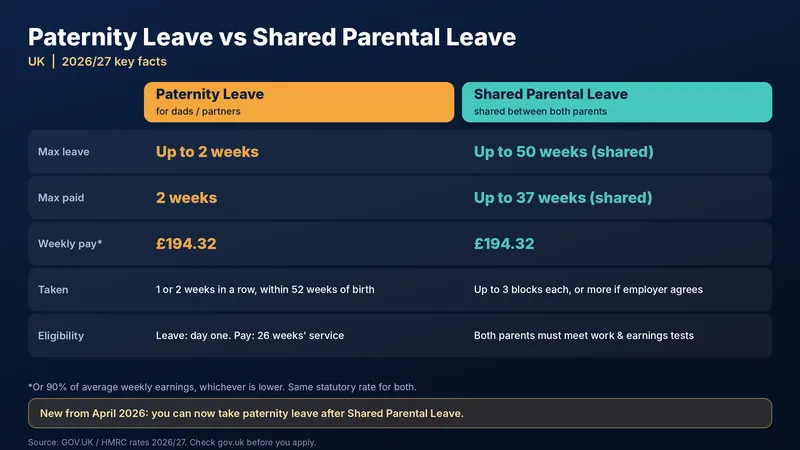
Paternity leave and Shared Parental Leave (SPL) are different options available to eligible parents.
| Feature | Paternity Leave | Shared Parental Leave |
| Leave duration | Up to 2 weeks | Up to 50 weeks shared |
| Pay | Up to 2 weeks of statutory pay | Up to 37 weeks of statutory pay |
| Flexibility | One or two weeks | Can be divided into blocks |
| Main purpose | Support the partner and child | Share childcare responsibilities |
Shared Parental Leave allows eligible parents to share up to 50 weeks of leave and up to 37 weeks of statutory pay after maternity or adoption leave and pay are curtailed.
From April 2026, eligible employees can also take paternity leave after Shared Parental Leave and Pay. This gives families more flexibility when planning time off.
How to Apply for Paternity Leave in the UK
Applying for paternity leave is relatively straightforward, but employees should plan ahead and follow their employer's notification process.
Here are the main steps:
- Check your eligibility: Confirm whether you qualify for paternity leave and statutory pay.
- Speak to your employer: Contact your HR department or manager to understand the company's paternity leave policy.
- Give advance notice: For birth parents, you should normally inform your employer about the expected week of childbirth at least 15 weeks before the baby is due.
- Confirm your leave dates: Give at least 28 days' notice before the intended start of your paternity leave.
- Complete the paperwork: Submit your employer's required form or use the relevant government process.
You do not always need to provide an exact start date when initially notifying your employer. You can indicate that you intend to start leave on the day of the birth or a specified number of days afterwards.
Different notification arrangements apply to adoption and some other circumstances.
Best Paternity Leave in the UK: What Should Employees Look For?
When searching for the best paternity leave in the UK, employees should compare the complete parental benefits package rather than focusing only on the number of weeks offered.
A company offering six weeks of fully paid leave may provide better financial support than one offering eight weeks at reduced pay.
Before accepting a job offer or planning parental leave, check:
- How many weeks of paid paternity leave are available?
- Does the company provide full salary or statutory pay?
- Can leave be taken in separate periods?
- Are partners and adoptive parents covered?
- Does the employer offer additional childcare or family benefits?
- Is flexible or remote working available after returning to work?
It is also worth checking whether enhanced benefits apply from the first day of employment or require a minimum period of service.
FAQs
1. How many weeks of paternity leave can fathers take in the UK?
Eligible employees can take up to two weeks of statutory paternity leave. They can take both weeks together or separately in individual one-week blocks. Employers can offer additional leave.
2. Is paternity leave fully paid in the UK?
Not automatically. Statutory Paternity Pay is £194.32 per week or 90% of average weekly earnings, whichever is lower, for the 2026/27 tax year. Some employers offer full salary during paternity leave.
3. Can I get paternity leave if I have just started a new job?
Yes. Since 6 April 2026, eligible employees can take paternity leave from their first day of employment. However, statutory paternity pay still requires 26 weeks of continuous employment by the qualifying week, along with other conditions.
4. Can I take paternity leave after Shared Parental Leave?
Yes. Changes introduced in April 2026 allow eligible employees to take paternity leave after Shared Parental Leave and Pay.
5. Can self-employed fathers claim statutory paternity pay?
Self-employed fathers do not normally qualify for Statutory Paternity Pay because it is an employment-based benefit. They should check whether other financial support or parental arrangements are available.
6. Do paternity leave rules apply across the whole UK?
The 2026 changes to day-one paternity leave apply in England, Scotland and Wales. Northern Ireland has separate employment legislation, so employees should check the rules applicable there.
Final Thoughts
Finding the best paternity leave in the UK means understanding both statutory rights and additional benefits offered by employers. While the legal entitlement provides up to two weeks of leave, enhanced company policies can offer longer periods of paid leave, full salary and greater flexibility.
With the April 2026 changes making paternity leave a day-one employment right, more new fathers and partners can access time off from the beginning of a new job. Before applying, compare employer policies carefully to find the benefits that best support your family and financial needs.
Recommended Stories for You

Team SR Jan 13, 2025

Team SR Jun 30, 2025

Team SR Nov 11, 2025

Oliver Bennett Dec 15, 2025

Team SR Sep 20, 2024

Oliver Bennett Oct 28, 2026
Trending Stories

Business Credit Cards For Startups

Unique Business Ideas In Marseille For 2024

Top Incubators And Accelerator Of UK

Startup Ecosystem Of Netherlands

List of European Ecommerce Unicorn

How To Start A Business Uk?

Grants From The Government To Start A Business

Passive Income Business Ideas 2024