

Can You Build a Successful Startup with Vibe Coding? Here’s What Founders Need to Know
Jun 17, 2026 | By Team SR
What Vibe Coding Actually Is and Why Founders Are Paying Attention
Vibe coding sounds like a shortcut. But the founders using it to ship real products in days aren't cutting corners. They're working with a fundamentally different stack. Instead of spending months learning to code or hunting for a technical co-founder, they describe what they want, watch the software take shape, and start testing with real people almost immediately.
 Follow us
 Follow us
That shift challenges some long-held startup wisdom. For years, the advice was clear: get a technical founder or commit to a long development runway. Vibe coding pokes a hole in that assumption. So let's get into it. This article covers what vibe coding actually is, why AI app builders have changed the math for non-technical founders, where vibe-coded startups thrive, where they hit walls, and what you still need to get right to turn a working product into a real company.
Why an AI App Builder has made vibe coding a legitimate startup strategy
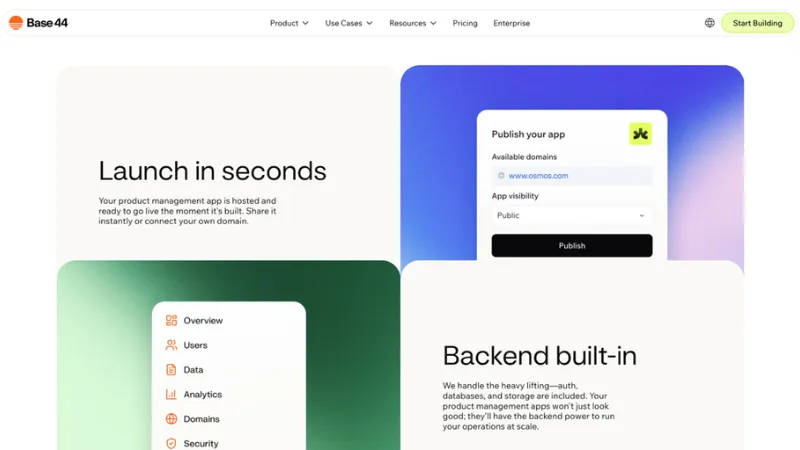
A free AI App Builder like the one Base44 offers doesn't just generate code. It lets you set up a custom app, automate your core workflows, and build processes that scale, without a single line of hand-written code. That's the foundation vibe coding startups are being built on. You bring the product vision and the understanding of your market; the tool handles the heavy mechanical work of turning that vision into something people can actually click, tap, and pay for.
This matters because the entry point for building software used to be steep. You either wrote the code yourself or paid someone who could. Now a founder with strong instincts and zero programming background can go from idea to functioning prototype in an afternoon.
The growth behind this isn't hype. GitHub's Octoverse report has tracked a sharp rise in AI-assisted development, with AI tools now contributing to a significant share of code written across major platforms. When that much of the work is machine-assisted, the line between "developer" and "non-developer" starts to blur.
RECOMMENDED FOR YOU

How IoT Is Quietly Rewiring Europe’s Cities, Cars, Factories, and Farms
Oliver Bennett
Jun 16, 2026
Is Your Business Suffering from Big Data Burnout? 5 Ways to Democratize Data
Team SR
Apr 14, 2026

Here's what an AI app builder typically handles for you:
- Core app structure: pages, navigation, and the basic logic that holds everything together
- Data and storage: where user information lives and how it moves through your app
- Workflow automation: the repetitive tasks that would otherwise eat your time
- Integrations: connecting payments, email, or other tools without manual setup
What it doesn't handle is the thinking. The strategy, the product decisions, and the market understanding still sit with you. The tool removes the technical barrier, not the business one.
What vibe coding actually is, and why founders are paying attention
Vibe coding means building software by describing what you want in plain language and letting AI generate and refine the code, rather than writing it line by line. The term came from Andrej Karpathy in early 2025, when he described a way of working where you "give in to the vibes" and let the AI handle the details while you guide it through conversation.
In practice, it looks like a back-and-forth. You type something like "add a sign-up form that sends a welcome email," the AI builds it, you test it, and you ask for changes. You're directing the work without touching the underlying mechanics. It feels less like programming and more like briefing a very fast, very literal teammate.
This approach lands especially well with founders who understand their customers deeply but have no development background. If you know exactly what your product should do but couldn't write a function to save your life, vibe coding hands you a way to build anyway.
The numbers back up how widespread AI-assisted coding has become. The Stack Overflow Developer Survey has reported that a large majority of developers now use or plan to use AI tools in their daily work. When professionals lean on these tools this heavily, it's no surprise that non-technical founders are following.
A few reasons founders are paying attention:
- Speed: working prototypes in hours, not months
- Lower cost: no need to hire developers before you've validated anything
- Control: you stay close to the product instead of translating ideas through someone else
- Iteration: changes happen in minutes, so testing ideas gets cheap
Where vibe coding startups thrive
Vibe coding isn't magic, it's a tool with clear strengths and real limits.
Where it shines:
- Rapid prototyping: you can put a clickable version of your idea in front of users almost immediately
- Low-barrier MVPs: building a minimum viable product no longer requires a development budget
- Fast iteration: feedback can turn into product changes the same day
- Cheap experimentation: you can test five ideas for the cost of what used to buy one
Where it gets tricky: - Code quality: AI-generated code can work on the surface while hiding messy logic underneath
- Security gaps: AI doesn't always account for vulnerabilities, and a small oversight can expose user data
- Technical debt: quick fixes pile up, and a product that grew fast can become hard to maintain
- Scalability limits: code that runs fine for 50 users may buckle at 50,000
There's also a dimension founders often miss: how your product performs in real hands shapes how people see your company. How a product performs in the hands of real users has a direct impact on brand reputation, especially in the early stages when trust is the entire business. A buggy launch or a security slip doesn't just frustrate users. It follows you. Customers don't care whether your code was hand-written or AI-generated. They care whether it works.
This connects to a wider truth about why startups fail. CB Insights, which has studied hundreds of startup post-mortems, consistently finds that building something nobody wants and running out of money rank among the top causes of failure, far ahead of technical problems. Poor product quality and premature scaling show up too. In other words, the danger in vibe coding rarely comes from the code itself. It comes from skipping the parts that have nothing to do with code.
What separates a vibe-coded toy from a vibe-coded business
A weekend project and a real company can use the exact same tools. The difference is everything that happens around the build. Here are the five things that decide whether your vibe-coded product becomes a business:
- Validated demand before a single prompt is written. Talk to real people first. Confirm there's a problem worth solving and that they'd pay to solve it. Building is the easy part now, but knowing what to build is the hard part.
- A clear monetization model scoped before launch, not retrofitted afterward. Decide how you'll make money early. Tacking on pricing after launch usually means rebuilding your product around it.
- A genuine feedback loop with real users from week one. Get your product in front of actual customers fast and listen closely. Their reactions should shape every iteration.
- Basic security and data privacy hygiene, even in AI-generated code. Check that user data is stored safely, connections are encrypted, and you're meeting privacy expectations. AI won't always flag these gaps, so you have to.
- A distribution strategy that doesn't assume "build it and they'll come." Plan how people will find your product. Great software with no audience is still a failure. Know your channels before you launch.
Nail these, and your vibe-coded product has a real shot. Skip them, and you've built a polished demo that goes nowhere.
Frequently asked questions
- What is vibe coding, and how is it different from traditional software development?
Vibe coding is building software by describing what you want in natural language and letting AI generate the code. Traditional development means writing that code yourself, line by line. With vibe coding, you direct the AI through conversation instead of handling the technical details directly.
- Can a non-technical founder build a real product using vibe coding?
Yes. That's the biggest change here. A founder with a clear product vision and good market understanding can build a functioning product without any coding background. The limits show up at scale and in complex systems, where some technical oversight becomes valuable.
- What are the biggest risks of launching a startup built entirely through vibe coding?
The main risks aren't technical. They're skipping validation and distribution. On the build side, watch for hidden security gaps, mounting technical debt, and code that struggles to scale as you grow.
- Which types of apps are best suited to vibe coding approaches?
Prototypes, MVPs, internal tools, and straightforward web or mobile apps work well. Products with simple logic and clear workflows are the strongest fit. Highly complex systems with strict performance or security demands need more technical attention.
- Do investors take vibe-coded startups seriously?
Increasingly, yes, but they care about traction, not tools. Investors want proof people want your product and will pay for it. How you built it matters far less than whether it works and grows.
Recommended Stories for You

Team SR Jun 3, 2026

Team SR Jul 2, 2025

Team SR Oct 28, 2025

Team SR Nov 19, 2025

Team SR Sep 13, 2025
Team SR Feb 21, 2026
Trending Stories

How to Cope with a Startup Closing: Ruslan Tymofieiev Breaks Down Main Points

Modern Slavery Policy vs Statement: Why You Need Both
The Future of PropTech: How AI Interior Design Startups Are Transforming Real Estate and Home Renovation Markets

Streamlining Payments: A Guide for Service-Based Businesses

The Connection Between Hosting and Brand Reputation

F-01 Fireguard Practice Test 2025: Complete Study Guide to Pass Your Fire Safety Exam with Confidence

Top Influencer Marketing Agencies in Europe for Startups in 2025
Top Digital Marketing Agencies According to Client Reviews