
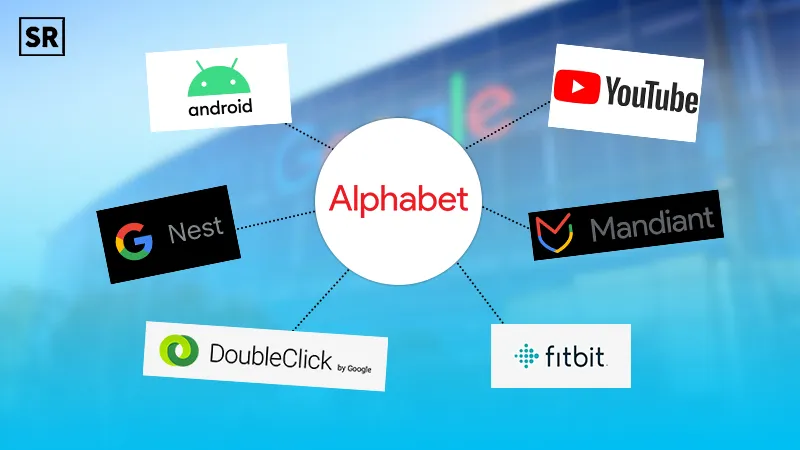
When most people hear the word Google, they immediately think of the world's most popular search engine. But here's something many people don't realise: Google is only one piece of a much bigger company called Alphabet Inc.
 Follow us
 Follow us
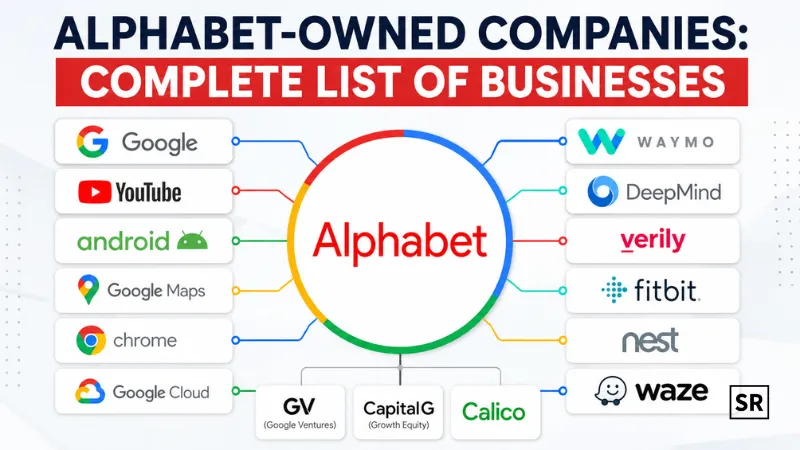
Compared to Google Search, Alphabet owns far more. YouTube, Android, Google Maps, Google Cloud, Waymo, DeepMind, Fitbit, Waze, and numerous other businesses operating in fields ranging from artificial intelligence to self-driving cars and healthcare are all under its control.
Since Alphabet was created in 2015, its goal has been simple: keep Google's massive internet business running while giving its more ambitious projects the freedom to innovate.
So, what companies does Alphabet actually own?
RECOMMENDED FOR YOU


Top 10 Most Profitable Franchise Businesses in the UK in 2026
Olivia James
Aug 4, 2026
In this guide, we'll walk through the biggest Alphabet-owned companies, explain what each one does, and show how they fit into one of the world's largest technology empires.
What Is Alphabet?
Alphabet Inc. is the parent company of Google.
It was created in 2015 after Google founders Larry Page and Sergey Brin decided the company had grown too large to manage under a single brand.
Google was no longer just a search engine. It has expanded into smartphones, cloud computing, artificial intelligence, online video, digital advertising, navigation, healthcare, and experimental technologies.
Instead of keeping everything under one umbrella, the founders reorganised the business.
Google became one company inside Alphabet, while newer and more experimental projects became independent businesses under the same parent organisation.
This structure helped Alphabet operate more efficiently while giving investors a clearer picture of how each business performs.
Today, Alphabet is one of the world's most valuable companies and generates hundreds of billions of dollars in annual revenue.
Google vs. Alphabet: What's the Difference?
Many people use "Google" and "Alphabet" interchangeably, but they aren't exactly the same.
Think of Alphabet as the parent company and Google as its largest subsidiary.
Google manages items that people use on a daily basis, such as:
- A Google search
- Gmail
- Maps on Google
- Chrome
- Photos from Google
- Google Play
- Google Drive
- YouTube
- Android
However, Alphabet also has companies in robotics, autonomous driving, healthcare, artificial intelligence, venture capital, and emerging technologies.
In simple terms:
Alphabet owns Google, but Google doesn't own Alphabet.
How Alphabet Is Organised
Alphabet divides its business into three major segments.
Google Services
This is the company's biggest business by a huge margin.
It includes nearly all the products billions of people use every day, including Search, YouTube, Android, Chrome, Gmail, Google Maps, Google Ads, and Google Play.
Most of Alphabet's revenue comes from advertising displayed across these services.
Google Cloud
Google Cloud provides businesses with cloud computing, cybersecurity, artificial intelligence, data storage, and collaboration tools.
It competes directly with Amazon Web Services (AWS) and Microsoft Azure.
While smaller than Google's advertising business, Cloud has become one of Alphabet's fastest-growing divisions.
Other Bets
This is where Alphabet keeps its ambitious long-term projects.
Instead of generating huge profits today, these businesses are focused on solving future challenges.
Examples include self-driving cars, biotechnology, healthcare research, and drone delivery.
Some projects eventually become independent companies within Alphabet.
A Complete List of Alphabet-Owned Companies
1. Google
Google manages items that people use on a daily basis, such as:
- A Google search
- Gmail
- Maps on Google
- Chrome
- Photos from Google
- Google Play
- Google Drive
- YouTube
- Android
However, Alphabet also has companies in robotics, autonomous driving, healthcare, artificial intelligence, venture capital, and emerging technologies.
Today, billions of searches happen every single day.
But Google's business extends far beyond search.
It operates Gmail, Chrome, Maps, Photos, Docs, Calendar, Translate, Google Play, Google Ads, and dozens of other digital products that have become part of everyday life.
Even after Alphabet was created, Google remains the company's biggest and most profitable business.
2. YouTube
Few acquisitions have been as successful as YouTube.
Google purchased the video-sharing platform in 2006 for $1.65 billion.
At the time, many analysts questioned whether the deal made sense.
Today, it looks like one of the smartest acquisitions in technology history.
YouTube has grown into the world's largest video platform, with billions of monthly users watching everything from tutorials and music videos to podcasts, live streams, documentaries, and educational content.
It has also become one of Alphabet's biggest advertising businesses.
For millions of creators, YouTube isn't just entertainment; it's a full-time career.
3. Android
If you've ever owned a Samsung, OnePlus, Xiaomi, Motorola, or Google Pixel phone, you've probably used Android.
Years before smartphones became popular, in 2005, Google discreetly purchased Android.
Android is currently the most popular mobile operating system, powering billions of mobile devices globally.
Beyond smartphones, Android also runs tablets, smart TVs, watches, automotive systems, and other connected devices.
Its open-source design has helped manufacturers build affordable smartphones for customers around the globe.
4. Waze
Waze takes navigation one step further than traditional GPS apps.
Instead of relying only on maps, it uses information shared by millions of drivers in real time.
Users can report accidents, road closures, traffic jams, speed cameras, and construction work.
That means Waze often finds faster routes than other navigation apps.
Google acquired Waze in 2013, and although many of its features have influenced Google Maps, Waze continues to operate as its own navigation platform.
5. Fitbit
Fitness trackers were already popular when Google acquired Fitbit in 2021, but the purchase gave Google a much stronger position in wearable technology.
Fitbit devices monitor:
- Heart rate
- Sleep quality
- Daily activity
- Calories burned
- Exercise
- Stress levels
Google has gradually integrated Fitbit's health technology into its Pixel Watch lineup while continuing to improve its health tracking features.
With healthcare becoming increasingly digital, Fitbit remains an important part of Alphabet's long-term strategy.
6. Google Nest
Google entered the smart home market by acquiring Nest Labs in 2014.
Today, Google Nest offers a wide range of connected home devices, including:
- Smart speakers
- Smart displays
- Video doorbells
- security Camera
- Detectors for smoke
- Wireless networks
- Intelligent thermostats
These products work together through Google Assistant, allowing users to control lighting, temperature, entertainment, and home security using voice commands or a smartphone.
As smart homes become more common, Google Nest continues expanding Alphabet's hardware ecosystem.
7. Waymo
When people talk about self-driving cars, Waymo is usually one of the first names that comes up.
Waymo actually started as Google’s self-driving car project back in 2009 before becoming an independent Alphabet company in 2016.
Today, it’s much more than a research experiment. Waymo operates fully autonomous taxi services in several U.S. cities, where passengers can book rides without a human driver behind the wheel.
To securely navigate city streets, the company uses LiDAR sensors, cameras, radar, and artificial intelligence. Waymo has completed millions of autonomous miles and continues to be one of the leading innovators in the field, even though self-driving technology still faces obstacles.
For Alphabet, Waymo isn’t just another startup; it’s a long-term bet on the future of transportation.
8. DeepMind
Artificial intelligence has become one of the hottest topics in technology, and DeepMind is a major reason Alphabet leads this race.
Google acquired the London-based AI research company in 2014, long before AI became a global trend.
DeepMind became famous for developing AlphaGo, the AI program that defeated world champion Go player Lee Sedol, something experts once believed wouldn’t happen for decades.
Today, DeepMind works on some of Alphabet’s most advanced AI technologies.
Its research powers improvements across Google’s products, including Search, Google Assistant, healthcare research, language models, and scientific discoveries.
Following the rise of generative AI, DeepMind has become one of Alphabet’s most valuable assets.
9. Verily
Healthcare is another industry Alphabet wants to transform.
That’s where Verily comes in.
Originally launched as a Google X project, Verily focuses on using technology, artificial intelligence, and data analysis to improve healthcare.
Its work includes:
- Clinical research
- Medical data analysis
- Digital health tools
- Disease prevention
- Personalized healthcare
Instead of building hospitals or manufacturing medicines, Verily develops technology that helps doctors, researchers, and healthcare providers make better decisions.
As healthcare becomes increasingly digital, Verily continues exploring ways to improve patient care using data and AI.
10. Wing
Imagine ordering groceries and having them delivered by drone within minutes.
That’s exactly what Wing is trying to achieve.
Wing develops autonomous drone delivery systems capable of transporting small packages quickly and efficiently.
The company has already completed commercial deliveries in selected locations, proving that drone delivery isn’t just science fiction anymore.
While still relatively small compared to Google’s core businesses, Wing represents Alphabet’s willingness to invest in technologies that could completely change everyday life.
11. Calico
Most technology companies focus on software.
Calico focuses on something much bigger—human aging.
Founded in 2013, Calico researches age-related diseases and biological processes to better understand why people age and how longer, healthier lives might be possible.
The company brings together scientists, medical researchers, and biotechnology experts to study diseases such as Alzheimer’s and other conditions linked to aging.
Although Calico doesn’t receive as much public attention as YouTube or Android, it’s one of Alphabet’s most ambitious healthcare projects.
12. GV (Google Ventures)
Not every company needs to be acquired.
Sometimes, investing early can be just as valuable.
GV, originally called Google Ventures, is Alphabet’s venture capital arm.
Instead of building products itself, GV invests in promising startups across industries such as:
- Artificial intelligence
- Biotechnology
- Healthcare
- Cybersecurity
- Consumer technology
- Financial technology
Over the years, GV has backed hundreds of startups, many of which later became successful businesses.
13. CapitalG
CapitalG works differently from GV.
While GV invests in young startups, CapitalG focuses on companies that have already proven themselves and are ready for rapid growth.
Its investments span enterprise software, cybersecurity, cloud computing, digital commerce, and financial technology.
Besides funding, CapitalG gives growing companies access to Alphabet’s engineering expertise, business insights, and global network.
Other Notable Alphabet-Owned Companies
Alphabet has also acquired several smaller businesses that strengthen its products and services.
Some of the most important include:
- Kaggle – One of the world’s largest communities for data scientists and machine learning competitions.
- Looker – A business intelligence platform that helps organisations analyse large amounts of data.
- Mandiant – A leading cybersecurity company helping businesses defend against cyberattacks.
- Photomath – An educational app that solves math problems using a smartphone camera.
- AppSheet – A no-code platform that lets businesses build custom apps without programming knowledge.
While these companies may not be household names, they help Alphabet stay competitive in enterprise software, education, cybersecurity, and artificial intelligence.
The Future of Alphabet
Alphabet is no longer just an internet company.
It’s becoming an artificial intelligence, healthcare, cloud computing, robotics, and autonomous transportation company all at once.
Much of its future growth is expected to come from:
- The use of artificial intelligence
- Cloud computing
- Medical technology
- Self-driving cars
- Smart home appliances
- The use of quantum computing
- Technology that is renewable
Alphabet continues to prepare for industries that could define the next ten years by investing billions in research and innovation each year.
Conclusion
Alphabet has evolved far beyond the company that built Google’s search engine.
Today, it owns some of the world’s most recognizable technology brands, including YouTube, Android, Waze, Fitbit, and Google Nest, while also investing heavily in future-focused businesses like Waymo, DeepMind, Verily, and Wing.
Alphabet is one of the most significant technology businesses in the world because of its ambitious innovation and successful products. You probably already use technology created by an Alphabet-owned company on a daily basis, whether you're watching YouTube, using Google Maps to navigate, utilising Fitbit to check your health, or reading about DeepMind's AI innovations.
Is YouTube owned by Alphabet?
Is Google Cloud part of Alphabet?
Which Alphabet-owned company could become the next big success?
Why did Google create the Alphabet?
Does Alphabet own YouTube?
Which Alphabet company is working on self-driving cars?
What is Alphabet’s “Other Bets” division?
Recommended Stories for You

Bitcoin Cash (BCH) Price Prediction (2025, 2026, 2027 – 2030): Expert Analysis & Predictions
Kailee Rainse May 28, 2025

Kailee Rainse Mar 26, 2026

Kailee Rainse Jun 4, 2026
Team SR Jun 14, 2025

Kailee Rainse Mar 24, 2026

Team SR Aug 4, 2025
Trending Stories
TRON (TRX) Price Prediction (2025 – 2030)
EnQuest Share Price Prediction (2025–2030): Expert Analysis & Predictions

Europa Oil & Gas Share Price Prediction (2025–2030): Expert Analysis & Forecasts

Genflow Biosciences Share Price Prediction 2025, 2026 to 2030 – Expert Analysis

Italy – Democracy Country, Population, Economy and Business Growth
Haydale Graphene Industries Share Price Prediction 2025, 2026 to 2030 – Expert Analysis
Made Tech Group Share Price Prediction 2025, 2026 to 2030 – Expert Analysis
Great Western Share Price Prediction (2025-2030): Expert Analysis & Forecasts